Showing posts with label Jaguar. Show all posts

Thursday, January 10, 2019

Art Deco Style meets Classic Auto Design

Alain and his Camero, Courtesy of http://www.alainlevesque.ca


Alain Lévesque from Hemmings Classic Car


February, 2010 - Mark J. McCourt


Alain working on one of his classic pieces
In the wide spectrum of talented artists, only a handful have developed an instantly recognizable, totally unique style that is incomparably their own. In the focused world of automotive fine art, there is no one who paints like Québec, Canada, native Alain Lévesque, and because of this, his art is sought and celebrated around the world.

"I was very young when I first became interested in automobiles, probably four or five," he recalls. "It was well before I started school. It was probably because my father was so enthusiastic about automobiles; this could have been how I tried to capture my parents' interest. I had a hard time finishing my schoolwork because I was drawing cars in my books. My friends asked me all the time, 'Hey Alain, draw me a Corvette, draw me a Ferrari.'"

Alain pursued graphic design in college, studying at the Université du Québec in Montréal in the 1980s. He later went to work for a publishing company, creating numerous acclaimed poster designs for events like the Montréal World Film Festival and the Americas Cycling Grand Prix.

A 1989 work trip provided the seed that would start him on a new track, one that combined his talent with his passion. "I found an automotive art gallery in the St. James area of London; I'd never seen an art gallery with this specialty before, and seeing these paintings and sculptures--this was the first time that I associated art and automobiles. I was really amazed, it was like a parallel world for me," he explains.

The gallery's owner, Simon Khachadourian, soon commissioned Alain to produce two pieces; the artist returned to London six months later to deliver them. "It was quite exciting for me to get into this world and realize that it was possible to live as an artist with the automobile as my main subject." Alain also soon found representation closer to home, beginning a 20-year working relationship with Jacques Vaucher and his l'art et l'automobile galleries in America.

l'art et l'automobile large poster by Alain  Lévesque. available at arteauto.com
l'art et l'automobile large poster by Alain 
Lévesque. Available at arteauto.com
It was Khachadourian who first made Alain aware of a major influence behind his trademark abstract interpretive style: "My style is well established now, but I had to work hard to get there--I was developing it at university. Mr. Khachadourian told me my pieces were typical of 'Italian Futurism.' I wasn't really conscious as to the root of my style, and he told me about this art movement, explaining that it was part of the avant-garde art movement of the early 20th century, like the Bauhaus and Cubist movements of the same period. Cubism is well known, and I knew a lot of attention has been paid to Bauhaus because of its importance in avant-garde, but not much is said about Italian Futurism, especially in Europe, due to its political connection with Mussolini. We don't have the same reflections here in North America.

"Mr. Khachadourian offered me a huge reference book on Italian Futurism, and from that I realized how deeply I was inspired by this without knowing it; I developed my style from there more consciously," he continues. "I'd rather be expressive than descriptive. To me, the interest is in the way the subject is treated, rather than in the subject itself. That my work appears as a total abstraction does not bother me, as long as it is able to communicate an idea. The automobile becomes a pretext to create."

Many of Alain's recent pieces have been commissioned, so the first step for him is to learn about the particular car in question before starting his design. "I have to ask the client or representative to tell me about the car's era, where it was created and who owned it. From there, I'll do two or three rough pencil drawings that I send to the client to give him a wide spectrum of options. He might like some of the first with a bit of the third, so I'll construct a new image, this time painted in color using gouache, to give him an idea of the palette. When he agrees with the design and canvas, I move on to the final thing.

Jacques Vaucher, owner of l'art et l'automobile, stands next to one of Alain's works, A room divider detailing a classic Bugatti Dashboard.  Available at arteauto.com
Jacques Vaucher, owner of l'art et l'automobile, stands next to one of Alain's works, A room divider detailing a classic Bugatti Dashboard.  Available at arteauto.com

"For years, I worked with gouache and airbrush. I still use the airbrush technique, as it's a good tool for strong graphic designs. I now sometimes use acrylic, but more and more, I prefer working in oil paint because of the quality of the rendering of the shades. Oil is so rich in terms of color, and it gives you the opportunity to work with the shading over a long period of time--more so than acrylic, which dries very quickly," he explains.

Because of his unique style and vision, Alain has been a favorite of concours organizers when it comes to creating original artwork. He has painted at the request of automakers like Porsche and Daimler-Chrysler, has exhibited at Detroit's Meadow Brook Concours d'Elegance since 1995, and has even exhibited alongside the Automotive Fine Arts Society at their annual show at the Pebble Beach Concours d'Elegance. Despite these prestigious showings and commissions, he continues to challenge himself with new and different themes: "My goal is to convey the essence of the automobile, not to illustrate it."

De Soto
"This piece was commissioned by Barrett-Jackson in 2003. They asked me to create an image inspired by typical American fins, a witness of what was the glorious bold American automobile industry era."
1963 Riviera
"Among the masterpieces of Bill Mitchell's legacy, with the Sting Ray and the Toronado, the Riviera's powerful personality makes you feel like you can almost have a conversation with her."
1956 Lincoln
"Working on a commissioned painting of the mighty Batmobile, I felt that I had to return to the classic to find out where the beast was hidden..." 
Cord
"Since my work is related to the Streamline and Art Deco era, it was a natural for me to bring that car in. The Cord's radical design is a signature of the boldness and creativity of the 1920s and 1930s." 
Miller
"Created for the Indianapolis 500 competition in the 1920s, the Miller 91 belongs to the 'Machine Age' era. Dramatically graphic, it recalls the powerful majesty of the Hoover Dam."

Alain redefines the automobile with avant guarde futurism.

I first met Alain in the '80's, and after collaborating on a few shows in New York we became fast friends and have worked together ever since. I immediately enjoyed his work the moment I saw it and have partnered with Alain in order to help share his beautiful artwork with collectors around the world. To celebrate Alain's artistic accomplishments, we here at l'art et l'automobile have gathered all of his artwork we have in the gallery, and present it here to you.

We invite you to view the Alain Lévesque gallery and acquire one of these magnificent pieces for you to display proudly.

Enjoy,

Jacques Vaucher

For more great automotive artwork and memorabilia, don't forget to browse the many other categories on our WEBSITE. Remember we also have many more items in our gallery, do not hesitate to contact us if you are looking for something in particular.


And as always, be sure to Like and Share on Facebook, Follow us on Twitter, share a photo on Instagram and read our Blogs.

Thursday, November 15, 2018

A Colorful History of Racing Hues: British Racing Green

COLOR INSPIRATIONS: HOW BRITISH RACING GREEN INFLUENCED SPORT TRIUMPHS AND EXCLUSIVE STYLE, Photo Courtesy of Federico Bajetti for The Outlierman © 2017


HOW BRITISH RACING GREEN INFLUENCED SPORT TRIUMPHS AND EXCLUSIVE STYLE


By Adam Kaslikowski for Petrolicious and The Outlierman, edited by James Karthauser


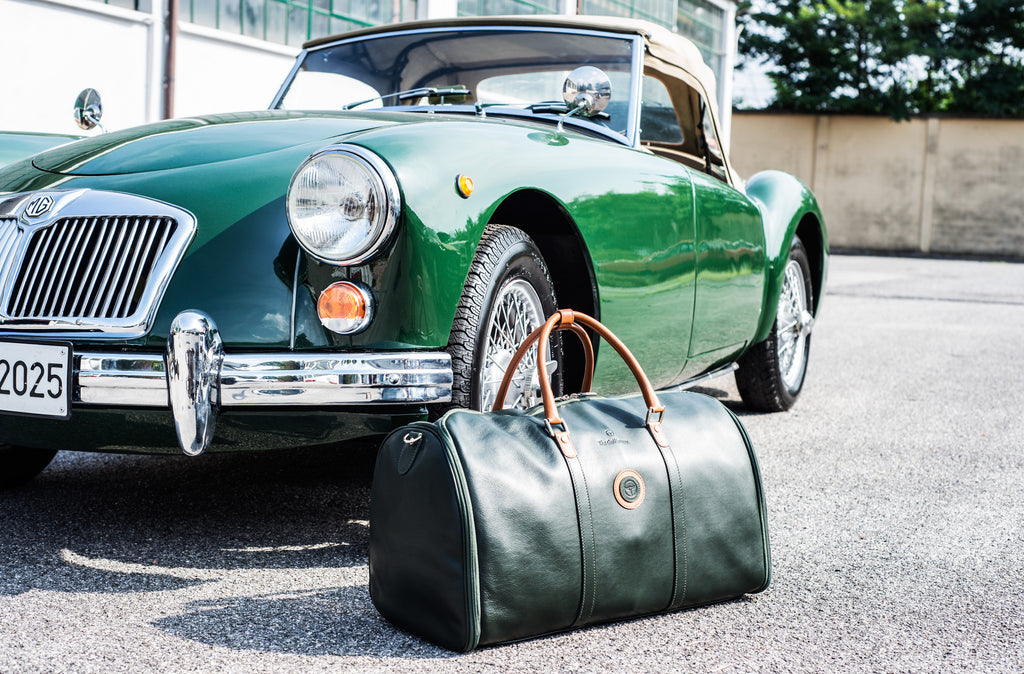
What Jaguar isn't BRG? Photo Courtesy  of Petrolicious
What English Car isn't BRG? Photo Courtesy
of Petrolicious
British Racing Green is one of the most iconic colors of the automotive world. It’s provenance goes back 110 years and has decorated countless racing icons. Unfortunately, there are a lot of misconceptions about the origin of this special emerald color. Here we will attempt to sort through the myriad stories and present to you the true origin of British Racing Green.

At the turn of the 20th century, Grand Prix racing was very different. Races were more a contest between nations than they were between drivers or factories. Wealthy American newspaper man James Gordon Bennett, Jr. organized an annual race pitting various countries against each another in a bid for automobile manufacturing supremacy.

The Gordon Bennett Cup races were city-to-city contests, with entries required to consist entirely of components manufactured in their home country. Each country was limited to three entries each, and each car was required to carry both a driver and a riding mechanic at all times. To make national identification of the participants easier, each country was required to adopt a national racing color. They were: blue for France, yellow for Belgium, white for Germany and red for Italy.


James Bond might have stood out less if his DB5 was BRG rather than silver...  Photo Courtesy of Petrolicious
James Bond might have stood out less if his DB5 was BRG rather than silver...
Photo Courtesy of Petrolicious


France walked away with the inaugural victory in 1900, and thus was given the honor of hosting the races for the 1901 race. British manufacturer David Napier opted to contest this second race, and entered with his own 50 hp car. Unfortunately, this particular car weighed in at a massive three tons and could not keep its British (Dunlop) tires underneath it. Selwyn F. Edge, the driver for the 1901 race, opted to fit more robust French tires and was subsequently disqualified from the Cup. Most interestingly though, this Napier wore a pale shade of olive that the factory called Napier Green. It is unclear why Napier chose green as his color of choice; most likely it was simply personal preference. Regardless, the deep green we know today had yet to become Britain’s official racing color.

With the disqualification of the heavy Napier, the first two years showcased complete domination by the French, and the other participating countries were beginning to sting at the embarrassment of being unable to challenge the Gallic successes. For the 1902 race, Napier was determined to address its failure from 1901 and developed a much lighter car weighing in at just a ton. With the car’s weight lowered dramatically, the British tires survived the strain of the race. And it wasn’t just the tires that survived – all other entrants for the 1902 race retired from the race due to mechanical problems. With the Napier alone, the Brits sailed to their first Gordon Bennett Cup victory.

British racing green enhances the undeniable presence of glamor of an Aston Martin DB4 GT Zagato, shown in this photo taken with complete admiration during the 2016 Concorso d'Eleganza Villa d'Este. Photo Courtesy of Federico Bajetti
British racing green enhances the undeniable presence of glamor of an Aston Martin DB4 GT Zagato, shown
in this photo taken with complete admiration during the 2016 Concorso d'Eleganza Villa d'Este.
Photo Courtesy of Federico Bajetti 

Due to their victory, England was scheduled to host the 1903 event. However, the rule of the British land was that no automobile was allowed to exceed 12mph, and this decree from parliament essentially made motor racing illegal on the entire island. In a mad scramble, the British organizers switched the location of the 1903 to Ireland – a land where the local laws were “adjusted” to accommodate road racing.

A total of three Napier cars contested the 1903 race, and they were pitted against French, German and American entries. According to contemporary newspapers, the olive shade of Napier green was darkened to Shamrock Green in honor of Ireland hosting the races and this is the first public reference to a British car being painted green as a part of a national livery. While it would seem that Napier Green was the coincidental choice of a private manufacturer, what would eventually become known as British Racing Green was a tribute, ironically, to Ireland.

A charismatic color, green: distinct and unexpected. Photo Courtesy of Federico Bajetti for The Outlierman © 2017
A charismatic color, green: distinct and unexpected. Photo Courtesy of Federico Bajetti for
The Outlierman © 2017


As English auto manufacturers are nothing if not an independent lot, there has never been one true shade of British racing green. While most of us picture a deep forest green, this is not a steadfast rule. From Napier’s pale olive to Bentley’s near black, almost any emerald hue applied to a British car will be greeted with the name British Racing Green.

The British racing green is the symbolic color of British motoring, with over 110 years of honorary history in the world of car racing, it also has a long line of legendary cars and drivers linked to it: from great drivers like Henry Segrave, Kenelm Lee Guinness, William Grover-Williams to iconic teams such as Aston Martin, Vanwall, Cooper, Lotus and BRM.

A Classic, arrayed in British Racing Green,  Photo Courtesy of Petrolicious
A Classic, arrayed in British Racing Green,
Photo Courtesy of Petrolicious
A charismatic color, green: distinct and unexpected. Revived in 2000 by Jaguar Racing in Formula 1; then again with Bentley, which would end up winning at LeMans in 2001, 2002 and 2003; and more recently with Aston Martin, who gave this hue to its DBR9. Enthusiasts were also able to admire the British racing green on the Jaguar XK by Rocketsports Racing during the 24 Hours of Le Mans and also on the Lotus T127 in 2010.

Thanks to the triumphs of The British teams and the bewitching charm of the cars that have "worn" it, today the British racing green is still part of the colors that symbolize exclusivity and sporting passion. A shade full of character, history and style that can be celebrated and expressed thanks to the fantastic machines, assembled by some of the finest manufacturers in the world, at the hands of British racing legends, collectors and daily drivers alike.

We here at l'art et l'automobile, as you may know, are avid racing historians, and the Drivers, Manufacturers and race tracks of Great Britain have definitely resonated through the various racing sports throughout the years. To celebrate 60th anniversary of the legendary Mike Hawthorn becoming Britain’s first ever Formula One World Champion and Lewis Hamilton clenching his 5th World Championship Title, we gathered all of our artwork and memorabilia related to the Cars and Drivers of the Isles, and present them here to you.

We invite you to view the British Cars and Drivers gallery and acquire one of these pieces of racing history while they last. Please tour the collection here and perhaps you will find something to add to your collection.

All our best from the staff at l’art et l’automobile,


Jacques Vaucher

For more great automotive artwork and memorabilia, don't forget to browse the many other categories on our WEBSITE. Remember we also have many more items in our gallery, do not hesitate to contact us if you are looking for something in particular.

And as always, be sure to Like and Share on Facebook, Follow us on Twitter, share a photo on Instagram and read our Newsfeed.