Showing posts with label Bugatti. Show all posts

Thursday, January 10, 2019

Art Deco Style meets Classic Auto Design

Alain and his Camero, Courtesy of http://www.alainlevesque.ca


Alain Lévesque from Hemmings Classic Car


February, 2010 - Mark J. McCourt


Alain working on one of his classic pieces
In the wide spectrum of talented artists, only a handful have developed an instantly recognizable, totally unique style that is incomparably their own. In the focused world of automotive fine art, there is no one who paints like Québec, Canada, native Alain Lévesque, and because of this, his art is sought and celebrated around the world.

"I was very young when I first became interested in automobiles, probably four or five," he recalls. "It was well before I started school. It was probably because my father was so enthusiastic about automobiles; this could have been how I tried to capture my parents' interest. I had a hard time finishing my schoolwork because I was drawing cars in my books. My friends asked me all the time, 'Hey Alain, draw me a Corvette, draw me a Ferrari.'"

Alain pursued graphic design in college, studying at the Université du Québec in Montréal in the 1980s. He later went to work for a publishing company, creating numerous acclaimed poster designs for events like the Montréal World Film Festival and the Americas Cycling Grand Prix.

A 1989 work trip provided the seed that would start him on a new track, one that combined his talent with his passion. "I found an automotive art gallery in the St. James area of London; I'd never seen an art gallery with this specialty before, and seeing these paintings and sculptures--this was the first time that I associated art and automobiles. I was really amazed, it was like a parallel world for me," he explains.

The gallery's owner, Simon Khachadourian, soon commissioned Alain to produce two pieces; the artist returned to London six months later to deliver them. "It was quite exciting for me to get into this world and realize that it was possible to live as an artist with the automobile as my main subject." Alain also soon found representation closer to home, beginning a 20-year working relationship with Jacques Vaucher and his l'art et l'automobile galleries in America.

l'art et l'automobile large poster by Alain  Lévesque. available at arteauto.com
l'art et l'automobile large poster by Alain 
Lévesque. Available at arteauto.com
It was Khachadourian who first made Alain aware of a major influence behind his trademark abstract interpretive style: "My style is well established now, but I had to work hard to get there--I was developing it at university. Mr. Khachadourian told me my pieces were typical of 'Italian Futurism.' I wasn't really conscious as to the root of my style, and he told me about this art movement, explaining that it was part of the avant-garde art movement of the early 20th century, like the Bauhaus and Cubist movements of the same period. Cubism is well known, and I knew a lot of attention has been paid to Bauhaus because of its importance in avant-garde, but not much is said about Italian Futurism, especially in Europe, due to its political connection with Mussolini. We don't have the same reflections here in North America.

"Mr. Khachadourian offered me a huge reference book on Italian Futurism, and from that I realized how deeply I was inspired by this without knowing it; I developed my style from there more consciously," he continues. "I'd rather be expressive than descriptive. To me, the interest is in the way the subject is treated, rather than in the subject itself. That my work appears as a total abstraction does not bother me, as long as it is able to communicate an idea. The automobile becomes a pretext to create."

Many of Alain's recent pieces have been commissioned, so the first step for him is to learn about the particular car in question before starting his design. "I have to ask the client or representative to tell me about the car's era, where it was created and who owned it. From there, I'll do two or three rough pencil drawings that I send to the client to give him a wide spectrum of options. He might like some of the first with a bit of the third, so I'll construct a new image, this time painted in color using gouache, to give him an idea of the palette. When he agrees with the design and canvas, I move on to the final thing.

Jacques Vaucher, owner of l'art et l'automobile, stands next to one of Alain's works, A room divider detailing a classic Bugatti Dashboard.  Available at arteauto.com
Jacques Vaucher, owner of l'art et l'automobile, stands next to one of Alain's works, A room divider detailing a classic Bugatti Dashboard.  Available at arteauto.com

"For years, I worked with gouache and airbrush. I still use the airbrush technique, as it's a good tool for strong graphic designs. I now sometimes use acrylic, but more and more, I prefer working in oil paint because of the quality of the rendering of the shades. Oil is so rich in terms of color, and it gives you the opportunity to work with the shading over a long period of time--more so than acrylic, which dries very quickly," he explains.

Because of his unique style and vision, Alain has been a favorite of concours organizers when it comes to creating original artwork. He has painted at the request of automakers like Porsche and Daimler-Chrysler, has exhibited at Detroit's Meadow Brook Concours d'Elegance since 1995, and has even exhibited alongside the Automotive Fine Arts Society at their annual show at the Pebble Beach Concours d'Elegance. Despite these prestigious showings and commissions, he continues to challenge himself with new and different themes: "My goal is to convey the essence of the automobile, not to illustrate it."

De Soto
"This piece was commissioned by Barrett-Jackson in 2003. They asked me to create an image inspired by typical American fins, a witness of what was the glorious bold American automobile industry era."
1963 Riviera
"Among the masterpieces of Bill Mitchell's legacy, with the Sting Ray and the Toronado, the Riviera's powerful personality makes you feel like you can almost have a conversation with her."
1956 Lincoln
"Working on a commissioned painting of the mighty Batmobile, I felt that I had to return to the classic to find out where the beast was hidden..." 
Cord
"Since my work is related to the Streamline and Art Deco era, it was a natural for me to bring that car in. The Cord's radical design is a signature of the boldness and creativity of the 1920s and 1930s." 
Miller
"Created for the Indianapolis 500 competition in the 1920s, the Miller 91 belongs to the 'Machine Age' era. Dramatically graphic, it recalls the powerful majesty of the Hoover Dam."

Alain redefines the automobile with avant guarde futurism.

I first met Alain in the '80's, and after collaborating on a few shows in New York we became fast friends and have worked together ever since. I immediately enjoyed his work the moment I saw it and have partnered with Alain in order to help share his beautiful artwork with collectors around the world. To celebrate Alain's artistic accomplishments, we here at l'art et l'automobile have gathered all of his artwork we have in the gallery, and present it here to you.

We invite you to view the Alain Lévesque gallery and acquire one of these magnificent pieces for you to display proudly.

Enjoy,

Jacques Vaucher

For more great automotive artwork and memorabilia, don't forget to browse the many other categories on our WEBSITE. Remember we also have many more items in our gallery, do not hesitate to contact us if you are looking for something in particular.


And as always, be sure to Like and Share on Facebook, Follow us on Twitter, share a photo on Instagram and read our Blogs.

Thursday, December 27, 2018

Spray It Again Dan

Dan Sprays the Crowd with Moët in a moment of true celebration. Photo Courtesy of All American Racers


Dan Gurney’s 1967 Champagne Week


story and photos by Eoin Young, edited by James Karthauser


It was a Champagne week for Daniel Sexton Gurney back in mid-summer 1967, when he won the Le Mans 24-hours for Ford one Sunday and was a winner again the next weekend when he took the laurels in the Belgian Grand Prix in his own Eagle.

Dan Gurney prepares a surprise for the audience that would go on to unexpectedly start a tradition. Photo Courtesy of Dyler.com
Dan Gurney prepares a surprise for the audience that would go on to unexpectedly start a tradition.
Photo Courtesy of Dyler.com


Dan Gurney was the first driver to spray the champers about rather than swigging it after he and A.J. Foyt had won at Le Mans. “I was so stoked that when they handed me the magnum of Moët I shook the bottle and began spraying at the photographers, drivers, Henry Ford II, Carroll Shelby and their wives. It was a very special moment.” Gurney made Champagne history when he sprayed the bubbly and the moment was captured on a special ‘Spray it Again, Dan’ fan poster.

This classic moment was memorialized in this beautiful poster, 'Spray it Again Dan,' available at arteauto.com
This classic moment was memorialized in this beautiful poster, 'Spray it Again Dan,'
available at arteauto.com


“What I did with the Champagne was totally spontaneous. I had no idea it would start a tradition. I was beyond caring and just got caught up in the moment. It was one of those once-in-a-lifetime occasions where things turned out perfectly...I thought this hard-fought victory needed something special.” “LIFE” photographer Flip Schulke, was a popular chap on the racing scene and Dan had hauled him up on to the stage before he started spraying the Champagne. “I took one photo and then ducked,” Schulke recalled. “When it was over Dan handed me the empty bottle and autographed it.

AJ Foyt (right) and Dan Gurney (left) on victory stand.   Photo Courtesy of Ford Archive
AJ Foyt (right) and Dan Gurney (left) on victory stand.
Photo Courtesy of Ford Archive


That original Moët Champagne bottle is now in pride of place in the conference room at All American Racers headquarters. Schulke had converted it to a table lamp and used it in his Florida home for 30 years before returning it to Gurney with the comment “You did it...you should have it!” Dan and Evi removed the lampshade, took the electrics out, and had a special glass case made to preserve the famous bottle.

Ford Mk IV winning at Le Mans 1967.  Photo Courtesy of All American Racers
Ford Mk IV winning at Le Mans 1967.  Photo Courtesy of All American Racers


Gurney and Foyt drove their way into Le Mans history with the red 7-litre Mk IV Ford, specially modified with a bump on the roof to accommodate the lanky Dan. They raised the race record by 10mph to 135mph average for the 24 hours, covering a total of 3,250 miles. It was also the first time that an American car and driver combination had won at Le Mans.


Dan Gurney takes the chequer to win the Belgian Grand Prix at Spa in 1967 in his Eagle-Westlake V12.  Photo Courtesy of All American Racers
Dan Gurney takes the chequer to win the Belgian Grand Prix at Spa in 1967 in his Eagle-Westlake V12. 
Photo Courtesy of All American Racers

Dan won at Spa in his own 3-litre V12 Eagle- Weslake. The 3-litre Cosworth-Ford V8s had arrived to win first time out at Zandvoort in Jim Clark’s works Lotus 49, and the two new cars bracketed the Eagle on the front row at Spa. Clark stormed into an immediate lead with Jackie Stewart second in the unloved H16 BRM with Gurney third. Gurney was moving in on Stewart when Clark pitted with a blown spark plug and Gurney also stopped to warn of fluctuating fuel pressure but there was nothing the crew could do so he was sent back out, now in second place, 16sec behind Stewart. Dan was now in attack mode, lowering the lap record as he chased down Stewart and went into the lead with seven laps left.

It was Moët that Dan sprayed in those days and it was Moët that was presented at races thereafter on a gratis basis, Moët et Chandon presumably figuring that giving their bubbles free was financial involvement enough. But Bernie Ecclestone decided that ‘free’ was a word with which he was uncomfortable. He put the naming rights for the official alcoholic fizz in Formula 1 up for bids, and G.H. Mumm won.

Dan Guarney at speed on the way to winning the  Belgian Grand Prix at Spa.  Photo Courtesy of  All American Racers
Dan Guarney at speed on the way to winning the
Belgian Grand Prix at Spa.  Photo Courtesy of
All American Racers
Dan might have been the first racer to spray the bubbly after a race win, but G.H. Mumm Champagne had arrived in motor racing eighty years earlier when Raymond Mays christened his Brescia Bugatti Cordon Rouge.

Mays had been winning sprints and hillclimbs with the elegant lightweight Type 13 Bugattis that were in production from 1910 to 1926. In the 1930s Mays would create the ERA (English Racing Automobiles) racing marque and in the late 1940s he was the man behind BRM (British Racing Motors). The first BRM was a screaming 1500cc V16 which sounded far better than its racing record would read but a BRM would win the 1962 World Championship in the hands of Graham Hill. Gurney had a dismal summer with BRM in 1960 with a best result of 10th at Silverstone.

In a 1973 interview, Mays told me the story about dining with his engineer friend, Amherst Villiers, in a London restaurant in 1923 when a Champagne label caught his eye. “I had just won a speed trial in the Bugatti and we were celebrating over dinner with a bottle of Champagne. It occurred to me that the striking red and gold Cordon Rouge label on the bottle was just what I needed as a racing name for my Bugatti, and I suppose that was really where sponsorship in racing started.” At the time of the interview, Mays was 73 and still active as Director of Racing for the Marlboro-BRM team.

That night in 1923, Mays asked the waiter if he could steam the label off the bottle as a guide for the name to be painted on the bonnet of his Bugatti and he wrote to the head office of the G.H. Mumm Champagne company, makers of Cordon Rouge in Reims, asking for their permission for him to borrow their brand name for his French racing car. The company replied immediately, delighted with the idea, and despatched three cases of Champagne to toast their new association with success.

Pleased with this double result from the bubbly company, Mays wrote to the makers of Cordon Bleu Cognac but while he received permission to use the name on his ‘other’ Brescia, he was never offered any brandy!

In fact this was inadvertently a first venture into the world of commercial sponsorship in motorsport that has led to the wheel turning full circle. Cordon Rouge Champagne is now the official bubby in Grand Prix racing for presentation and spraying on the Formula 1 rostrums.

Tom Wheatcroft arranged with Raymond Mays to open his motor racing museum at Donington Park in 1974, linking with the UK importers of G.H. Mumm Champagne – half a century after Mays ‘discovered’ the label – and the bubbles started spraying in vintage racing circles with a replica of a Brescia Bugatti used in major store promotions. A special Cordon Rouge Classic Bugatti hillclimb was held by the Bugatti Owners’ Club at Prescott on June 2, 1974 and the winner at six vintage meetings during the summer was presented with a Jereboam of Cordon Rouge and each finisher received a bottle.

Cordon Rouge Champagne had already been the toast of society for half a century when Mays, the young Cambridge graduate made racing history by being the first to carry what amounted to a commercial sponsor’s name on his racing car. That the ‘sponsor’ was a top Champagne company only added to the flair of Mays’ talent as a racing driver. With ‘Cordon Rouge’ he was to dominate speed trials and hillclimbs all over England during the summer of 1924.

Mays, the son of a prominent wool brokerage family from Bourne, Lincolnshire, leapt to prominence in speed events in 1921, while still at Cambridge. He drove a speed model Hillman in those days and had such instant success that he invested everything in a new Brescia Bugatti for the 1922 season. Once again he excelled and during 1923 the Bugatti was run in much modified trim. The speed and engineering so impressed Ettore Bugatti that Mays was provided with a second Brescia for the season of 1924, thus providing him with the need to differentiate between his two Bugattis.

Raymond Mays in the Cordon Rouge Brescia Bugatti.  Photo Courtesy of All American Racers
Raymond Mays in the Cordon Rouge Brescia Bugatti.
 Photo Courtesy of All American Racers
The Brescia was a 1500cc 16-valve 4-cylinder sporting car, the competition models being Type 13s in the Bugatti numbering system. They won the voiturette race at Brescia in 1921 to earn the title and Mays made his debut with his Brescia at the Laindon hillclimb, facing Leon Cushman and Eddie Hall in similar cars and placed second in his class. By the end of the 1922 season Mays and the striking blue-grey Bugatti had become extremely competitive. During the winter of 1922-23 Mays began a modification programme on the Bugatti working with Amherst Villiers, a brilliant engineering friend from Cambridge days. Mays wanted a ‘super hillclimb car’ and Villiers designed new pistons and camshaft and made other modifications to boost the Bugatti’s engine from a rev limit of 4300rpm to over 6000rpm – an almost unheard of figure in those days. Running specially-brewed RD2 alcohol fuel – it cost over six shillings a gallon in those days which was regarded as insanely expensive – Mays found that he had the super-car he wanted, but there were development problems with bearings.

Villiers was also an accomplished painter having produced portraits of subjects as diverse as Graham Hill and James Bond creator, Ian Fleming. It was Villiers who designed a fictional car to the fit the role of Chitty Chitty Bang Bang which Fleming was using as the theme for a children’s book. His painting of Mays at speed in the Brescia Bugatti was used by G.H. Mumm in a presentation and a poster for the Prescott Hillclimb that summer.

M. Lefrere in Bugatti’s London agency, was most impressed and at the Show he gave Mays a personal letter of introduction to Le Patron, Ettore Bugatti. Bugatti invited the young Englishman to the Molsheim factory, emphasising that he bring his Brescia with him.

Mays senior was delighted at his son’s newfound success and financed the trip to Molsheim, taking the modified car for Bugatti’s inspection. Ettore stood worked long and hard on the cars, Mays helping on evenings away from the wool business. Bleu was potentially faster than Rouge with its later engine, but it mixed success with misfortune, winning at South Harting and throwing a rear wheel at Caerphilly. After this hair-raising ‘moment’ the car was set aside for axle shaft changes, while Rouge howled from strength to strength, winning all over the country.

Dan Gurney with the original Moët bottle in the All American Racers’ boardroom.  Photo Courtesy of All American Racers
Dan Gurney with the original Moët bottle
in the All American Racers’ boardroom.
The Brescia Bugattis finally ran out of hours and engines and Mays moved on but he had brought Champagne and sponsorship to motor racing, making history as he did so. Dan Gurney might have been the first driver to spray the crowd after a race win in 1967, but Bernie Ecclestone made an extra little bit of history, whether he realised it or not, by bringing Cordon Rouge back into the motorsport winner’s circle!

We here at l'art et l'automobile hope that your holiday season has been filled with laughter and joy, and if you're of the particular frame of mind, filled with champaign toasts and the occasional dousing.  We hope you have enjoyed this little taste of Racing History, and that your spirits rise like the bubbles from the champaign flutes.

We also wish to toast Dan Gurney, who's accomplishments and exploits have not only gone down in racing history, but who's jovial spirit and gleeful nature have given us a much lauded tradition that racers still honor and celebrate to this day.

Cheers to Dan and Cheers to you this holiday season!

Jacques Vaucher

Remember we have a wide variety of items in our gallery, so do not hesitate to contact us if you are looking for something in particular.

And as always, be sure to Like and Share on Facebook, Follow us on Twitter, share a photo on Instagram and read our Newsfeed.

Monday, July 30, 2018

The Automobiles of Ettore Bugatti

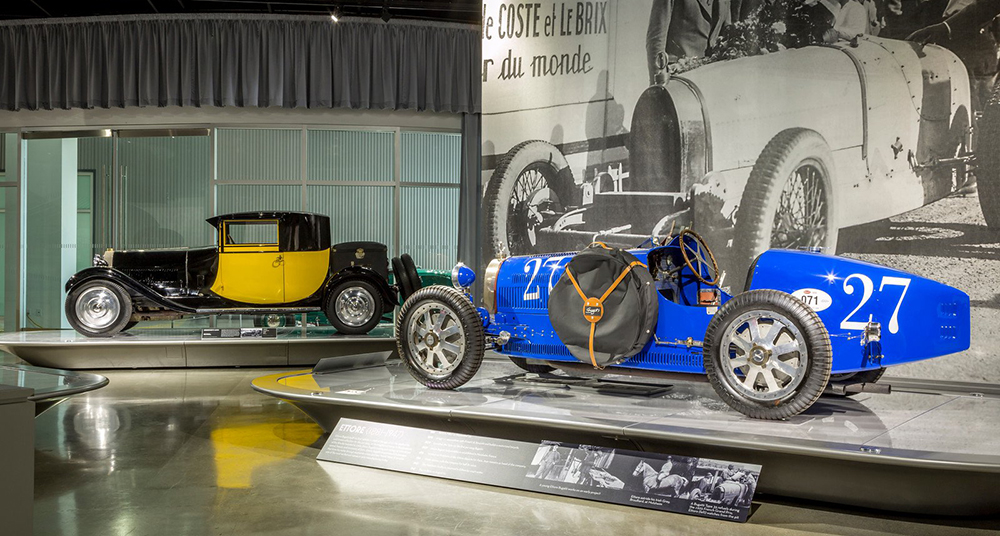
Bugatti Type 44 and Type 35, on display together at Petersen Automotive Museum’s The Art of Bugatti Exhibition Photo courtesy of the Petersen Automotive Museum © 2016

One of the greatest car manufacturers in the world.

by James Karthauser


Greetings Auto Lovers,

Ettore Bugatti was born in Milan, Italy, and the automobile company that bears his name was founded in 1909 in Molsheim, which was part of the German Empire from 1871 to 1919. The company was known both for the level of detail of its engineering in its automobiles, and for the artistic manner in which the designs were executed, given the artistic nature of Ettore's family (his father, Carlo Bugatti (1856–1940), was an important Art Nouveau furniture and jewelry designer).

Ettore Bugatti, Acrylic Painting on Canvas by Barry Rowe
Ettore Bugatti in front of his paddock at the French Grand Prix, detailed in a Painting by Barry Rowe
available in our Bugatti Collection at arteauto.com.  


After World War One, Bugatti was able to obtain at the last minute, a stand at the 15th Paris motor show in October 1919. He exhibited three light cars, the Type 13, 22 and 23, each fitted with the same 4-cylinder 1,368cc engine. Ettore Bugatti, who considered himself not just a constructor but an artist, ensured that his cars made a good showing.   

Bugatti Type 13, the smallest of the three models Ettore Bugatti exhibited in Paris in 1919.
Photo courtesy of CarinPicture.com


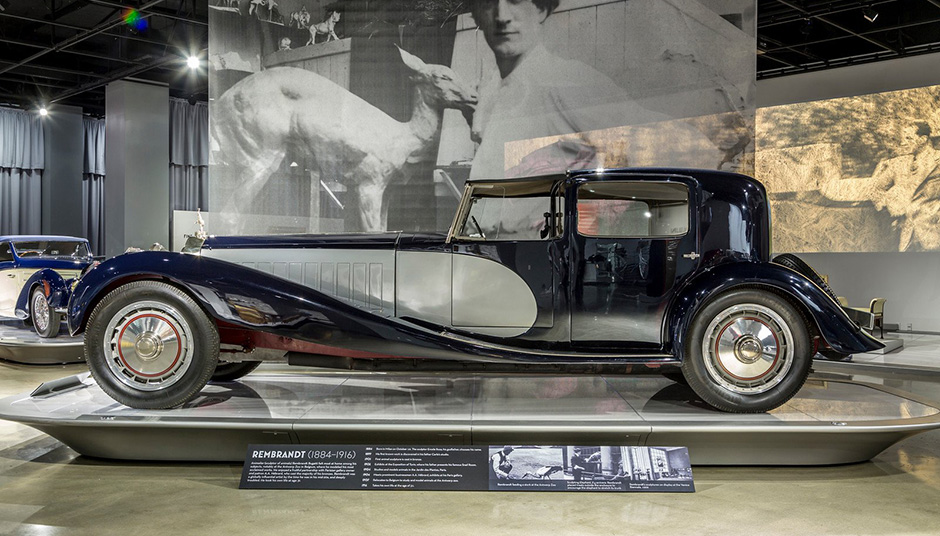
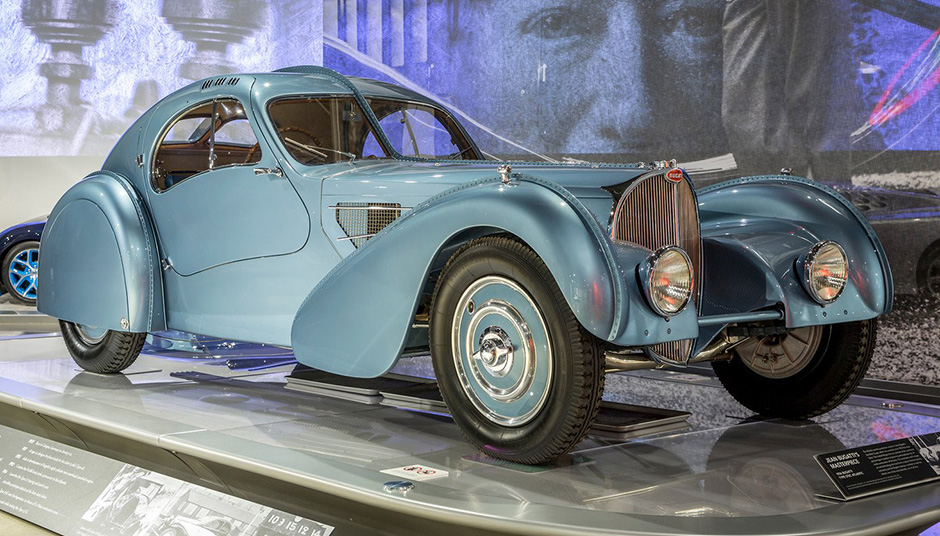
The company was at its peak during the 1920’s and 30’s, building some very successful race cars and luxurious sports cars. Famous Bugattis constructed during this period include the Type 35 Grand Prix cars, the Type 41 "Royale", the Type 57 "Atlantic" and the Type 55 sports car. The company also enjoyed great success in early Grand Prix motor racing: in 1929 a privately entered Bugatti won the first ever Monaco Grand Prix. Racing success culminated with driver Jean-Pierre Wimille winning the 24 hours of Le Mans twice (in 1937 with Robert Benoist and 1939 with Pierre Veyron).

1932 Bugatti Type 41 Royale, on display at Petersen Automotive Museum’s The Art of Bugatti Exhibition
Photo courtesy of the Petersen Automotive Museum © 2016


Bugatti cars were extremely successful in racing. The little Bugatti Type 10 swept the top four positions at its first race. The 1924 Bugatti Type 35 is probably the most successful racing car of all time, with over 2,000 wins. The Type 35 was developed by Bugatti with master engineer and racing driver Jean Chassagne who also drove it in Bugatti’s first ever Grand Prix in 1924, in Lyon. Bugattis swept to victory in the Targa Florio for five years straight from 1925 through 1929. Louis Chiron held the most podiums in Bugatti cars, and the modern marque revival Bugatti Automobiles S.A.S. named the 1999 Bugatti 18/3 Chiron concept car in his honor. But it was the final racing success at Le Mans that is most remembered—Jean-Pierre Wimille and Pierre Veyron won the 1939 race with just one car and meager resources.

Bugatti Type 35 working re-creation by Pur Sang
The Bugatti Type 35 Racer, possibly the most winning race car of all time.  This particular example
is a working recreation by Pur Sang.  Photo Courtesy of Autoweek.

Bugattis are noticeably focused on design. Engine blocks were hand scraped to ensure that the surfaces were so flat that gaskets were not required for sealing, many of the exposed surfaces of the engine compartment featured guilloché (an artistic pattern made trough engine turning) finishes on them, and safety wires had been threaded through almost every fastener in intricately laced patterns. Rather than bolt the springs to the axles as most manufacturers did, Bugatti's axles were forged such that the spring passed through a carefully sized opening in the axle, a much more elegant solution requiring fewer parts. He famously described his arch competitor Bentley's cars as "the world's fastest lorries" for focusing on durability. According to Bugatti, "weight was the enemy".

Bugatti Type 57 Atlantic, on display at Petersen Automotive Museum’s The Art of Bugatti Exhibition
Photo courtesy of the Petersen Automotive Museum © 2016


At l’art et l’automobile we appreciate artistry and craftsmanship as much as anyone, and in the case of Bugatti, those characteristics have produced a marque that refines and defines the terms in the automotive industry. For many, the Bugatti Marque represents the pinnacle of classic automotive engineering, and we are hard pressed to disagree. To that end, we have amassed a good collection of items representing this illustrious marque through the decades. Enjoy looking through the gallery at arteauto.com, and perhaps add a piece to your collection.

Regards.

Jacques Vaucher

For more great automotive memorabilia, don't forget to browse the many other categories on our NEW WEBSITE. Remember we also have many more items in our gallery, do not hesitate to contact us if you are looking for something in particular.

And as always, be sure to Like and Share on Facebook, Follow us on Twitter, share a photo on Instagramand read our Blogs.