Showing posts with label Formula 1. Show all posts

Thursday, November 15, 2018

A Colorful History of Racing Hues: British Racing Green

COLOR INSPIRATIONS: HOW BRITISH RACING GREEN INFLUENCED SPORT TRIUMPHS AND EXCLUSIVE STYLE, Photo Courtesy of Federico Bajetti for The Outlierman © 2017


HOW BRITISH RACING GREEN INFLUENCED SPORT TRIUMPHS AND EXCLUSIVE STYLE


By Adam Kaslikowski for Petrolicious and The Outlierman, edited by James Karthauser


What Jaguar isn't BRG? Photo Courtesy  of Petrolicious
What English Car isn't BRG? Photo Courtesy
of Petrolicious
British Racing Green is one of the most iconic colors of the automotive world. It’s provenance goes back 110 years and has decorated countless racing icons. Unfortunately, there are a lot of misconceptions about the origin of this special emerald color. Here we will attempt to sort through the myriad stories and present to you the true origin of British Racing Green.

At the turn of the 20th century, Grand Prix racing was very different. Races were more a contest between nations than they were between drivers or factories. Wealthy American newspaper man James Gordon Bennett, Jr. organized an annual race pitting various countries against each another in a bid for automobile manufacturing supremacy.

The Gordon Bennett Cup races were city-to-city contests, with entries required to consist entirely of components manufactured in their home country. Each country was limited to three entries each, and each car was required to carry both a driver and a riding mechanic at all times. To make national identification of the participants easier, each country was required to adopt a national racing color. They were: blue for France, yellow for Belgium, white for Germany and red for Italy.


James Bond might have stood out less if his DB5 was BRG rather than silver...  Photo Courtesy of Petrolicious
James Bond might have stood out less if his DB5 was BRG rather than silver...
Photo Courtesy of Petrolicious


France walked away with the inaugural victory in 1900, and thus was given the honor of hosting the races for the 1901 race. British manufacturer David Napier opted to contest this second race, and entered with his own 50 hp car. Unfortunately, this particular car weighed in at a massive three tons and could not keep its British (Dunlop) tires underneath it. Selwyn F. Edge, the driver for the 1901 race, opted to fit more robust French tires and was subsequently disqualified from the Cup. Most interestingly though, this Napier wore a pale shade of olive that the factory called Napier Green. It is unclear why Napier chose green as his color of choice; most likely it was simply personal preference. Regardless, the deep green we know today had yet to become Britain’s official racing color.

With the disqualification of the heavy Napier, the first two years showcased complete domination by the French, and the other participating countries were beginning to sting at the embarrassment of being unable to challenge the Gallic successes. For the 1902 race, Napier was determined to address its failure from 1901 and developed a much lighter car weighing in at just a ton. With the car’s weight lowered dramatically, the British tires survived the strain of the race. And it wasn’t just the tires that survived – all other entrants for the 1902 race retired from the race due to mechanical problems. With the Napier alone, the Brits sailed to their first Gordon Bennett Cup victory.

British racing green enhances the undeniable presence of glamor of an Aston Martin DB4 GT Zagato, shown in this photo taken with complete admiration during the 2016 Concorso d'Eleganza Villa d'Este. Photo Courtesy of Federico Bajetti
British racing green enhances the undeniable presence of glamor of an Aston Martin DB4 GT Zagato, shown
in this photo taken with complete admiration during the 2016 Concorso d'Eleganza Villa d'Este.
Photo Courtesy of Federico Bajetti 

Due to their victory, England was scheduled to host the 1903 event. However, the rule of the British land was that no automobile was allowed to exceed 12mph, and this decree from parliament essentially made motor racing illegal on the entire island. In a mad scramble, the British organizers switched the location of the 1903 to Ireland – a land where the local laws were “adjusted” to accommodate road racing.

A total of three Napier cars contested the 1903 race, and they were pitted against French, German and American entries. According to contemporary newspapers, the olive shade of Napier green was darkened to Shamrock Green in honor of Ireland hosting the races and this is the first public reference to a British car being painted green as a part of a national livery. While it would seem that Napier Green was the coincidental choice of a private manufacturer, what would eventually become known as British Racing Green was a tribute, ironically, to Ireland.

A charismatic color, green: distinct and unexpected. Photo Courtesy of Federico Bajetti for The Outlierman © 2017
A charismatic color, green: distinct and unexpected. Photo Courtesy of Federico Bajetti for
The Outlierman © 2017


As English auto manufacturers are nothing if not an independent lot, there has never been one true shade of British racing green. While most of us picture a deep forest green, this is not a steadfast rule. From Napier’s pale olive to Bentley’s near black, almost any emerald hue applied to a British car will be greeted with the name British Racing Green.

The British racing green is the symbolic color of British motoring, with over 110 years of honorary history in the world of car racing, it also has a long line of legendary cars and drivers linked to it: from great drivers like Henry Segrave, Kenelm Lee Guinness, William Grover-Williams to iconic teams such as Aston Martin, Vanwall, Cooper, Lotus and BRM.

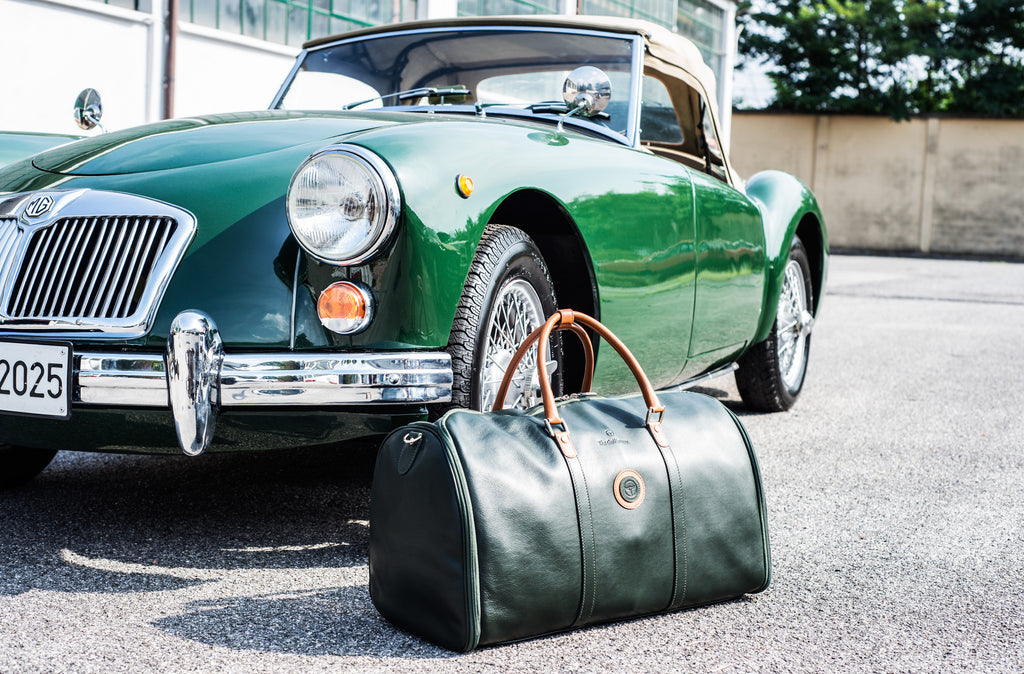
A Classic, arrayed in British Racing Green,  Photo Courtesy of Petrolicious
A Classic, arrayed in British Racing Green,
Photo Courtesy of Petrolicious
A charismatic color, green: distinct and unexpected. Revived in 2000 by Jaguar Racing in Formula 1; then again with Bentley, which would end up winning at LeMans in 2001, 2002 and 2003; and more recently with Aston Martin, who gave this hue to its DBR9. Enthusiasts were also able to admire the British racing green on the Jaguar XK by Rocketsports Racing during the 24 Hours of Le Mans and also on the Lotus T127 in 2010.

Thanks to the triumphs of The British teams and the bewitching charm of the cars that have "worn" it, today the British racing green is still part of the colors that symbolize exclusivity and sporting passion. A shade full of character, history and style that can be celebrated and expressed thanks to the fantastic machines, assembled by some of the finest manufacturers in the world, at the hands of British racing legends, collectors and daily drivers alike.

We here at l'art et l'automobile, as you may know, are avid racing historians, and the Drivers, Manufacturers and race tracks of Great Britain have definitely resonated through the various racing sports throughout the years. To celebrate 60th anniversary of the legendary Mike Hawthorn becoming Britain’s first ever Formula One World Champion and Lewis Hamilton clenching his 5th World Championship Title, we gathered all of our artwork and memorabilia related to the Cars and Drivers of the Isles, and present them here to you.

We invite you to view the British Cars and Drivers gallery and acquire one of these pieces of racing history while they last. Please tour the collection here and perhaps you will find something to add to your collection.

All our best from the staff at l’art et l’automobile,


Jacques Vaucher

For more great automotive artwork and memorabilia, don't forget to browse the many other categories on our WEBSITE. Remember we also have many more items in our gallery, do not hesitate to contact us if you are looking for something in particular.

And as always, be sure to Like and Share on Facebook, Follow us on Twitter, share a photo on Instagram and read our Newsfeed.

Thursday, November 8, 2018

Wear your colors, proud!


What, no polka dots? The expected and the unexpected among international racing colors


Daniel Strohl of Hemmings on Sep 25th, 2018, edited by James Karthauser


Our recent story on the dubious legend of how Germany got its silver auto racing color got us looking for original source materials to see if we could establish timelines for not just Germany’s national racing color but for all designated racing colors. As the stories go, not all of the racing colors were set in stone from the beginning, and it took a few decades of revisions to hammer them all out, by which time corporate logos pretty much rendered the colors moot.

Our research is ongoing and perhaps interminable, but we did get some help in the comments to that story from commenter Nick, who pointed out an article in the October 1928 edition of the Allgemeine Automobil-Zeitung in which the Association Internationale des Automobile Clubs Reconnus laid out not only the formulas for upcoming races but also the agreed-upon racing colors for 23 different countries.

Granted, the list is just for a certain time period and is incomplete — the article itself pointed that out, with color schemes undecided for Brazil, Chile, Cuba, Denmark, Greece, Luxembourg, Norway, Netherlands, Uruguay, and Yugoslavia — but after translating it, we saw that the AIACR went to great lengths to differentiate different countries on the racetrack not only with various colors but also with stripes, number/bubble combinations, and even patterns.

So we took the translated list to Josh Skibbee, one of our graphic artists, to have him take a whack at reproducing the various schemes. We had to go back and forth on some of the details quite a bit. For example, the designations call for Streifen, which translates to stripe, streak, or band; on a modern car, we’d apply those lengthwise along the top of the hood, but our research shows that in the late 1920s stripes were applied transversely across the hood and hood sides, an interpretation that makes more sense when considering that the designation for Ireland specifically calls for a horizontal stripe around the body and hood.

Some of the schemes (like Sweden’s) weren’t exactly clear to us even after some debate, some seem contrary to traditional notions of a country’s colors (why didn’t Switzerland get the scheme assigned to Portugal?), and some (like Lithuania’s) might be questionable to modern observers. But, hey, original sources don’t always tell us exactly what we expect. So, in alphabetical order:

Argentina: blue body, yellow hood, black stripes, red number on white field
Austria: blue body and hood, white stripes, white number on blue field
Belgium: yellow, black number
Bulgaria: green body, white hood, red number on white field
Czechoslovakia: white body, blue and white hood, red stripes, blue number
Egypt: light violet, red number on white field
Estonia: lower body and hood blue, upper body and hood white, black stripes, black number on white field
Finland: black, blue number on white field
France: blue, white number
Germany: white, red number
Great Britain: green, white number
Hungary: body white (fore) and green (aft), red hood, black number
Ireland: green with orange horizontal stripes around the hood and body, white number
Italy: red, white number
Latvia: black body, white hood, black number on white field
Lithuania: yellow and green checkered body and hood, red number
Poland: white body and hood, red stripes, red number
Portugal: red body and hood, white stripes, white number
Romania: marine blue body and hood, red stripes, yellow number
Spain: red body chassis and springs, yellow hood, black number on yellow field
Sweden: lower body and hood blue, upper body and hood yellow, three blue horizontal stripes on the upper part of the hood, white number
Switzerland: red body, white hood, red stripes, blue number
United States: white hood and body, blue stripes, blue number on white field

Also not included in this list are the national racing colors for Latveria (Doom demands an apology for this insult!), Ruritania, and Vulgaria. Wakanda remained unknown to the outside world at the time.

At l'art et l'automobile, we have always.

Enjoy looking through the collection and tell us which ones you would like to own. Please Tour the gallery at arteauto.com, and perhaps add a piece to your collection.

All our best from the staff at l’art et l’automobile,

Jacques Vaucher

For more great automotive artwork and memorabilia, don't forget to browse the many other categories on our WEBSITE. Remember we also have many more items in our gallery, do not hesitate to contact us if you are looking for something in particular.

And as always, be sure to Like and Share on Facebook, Follow us on Twitter, or share a photo on Instagram.

Thursday, November 1, 2018

The Dangerous Life of Juan Manuel Fangio


They Call Him 'El Maestro' for a Reason


article courtesy of Grandprixhistory.org, with excerpts from Erik Shilling of Jalopnik,
edited by James Karthauser


Stories about Juan Manuel Fangio, the one of the greatest Formula One drivers ever, are pretty well-trod at this point—there’s the famous 1957 German Grand Prix win, the fact that he was in his forties in his prime, the fact that he won 24 of the 51 grands prix he competed in. Less talked about is just how terrifying those races were.

Affectionately known as "bandy legs" by his many fans, Juan Manuel Fangio was born in Balcarce, Argentina the son of an Italian immigrant in 1911. After military service he opened his own garage and would race in local events. These "local" events were not the weekend meetings that occur all over England but long-distance races held over mostly dirt roads up and down South America. Fangio's first race at eighteen was in a Ford taxi. One particular race, which he won in 1940, the Gran Premio del Norte was almost 10,000 kilometres long. This race between Buenos Aires, up through the Andes to Lima, Peru and back again took nearly two weeks with stages held each day. No mechanics were allowed and any repairs would have to be completed by either the driver or co-driver at the end of each stage. Following many successes driving all makes of American modified stock cars; Fangio was sponsored by the government and sent to Europe to continue his career after the end of World War II. It was not until 1949 at the age of 37 that he achieved regular success on the European circuit. In 1950 he was given a drive at Alfa Romeo. Battling with his teammate Nino Farina he ended up in second place but the die had been cast.

The next year Fangio won the first of his five titles. 1952 saw him suffer his first major accident, at Monza, when he broke his neck and had to miss the rest of the season. The accident may have been caused by a promise Fangio had made to take part at the race in Monza after his race in Budapest. Because he missed the connecting flight he had to drive himself the whole night from Paris to Monza. Only half an hour before the race began he arrived and took up his starting position completely overtired. He had promised to race at Monza following a race in Belfast but due to missed connections he found himself driving all night from Paris only to arrive at the circuit one half hour prior to the race. Having to start from the back of the grid he made a rare mistake and the Maserati he was driving went into a big slide. Being extremely tired his reactions were not what they would normally have been and he could not regain control of the car before it hit an earthen bank and somersaulted in the air. Fangio was thrown out and would spend the next few hours hovering near death. The following year he returned at the wheel of a Maserati and finished the season in second place. Fangio always made it his policy to garner the loyalty of the team mechanics. He told them that they would receive ten percent of any winnings. During practice for the Italian Grand Prix he complained of a severe vibration but come race day the problem had completely disappeared. The mechanics had switched cars in the middle of the night and given Fangio's vibrating car to his teammate Bonetto.

In 1954 he moved to the Mercedes team and won his second World Championship. Fangio drove twelve Grands Prix for Mercedes winning eight times. This began a string of four straight titles. In 1955 he won a particularly brutal race at the Argentine Grand Prix. The three-hour race was run during a grueling heat wave. With a track temperature of over 135º few drivers other than Fangio were able to complete the race.

In 1957 the championship arrived at the German Grand Prix at the Nurburgring where it was generally acknowledge by the Grand Prix Circus that this would be Fangio's last season. He was determined to finish on top. Fangio and Hawthorn qualified one-two and the race looked set for an epic battle. The Maserati 250F Fangio drove in that German Grand Prix win made 270 horsepower from its six-cylinder, or enough to go nearly as fast as modern race cars (in a straight line, at least.) What was different was the downforce, tires, and brakes. The car produced little to no downforce, had far inferior brakes, and had tires that were as grippy as an ice cube.  Fangio started the race on half tanks and it was incumbent on him to build a large enough margin that would allow him to pit yet retained his lead. This he started to do, blistering the track at a record pace but Hawthorn and Collins in the Ferraris had other ideas. On the twelfth lap Fangio dove into the pits.

Even though everyone in the Maserati pits was prepared, the pit stop cost Fangio the lead when both Collins and Hawthorn thundered past. Finally the work was done and Fangio re-entered the fray. All seamed loss as Fangio was now 45 seconds behind the leading duo and few thought that even the great Fangio could make up this difference. Fangio was one of the few as he began chopping off large chunks of the gap to the leaders. In the Ferrari pit panic took hold as they pleaded for their drivers to go ever faster. Fangio would later say that he drove faster than he ever wanted to drive again. The lap record came tumbling down and he would soon be lapping at a faster average speed than that with which he had qualified! Both Collins and Hawthorn continued to race at a furious pace. Peter Lewis, the famous British journalist said that "he (Fangio) might almost have been pulling them backwards on the end of a rope for on the twentieth lap Fangio sliced eleven seconds off their lead. Fangio caught Collins first and passed him on the inside but the Englishman returned the favor and pushed Fangio back into third." The second time Fangio drew alongside and then slowly drew away. Just the Collins was hit in the eye by a stone thrown up by the Maserati's rear wheel but was saved by his goggles. Now it was Hawthorn's turn and still Fangio came on; actually driving straight on in one corner to force his way past Hawthorn. They would finish three seconds apart with Collins coming in third. The victory gave Fangio an unassailable lead in what would become his fifth and final World Championship.


So ended the maestro's greatest race. The Legendary racer had set nine lap records in his quest for victory, including seven in successive laps.  He said afterward that he had “conquered” the ‘Ring, and that the experience on the whole was absolutely terrifying.
“Even now, these many years later, I can feel fear when I think of that race,” he said. “Only I knew what I had done, the chances I had taken.
“The Nurburgring, you know, was always my favourite circuit, without any doubt. I loved it, all of it, and I think that day I conquered it. On another day, it might have conquered me, who knows? But I believe that day I took myself and the car to the limit - and perhaps a little bit more. I had never driven like that before, and I knew I never would again.”
Fangio had clinched the driver’s championship at the ‘Ring, and would only race four more F1 grands prix.

In 1958, driving his last race, the French Grand Prix he finished fourth and retired. His Maserati was not competitive that day and was about to be lapped by the race leader Mike Hawthorn. As a mark of respect for the great man known as "the maestro" by his peers Hawthorn braked and allowed Fangio to cross the line ahead of him. Getting out of the car after the race he said to his mechanic simply, "It is finished." Juan-Manuel Fangio was famous for winning a race at the slowest possible speed. His record of wins against starts will probably never be matched. 


Many consider Juan Manuel Fangio to be the greatest driver of all time. Several highly successful later drivers, such as Jim Clark, Alain Prost, Ayrton Senna and Michael Schumacher, have been compared with Fangio, however the qualities required for success, levels of competition, and racing rules have changed over time. His record of five World Championship titles stood for 45 years before German driver Michael Schumacher surpassed it in 2003. In his home country of Argentina, Fangio is revered as one of the greatest sportsmen the nation has ever produced. He lived until he was 84, but his memory and achievements live on, probaably embodied best by this quote:
You must always strive to be the best, but you must never believe that you are.
—Juan Manuel Fangio
At l'art et l'automobile, we follow racing, whether it be Formula, Indy or Le Mans, almost as if it were a religion.  And if one man were to be sanctified in the Church of Speed, it would be St. Fangio.   To celebrate a the life of El Maestro, we have gathered a selection of our Fangio Artwork and Memorabilia and are presenting them here to you.  Enjoy looking through the collection and tell us which ones you would like to own. Please Tour the gallery at arteauto.com, and perhaps add a piece to your collection.

All our best from the staff at l’art et l’automobile,

Jacques Vaucher

For more great automotive artwork and memorabilia, don't forget to browse the many other categories on our WEBSITE. Remember we also have many more items in our gallery, do not hesitate to contact us if you are looking for something in particular.

And as always, be sure to Like and Share on Facebook, Follow us on Twitter, or share a photo on Instagram.

Thursday, October 18, 2018

U.S. Grand Prix and Formula 1

Formula 1 returns to the United States at the Circuit of the Americas


After decades of trying, Formula One may finally be growing in America


written by Sophie Bearman and Mike Larson, edited by James Karthauser


For over 70 years, Formula One has been a premier global sport, with opulent, multi-day races held in countries across the world.

Formula One’s events are wildly popular — everywhere, that is, except for the United States. But that could be changing sooner than most think.

European roots


Italian racer Giuseppe Farina wins the world’s first Formula One Grand Prix in 1950. Photo courtesy of CNBC


Since its founding, Formula One has been an international organization.

The first world championship was held in 1950 at Silverstone in the United Kingdom. The winning driver, Italian racer Giuseppe Farina, drove a supercharged Alfa Romeo in front of 120,000 cheering spectators — including England’s reigning monarch, King George VI.

That European race set the stage for Formula One’s global presence, excluding America.

Headwinds in America


Formula One has a storied history in the United States. Mario Andretti sat on the pole for his first F1 start at Watkins Glen in 1968
Formula One has a storied history in the United States. Mario Andretti sat on the pole for his first
 F1 start at Watkins Glen in 1968. Photo By Lat Photographic

Logistically, it’s hard to be a Formula One fan in America. Most of the races take place in Europe, so watching live events often means waking up at the crack of dawn. The U.S. also has its own motor sports to watch like IndyCar and NASCAR, which has been around since the 1940s.

Peter Habicht is the founder of Formula One's largest fan group in America, located in San Francisco. The group has about 2,500 members.

“We have a difficult time following a lot of the European races because they go on at about five in the morning, so it’s a challenging proposition to get a group together, usually at a sports bar, to watch a live start of a race,” said Habicht.

Unlike basketball or football, Formula One racing provides very few American drivers to cheer on: The last American to win a race was Mario Andretti, and that was at the Dutch Grand Prix in 1978.

“The sport, under prior stewardship, began to move wherever the money was the highest," said Leo Hindery, InterMedia Partners managing partner and a former race car driver.

"And that left Formula One in places like Kuala Lumpur, Malaysia, Bahrain, Abu Dhabi, Singapore, Shanghai, none of which is bad for the sport except for in the process of doing that, they neglected to maintain a footprint here in the United States,” said Hindery, a Formula One promoter.

In 2005, the U.S. Grand Prix didn't turn out as Formula One might have hoped. Media reports at the time called it a disaster. At the very last minute, fourteen cars were forced to withdraw due to safety concerns. Most fans left the event feeling disappointed and cheated of their money. The race they’d come to see didn’t deliver.

“It was a low point, for sure, in American Formula One history,” said Habicht.

Improving relations with the US


Ayrton Senna leads the field at the United States Grand Prix at Phoenix in 1989.
Ayrton Senna leads the field at the United States Grand Prix at Phoenix in 1989. Photo By Lat Photographic


Still, the future of Formula One in America may be getting brighter. Competitor NASCAR has had an undeniably rough few years, which could be a boon for Formula One. More importantly, Formula One has had a significant change in leadership: In early 2017, it was acquired by Liberty Media, a U.S. company, for $8 billion.

Formula One’s new CEO, Chase Carey, has high hopes for the sport in America, telling CNBC at the time of the acquisition that he wanted to make the races feel more like Super Bowl events with mobile content, and behind-the-scenes access available for fans.

“Put an organization in place that lets us make these events everything they can be, reaches out across digital media that we're not connecting to today [and] build a marketing organization that connects to fans [and] enables fans to connect to the sport,” said Carey.

One year later and expansion in America is already happening: a new Miami street circuit Grand Prix will be added to the calendar in 2019. The race would be in addition to the U.S. Grand Prix. Hindery predicted there will be a race in the Northeast, possibly New Jersey, within the next two to three years as well.

America's untapped market


Fans greet racer Lewis Hamilton of Mercedes and Great Britain during the United States Formula One Grand Prix in 2017.
Fans greet racer Lewis Hamilton of Mercedes and Great Britain during the United States Formula One
Grand Prix in 2017.  Photo courtesy of CNBC

There’s a lot of money to be gained from ticket sales, advertisers and sponsors in America. U.S. consumers shelled out $56 billion to attend sporting events in 2016, according to a study by CreditCards.com.

“You have 325 million people in the United States which, just in sheer numbers, is an audience you shouldn’t leave behind,” explained Hindery.

Formula One could use the economic boost. In 2012, FinanceAsia, a Hong Kong-based financial news publication, reported Formula One's valuation was $9.1 billion. That means over the four-year period between that valuation and the subsequent $8 billion purchase, it lost 12 percent of its value.

However, it’s not a sure thing that Formula One will catch on in the States. U.S. Grand Prix attendance fell in 2017 by 4.4 percent from the year prior. And there are no American drivers racing in Formula One this year.

But if there’s ever a time for Formula One to capture America’s hearts, it’s now. With NASCAR struggling and new American F1 leadership, it’s possible the pastime can make a permanent mark on U.S. soil.

U.S. Grand Prix history review as Austin prepares for Formula One


Stirling Moss at the 1960 United States Grand Prix at Riverside.
Stirling Moss at the 1960 United States Grand Prix at Riverside. Photo By Lat Photographic


On Sunday October 22nd, Formula 1 returns to the U.S. for the first time with the U.S. Grand Prix in Austin, Texas, at the brand new, world-class race track, the Circuit of the Americas.  Having resumed Formula 1 racing in 2007, bringing the sport back to the U.S. for the first time since 2007 at Indianapolis Motor Speedway, this race should be an enormous boon to the push for the sport in America.

Although F1 has had a long and at times troubled relationship with the American market, the sport also has a rich history here. Since 1950, the U.S. has hosted 62 F1 events, including races at Watkins Glen, Sebring, the streets of Detroit and several others. As some F1 fans prepare to head to Austin while others plan to watch the U.S. Grand Prix on television, here's a quick recap of F1 racing's American history.

1950-1960—Indianapolis 500: OK, technically this was not a traditional Formula One race, let alone a road-course race. But 11 times from 1950-1960, the Indianapolis 500 counted as a round of the world championship, with points scored at Indy adding to F1 drivers' season tally.

1959—Sebring: In 1959, the U.S. hosted two F1 races for the first time. In addition to the Indy 500, F1 added the United States Grand Prix to its schedule. The race, held at Sebring International Raceway in Florida, was the ninth and final round of the 1959 season.

1960—Riverside: In 1960, the United States Grand Prix moved from Sebring to the famous—and today much missed—Riverside International Raceway in Riverside, Calif. Promoters had a difficult time drumming up interest for the Sebring race the previous year, and had similar problems with the Riverside race. It wasn't until the following year when F1 moved to Watkins Glen International in upstate New York that American fans started to embrace Grand Prix racing.

1961-1980—Watkins Glen: After running the United States Grand Prix at two different venues in 1959 and 1960, the event finally found a somewhat permanent home in 1961. Originally, Daytona International Speedway was supposed to host the 1961 event, but an agreement couldn't be made. In the end, F1 went to Watkins Glen, where it remained for almost 20 years.

1976-1983—Long Beach: After a 16-year hiatus, F1 returned to the West Coast in 1976. Dubbed the United States Grand Prix West, the race found a home in Long Beach for seven seasons. The Long Beach races also marked the first time a city street circuit was used in the U.S., and the event is credited with having a major impact on turning the city around and increasing its desirability as a place to live. Of course, when F1 left after the 1983 race, Long Beach continued to host the CART World Series, and today hosts the Izod IndyCar Series and American Le Mans Series. But it was F1 that started the city's ongoing affair with auto racing.

1981-1982—Las Vegas: F1 left Watkins Glen after the 1980 running of the United States Grand Prix. The U.S. did continue to host the final race of the F1 season, but in Las Vegas. For two seasons, F1 participated in the Caesars Palace Grand Prix, which featured a surprisingly decent—if rather flat—track layout in the parking lot of the famous Las Vegas hotel. When F1 did not return to Las Vegas, the CART World Series added the race to its schedule in 1983 and 1984.

1982-1988—Detroit: The year 1982 marked the first and only time that three F1 races have appeared in the United States during a single season. In addition to races in Long Beach and Las Vegas, downtown Detroit hosted its own street race. The circuit was bumpy—no surprise to Michigan drivers—tight and demanding. Alas, F1 could not come to an agreement with the host city for 1989, whereupon CART once again added Detroit to its schedule.

1984—Dallas: Although this weekend's U.S. Grand Prix marks F1's first visit to Austin, the series is no stranger to Texas. In 1984, Fair Park in Dallas was converted to an F1 circuit to host the Dallas Grand Prix. The race turned out to be a one-off event, and it was plagued when high ambient temperatures caused the track surface to break apart. Drivers said it was the roughest circuit they had encountered, and the race was a significant physical challenge for the Grand Prix aces. Keke Rosberg won the race, but Nigel Mansell put on a memorable show by hitting a wall on the final lap, coming to a stop and attempting to push his car over the finish line. Instead he collapsed, exhausted by the heat on the rough circuit.

1989-1991—Phoenix: After the final race in Detroit in 1988, F1 wanted a new venue. It came down to either Laguna Seca in California and the streets of Phoenix, and Phoenix got the nod. From 1989-1991, the United States Grand Prix found its home in Arizona, and the first event, held in June, roasted drivers and spectators with temperatures exceeding 100 degrees. The organizers learned a lesson; Phoenix's next two races were held in March.

1992-1999—Hiatus: There were no F1 races held in the U.S. during this time period, and some began to wonder if the sport would ever return. And then along came Indianapolis . . .

The 2007 United States Grand Prix at Indianapolis Motor Speedway. Photo By Lat Photographic


2000-2007—Indianapolis: After a nine-year absence, F1 came back to the U.S. in a huge way and to much fanfare in 2000. The series returned to its American roots, racing at Indianapolis Motor Speedway, after then-Speedway boss Tony George invested millions to build a road course inside the world-famous oval. Not only that, but George dropped millions more to construct modern F1-spec garages, offices and a new pagoda and media center on the oval's front straight.

That first year, in 2000, the venue offered the largest F1 crowd in history as more than 250,000 fans flooded the giant facility, and it looked like a smash hit that would cement the series in the U.S.

However, the race—and F1 in particular—suffered major backlash in 2005 when cars using Michelin tires were forced to withdraw due to concerns their tires would fail on the Speedway's banking. With 14 entries using Michelins, that left only six cars on Bridgestone tires to start the race. Fans were not impressed.

Still, Indy hosted two more races, and though the crowds fell off significantly, the attendance was still strong compared to other F1 events around the world. Nevertheless, George found F1 boss Bernie Ecclestone's financial demands for 2008 too high to make a profit, and the U.S. bid goodbye to Grand Prix racing yet again.

U.S. Grand Prix Winners

2007, Indianapolis: Lewis Hamilton, McLaren-Mercedes

2006, Indy: Michael Schumacher, Ferrari

2005, Indy: Michael Schumacher, Ferrari

2004, Indy: Michael Schumacher, Ferrari

2003, Indy: Michael Schumacher, Ferrari

2002, Indy: Rubens Barrichello, Ferrari

2001, Indy: Mika Häkkinen, McLaren-Mercedes

2000, Indy: Michael Schumacher, Ferrari

1991, Phoenix: Ayrton Senna, McLaren-Honda

1990, Phoenix: Ayrton Senna, McLaren-Honda

1989, Phoenix: Alain Prost McLaren-Honda

1988, Detroit: Ayrton Senna, McLaren-Honda

1987, Detroit: Ayrton Senna, Lotus-Honda

1986, Detroit: Ayrton Senna, Lotus-Renault

1985, Detroit: Keke Rosberg, Williams-Honda

1984, Dallas: Keke Rosberg, Williams-Honda

1984, Detroit: Nelson Piquet, Brabham-BMW

1983, Detroit: Michele Alboreto, Tyrrell-Ford

1983, Long Beach: John Watson, McLaren-Ford

1982, Detroit: John Watson, McLaren-Ford

1982, Las Vegas: Michele Alboreto, Tyrrell-Ford

1982, Long Beach: Niki Lauda, McLaren-Ford

1981, Las Vegas: Alan Jones, Williams-Ford

1981, Long Beach: Alan Jones, Williams-Ford

1980, Long Beach: Nelson Piquet, Brabham-Ford

1980, Watkins Glen: Alan Jones, Williams-Ford

1979, Long Beach: Gilles Villeneuve, Ferrari

1979, Watkins Glen: Gilles Villeneuve, Ferrari

1978, Long Beach: Carlos Reutemann, Ferrari

1978, Watkins Glen: Carlos Reutemann, Ferrari

1977, Long Beach: Mario Andretti, Lotus-Ford

1977, Watkins Glen: James Hunt, McLaren-Ford

1976, Long Beach: Clay Regazzoni, Ferrari

1976, Watkins Glen: James Hunt, McLaren-Ford

1975, Watkins Glen: Niki Lauda, Ferrari

1974, Watkins Glen: Carlos Reutemann, Brabham-Ford

1973, Watkins Glen: Ronnie Peterson, Lotus-Ford

1972, Watkins Glen: Jackie Stewart, Tyrrell-Ford

1971, Watkins Glen: Francois Cevert, Tyrrell-Ford

1970, Watkins Glen: Emerson Fittipaldi, Lotus-Ford

1969, Watkins Glen: Jochen Rindt, Lotus-Ford

1968, Watkins Glen: Jackie Stewart, Matra-Ford

1967, Watkins Glen, Jim Clark, Lotus-Ford

1966, Watkins Glen: Jim Clark, Lotus-BRM

1965, Watkins Glen: Graham Hill, BRM

1964, Watkins Glen: Graham Hill, BRM

1963, Watkins Glen: Graham Hill, BRM

1962, Watkins Glen: Jim Clark, Lotus-Climax

1961, Watkins Glen: Innes Ireland, Lotus-Climax

1960, Riverside: Stirling Moss, Lotus-Climax

1959, Sebring: Bruce McLaren, Cooper-Climax


At l'art et l'automobile, we are Formula 1 fans of a ravenous nature, and wish to celebrate our love of the sport with you, as well as to assist you in your collecting of Formula 1 artwork and memorabilia.

Enjoy looking through the collection and tell us which ones you would like to own. Please Tour the gallery at arteauto.com, and perhaps add a piece to your collection.

Enjoy the Race,


Jacques Vaucher

For more great automotive artwork and memorabilia, don't forget to browse the many other categories on our WEBSITE. Remember we also have many more items in our gallery, do not hesitate to contact us if you are looking for something in particular.

And as always, be sure to Like and Share on Facebook, Follow us on Twitter, share a photo on Instagram and read our Blogs.
Thursday, September 20, 2018

The Man Who Would Have Every Name (Signed)

102nd Indianapolis 500 field begins to take shape.  After Danica Patrick's announcement of joining Ed Carpenter Racing for the 2018 Indianapolis 500, this year's field for the Greatest Spectacle in Racing is beginning to settle.

Indy 500 autograph collectors find friendship and rivalry


written by Jordan J Wilson, edited by James Karthauser


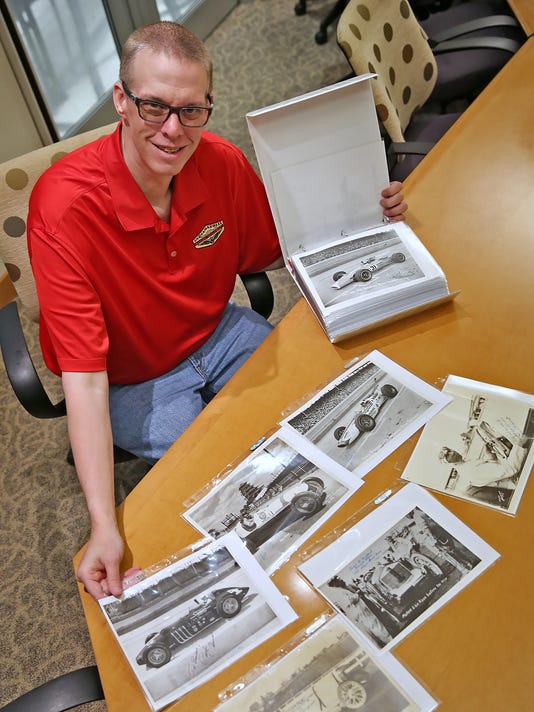
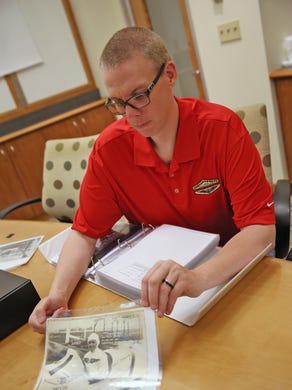
Mike Thomsen and some of his Collection. 
 Photo Courtesy of Kelly Wilkinson/IndyStar
Mike Thomsen approaches his title as the No. 1 autograph collector of Indy 500 drivers with an admonition.

You see, Thomsen’s 594 signatures only became the largest publicly known collection when the previous leader, Dr. Harlen Hunter, started auctioning off the 597 signatures he had last year.

“I really won’t consider myself No. 1 until I pass 597 because that’s where he got to,” said Avon's Thomsen, who won't divulge where he keeps his collection. “I picked up a rare one this month that made it 594, then I should be getting another one to make it 595, then all five rookies (this year) will make it exactly 600.”

Thomsen already belongs to “The 500 Club,” a self-appointed tag pinned to the highest-end collectors who have amassed autographs from at least 500 of the 758 starting drivers to have ever competed in the Indianapolis 500.

To his knowledge, Thomsen is one of just seven collectors in the world to eclipse 500. As far as anyone can tell, he would also be the first to reach 600 — though, he admits, there could be others “flying under the radar” elsewhere in the world.

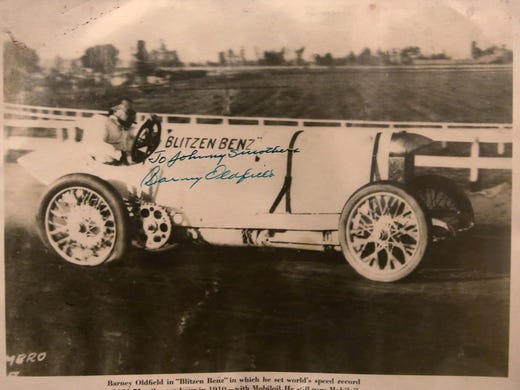
This is in Mike Thomsen's collection of Indy 500 drivers' autographs, Friday, May 27, 2016. He has the most autographs from different Indy 500 drivers, in the world. After the green flag waves, he says will have autographs from 600 of the drivers who ever drove in the race. This photo is of Barney Oldfield in the "Blitzen Benz" car. Oldfield set the world's speed record of 131.75 mph in 1910, in this car.  Photo Courtesy of Kelly Wilkinson/IndyStar
This is in Mike Thomsen's collection of Indy 500 drivers' autographs, Friday, May 27, 2016. He has
the most autographs from different Indy 500 drivers, in the world. After the green flag waves, he says
will have autographs from 600 of the drivers who ever drove in the race. This photo is of Barney
Oldfield in the "Blitzen Benz" car. Oldfield set the world's speed record of 131.75 mph in 1910, in
this car.  Photo Courtesy of Kelly Wilkinson/IndyStar


Otherwise, Thomsen knows most big-time 500 collectors and considers several to be close friends after working together over the years. For those he knows best, he tries to keep their “want lists” handy so that if he comes across a piece already in his collection that another collector needs, he can pass along the details.
“It’s kind of a little bit of camaraderie, but there’s competition, too,” Thomsen said. “There are guys in this industry that are willing to work with you, help you, share their knowledge; and then there are some guys who are willing to cut your throat to get the piece.”

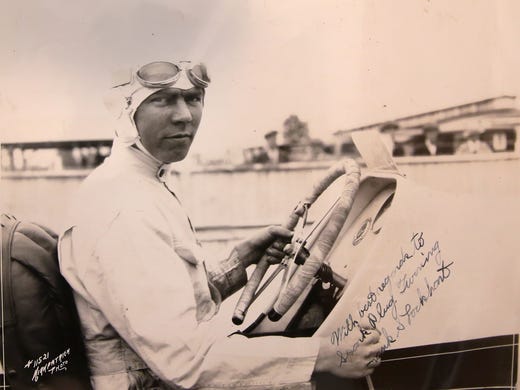
This photo is of Frank Lockhart, from about 1927. Photo Courtesy of Kelly Wilkinson/IndyStar


A cutthroat approach never suited Thomsen. For him, forming connections and friendships, and sharing his knowledge has always been part of the fun.

“That’s what I enjoy about it,” said Knightstown's Jim Vogel, who owns 513 signatures and considers Thomsen a friend. “It’s nice going to the track, and no matter what track I go to, I find somebody that I talked to or got autographs with. Everywhere you go, you’re seeing people (you know).”

Whenever he can, Thomsen stresses to new collectors the value of strong networking with previous generations, if simply for the invaluable knowledge veterans can pass along from their experiences.

Thomsen still credits much of his success as an established collector to his personal mentor, Jack Mackenzie, former caretaker of the Borg-Warner Trophy. As Mackenzie once told him, the biggest mistake new collectors make is trying to do too much. That’s to say, trying to collect every program, pit badge, autograph and everything in between. So, Thomsen focused exclusively on being the top guy in driver autographs.

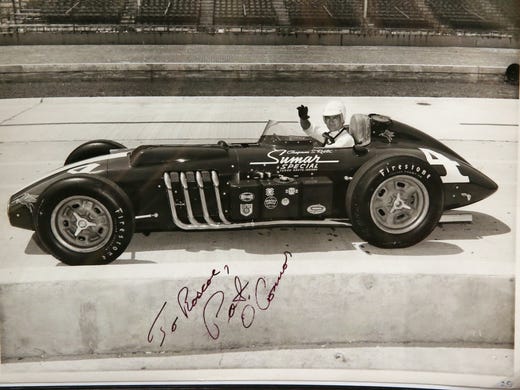
This is a photo of Pat O'Connor, 1958, Photo Courtesy of Kelly Wilkinson/IndyStar
This is a photo of Pat O'Connor, 1958, Photo Courtesy of Kelly Wilkinson/IndyStar


Veterans can also educate newcomers on the factors that make certain pieces more valuable: condition and quality, supply and demand, popularity of the driver. Without help, rookies might unknowingly pay more for a common autograph or pass up a lesser-known driver’s signature without realizing its value.

“Learn from everybody that made a mistake,” Thomsen said he tells new collectors. “There are so many mistakes you can make, and if you do your homework, you won’t make those mistakes.”

Mackenzie and Hunter, a retired orthopedic surgeon from Bedford, would be what Thomsen considers first-generation 500 collectors: people who spent time in the '70s and '80s building collections of autographed memorabilia ranging from programs and pennants to old autograph books.

“It was the time to get those guys from the '30s, '40s, '50s before they died,” Hunter said.

When it came to hunting down missing pieces, Hunter avoided websites like eBay for issues of authenticity. He recalls once seeing a listing that claimed to have the ballpoint pen of Gaston Chevrolet, who won the 1920 race and died in November of that year. Modern ballpoint pen designs, like the one in the listing, weren’t made commercially available until the 1940s.

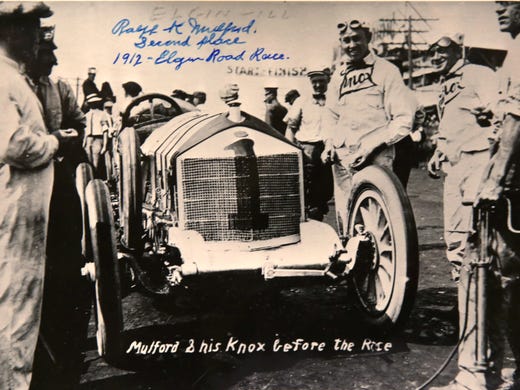
This photo is of Ralph Mulford, the second place winner of the first Indy 500 race. Photo Courtesy of Kelly Wilkinson/IndyStar
This photo is of Ralph Mulford, the second place winner of the first Indy 500 race.
Photo Courtesy of Kelly Wilkinson/IndyStar


Instead, Hunter cut out the middleman and purchased official documents that guaranteed authenticity, such as track licenses, check or entry forms that already contained drivers’ signatures. Or he would seek out drivers’ addresses and personally mail them memorabilia to sign.
Mike Thomsen shows some of his many
Indy 500 drivers' autographs and photos.
This photo is of the first two-time winner
Tommy Milton. Photo Courtesy of
Kelly Wilkinson/IndyStar

“And I always wanted to talk to (the driver),” Hunter said of a request he sent along with any mailed memorabilia. “Then, it becomes real, and you’re a real person to them.”

At 13, Thomsen discovered a similar sentiment when he wrote John Paul Jr. asking to have a photograph signed shortly after seeing him win the 1983 Michigan 500. Not only did Paul Jr. sign the photo, he also hand wrote Thomsen a two-page letter in appreciation of his interest.

“What if he wouldn’t have said anything back?” Thomsen wondered decades later. “It wouldn’t have set me on this path. But because he was so interested in it, he helped spur me into the interest.”

Oftentimes, seeking out the lore and history of 500 drivers matters more to collectors than the monetary payoff. Thomsen and collectors like him want to downplay the money involved — though some rarer autographs have been sold for upward of $1,500.

For Thomsen and most serious collectors, though, nothing quite compares to getting a new autograph and calling up friends to learn more about who the driver was.

“We’re not doing it because we’re going to be the Rockefellers or Bill Gates because of it,” Thomsen said. “To me, the cash at the end is learning about these guys.”


Top Five Collectors:


Mike Thomsen (594), Avon, Ind.

Dr. Steven Clinton (576), Dublin, Ohio

Stu Slifkin (564), Murrells Inlet, S.C.

Dr. Allen Hanson (553), Centuria, Wis.

Jim Vogel (513), Knightstown, Ind.


If you collect autographs, at l'art et l'automobile, we have a good selection of photographs, prints, trophies, paintings, programs and other memorabilia that have been autographed by some of the most successful drivers, team owners, manufacturers and famous celebrities of the 20th century. Enjoy looking through our collection and tell us which ones you would like to own. Please Tour the gallery at arteauto.com, and perhaps add a piece to your collection.

All our best from the staff at l’art et l’automobile,


Jacques Vaucher

For more great automotive artwork and memorabilia, don't forget to browse the many other categories on our WEBSITE. Remember we also have many more items in our gallery, do not hesitate to contact us if you are looking for something in particular.

And as always, be sure to Like and Share on Facebook, Follow us on Twitter, share a photo on Instagram and read our Blogs.