Showing posts with label Ferrari. Show all posts

Thursday, January 24, 2019

24 Hours of Daytona

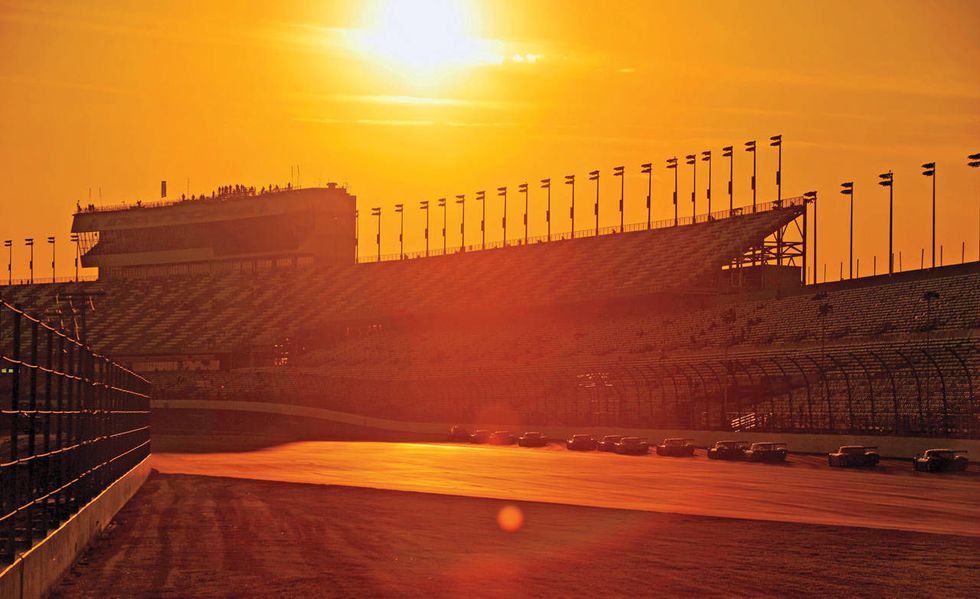
The Sun Sets on Daytona International Speedway, the setting for the Rolex 24 at Daytona


A Short history of a long race.


BY SAM POSE


Dan Gurney had a 2-minute lead at Daytona when the engine blew in his Lotus 19. "I knew it was very close to the end of the race," Dan recalls, "so I put the clutch in and let the car roll up to the line, stopping a few feet short of it." The finish line was on a banked part of the track. "I stopped in the upper lane, next to the starter's stand. I even got out of the car for a moment—I don't know why. Then the starter began waving the checkered flag. I turned left and just coasted down the banking, across the line."

To win.

That unusual finish took place a half-century ago in the Daytona Continental, a forerunner to the 24-hour race first held four years later in 1966. The course was part banking, part infield road course—a configuration new to racing. Overnight, Daytona, Sebring and Le Mans became what was informally known as endurance racing's Triple Crown. It would be hard to conceive of three races whose ambience differed more. The 12 Hours of Sebring, in central Florida, was held amid the vacant hangars and rusting World War II bombers of a little-used airfield; Le Mans—the doyen of the three—combined extreme danger with the intoxicating beauty of a long twilight rush through the pastoral French countryside. Daytona was all about the banking. It was intended for stock cars, not the fragile long-distance racers, and it was brutal, pounding the suspensions and leaving the drivers feeling as if they had just been in the ring with Mike Tyson. Derek Bell, who won both Daytona and Le Mans, thought Daytona was tougher; the banking never let you rest.
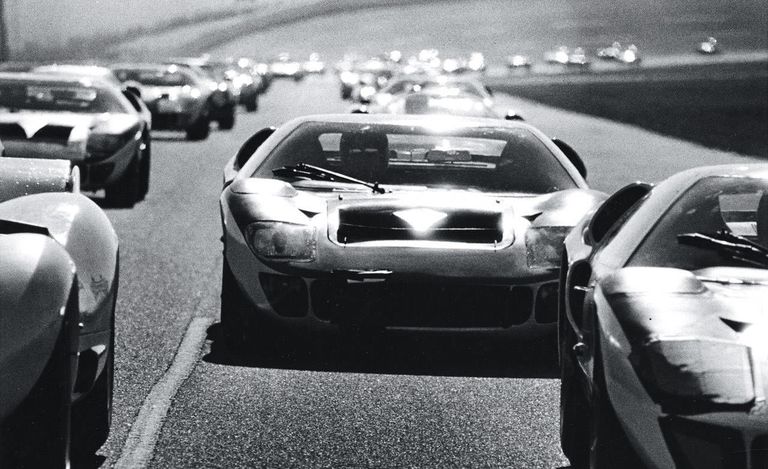
Ford GT40, photo courtesy of Road and Track


For one thing, you couldn't see where you were going. You looked left into the ground; right, and all you saw was the wall. Imagine racing inside a bowl: The road ahead didn't seem to curve but to climb; the impression was that you were always racing uphill. The big windshields of the NASCAR stockers allowed for good visibility, but in a 917 Porsche or a Ferrari 512, the knee-high roof blocked your view, so you scrunched down as best you could, craning your neck for a brief glimpse forward—many a driver ended his stint wracked with the pain of muscle cramps.

Only the middle two of the four lanes were usable, the bottom one too rough and the top, next to the wall, slippery with dust in the early hours, then with marbles as the race wore on. The idea was that cars in the slower classes would keep to the lower lane, leaving the high line for the fast boys, but out there on the banking, etiquette gave way to spur-of-the-moment expediency. Drivers of slow cars couldn't see behind them any better than those in the fast cars. When a Camaro, say, pulled out to pass, it would block the lane for a prototype bearing down on the scene with a closing rate of up to 70 mph. A split-second to decide: high or low? Nine out of 10 times it was too late to get on the brakes, and if you did there was the risk of losing control—the suspension settings were compromised, the flat infield turns calling for spring rates and ride heights that were the exact opposite of what you wanted for the banking. So there you were, the car crushed down onto the bumpstops, veering from lane to lane, centrifugal force pinning you in the seat and trying to drag your hands off the wheel, going 200 and unable to see much of anything—that was the banking experience. Oh, and for 10 hours, you got to do it in the night.
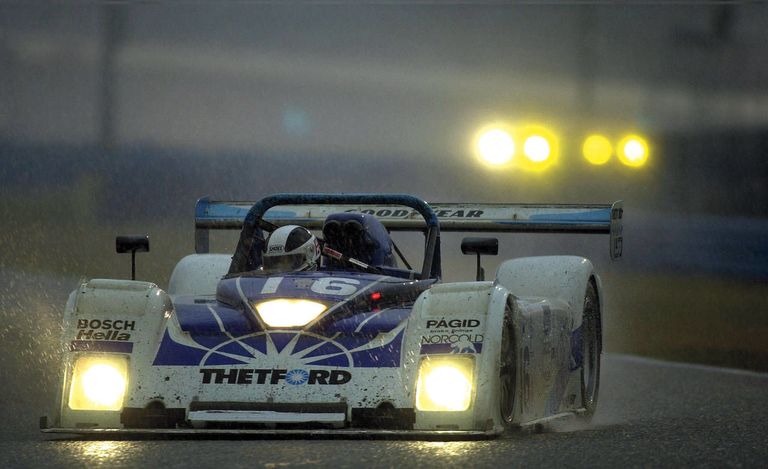

Dyson Riley & Scott Mk III, photo courtesy of Road and Track


The Daytona night is the longest in racing and often the coldest. Florida in February can be damp and freezing—parka weather. Along pit lane, crews jury-rigged plastic curtains to block the wind—in the daytime it looked like Shantytown, but at night it was quite beautiful, the translucent walls glowing in the dark. Inside the enclosures, men slumped on the concrete floor, fighting to stay awake.

The contrast between the stands packed with cheering NASCAR fans at the 500 and the same stands at night, empty except for a few fanatics frozen in place like lumps of coal, left no room for doubt as to the relative popularity of stock cars versus sports cars. The first year of the 24-hour race, Daytona's management sought to evoke the carnival atmosphere of Le Mans with a Ferris wheel, but although it revolved all night, its neon tubes bright yellow on the spokes, it failed to attract any customers—because there weren't any customers to attract. Attendance at Le Mans was close to 300,000; in those first years at Daytona the oft-repeated joke was that the drivers outnumbered the spectators.
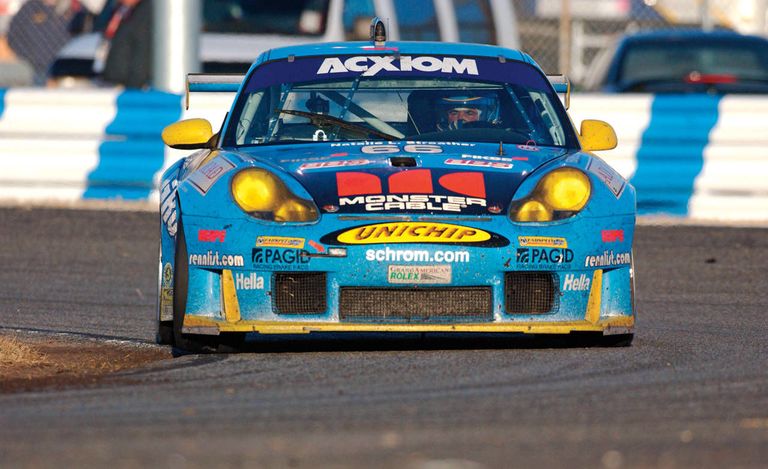

911 GT3 RS, photo courtesy of Road and Track


Despite the poor attendance, the race became an important fixture on the international calendar. There was the cachet of the name Daytona (even then the 500 was a big deal), plus 1966 was the height of the Ford versus Ferrari battle, which lent historical significance to the proceedings. Ford swept the 1966 race, with Ken Miles and Lloyd Ruby coming home first in a GT40 Mk II. The following year, Ferrari fought back, winning with their stunning 330 P4s. In 1968, Porsche scored the first of its record 22 wins, and 1969 saw Roger Penske's battered Lola—a victim of a crash on the banking—eke out a win. This was big-time racing, and Speedway President Bill France chose to absorb the losses at the gate in return for the international prestige.

I was in those races, and I actually looked forward to Daytona—especially when I got to drive a Ferrari for NART (Luigi Chinetti's North American Racing Team). True, every stint involved some lurid moment on the banking, and if you weren't on the banking you were scrabbling through the tight, utterly featureless corners of the infield portion of the lap, but it was a chance to race the top European Formula 1 drivers, who in those days also participated in sports car racing. Jackie Ickx, Pedro Rodríguez, Jo Siffert, Chris Amon, Lorenzo Bandini—these men were heroes to me, and somehow the suffering imposed by Daytona helped forge a bond with them, a sort of Brotherhood of the Banking.
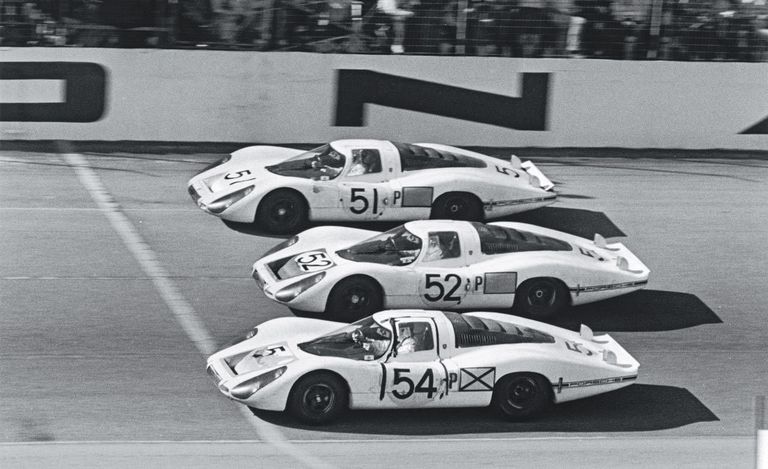

Porsche 907, photo courtesy of Road and Track

The epoch of the big 5-liter 917s and 512s ended with the 1971 season. The 1972 race, shortened to six hours, went to Ferrari's trim 3-liter sports racer—the last time the Ferrari factory would contest the race. The following year, 1973, saw a motley collection of sports racers upset by Peter Gregg's Porsche 911 RSR, which looked little different from the production 911s upon which it was based. Gregg was a brilliant but tightly wound Harvard grad who raced under the colors of Brumos Porsche, a dealership just up the road in Jacksonville. Peter's contacts at Weissach kept him a step ahead of the rest, but after the mighty prototypes and their swarms of engineers and mechanics, it was a letdown to see Daytona won by a car that looked as if it had just come from the showroom floor. Gregg's first victory was with Hurley Haywood, who would become the only driver to win Daytona five times. But it was Gregg, with four wins in five starts (including one for BMW), who defined an era—which ended with his suicide in 1980.

Through the 1980s, Porsche was the backbone of the race, and Daytona's prestige revived step by step as the German manufacturer supplied its many customers with ever faster cars—first the 935 and its derivatives, finally the superb Group C 962s, which were identical to the cars that were winning Le Mans. European aces such as Martin Brundle, Brian Redman and Rolf Stommelen filtered in along with Indy winners A.J. Foyt and Al Unser Jr. When Porsche finally had its fill of success, wins began going to such industry heavyweights as Jaguar, Nissan and Toyota, giving the race in the 1990s its second golden age. But only the factory-supported teams had a chance—the private teams were being driven out of the sport.
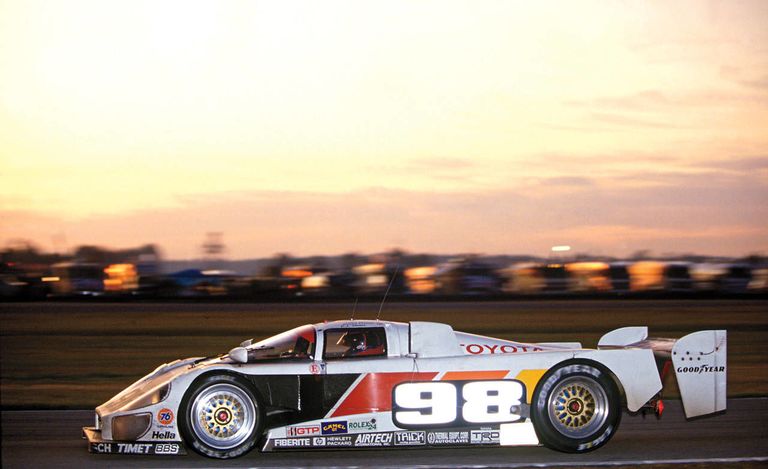

Dan Gurney's Eagle, photo courtesy of Road and Track


In 1999, the pressure for change was compelling enough to produce two new series, each backed by a man of great wealth and imagination. The American Le Mans Series, created by the inventor Don Panoz, established close ties with the French and adopted their rules. The other, sanctioned by the Grand American Road Racing Association, was the brainchild of Jim France. Jim was Bill France's son and part of the family's NASCAR dynasty, but he had a rogue gene: a passion for road racing. In 2000, Grand-Am took over Daytona's 24-hour classic and made it their marquee event. Both Panoz and France offered racing for prototypes and GT, but each took a different approach. Panoz's was caviar and champagne, while France's was burgers and beer.

Grand-Am promised NASCAR-style rules stability and rigid cost control—for example, no factory teams permitted and no in-season testing. The year 2003 saw the introduction of Daytona Prototype, a class with rules as tight as a spec series but open to a wide variety of engines, including Pontiac, Chevrolet, Lexus, Porsche and BMW. There were several chassis builders, too, of which Riley would become the most successful, winning at Daytona the last seven years. For safety and a better view of the banking, the rules mandated a bulbous greenhouse—and the big windshield, awkwardly mated to flat sides and a stubby nose, made for what most people agreed were ugly cars. But beauty is in the eye of the car owner, and the Daytona Prototype—and the prestigious series sponsor, Rolex, that went with it—was an attractive package. By 2006, 30 prototypes were on the grid for what was now called the Rolex 24. The GT cars did more than just fill out the fields; at first they were—embarrassingly—as fast as the new prototypes, forcing the organizers to invert the grid so as to have the prototypes up front at the start. A now-iconic Porsche 911 scored an upset victory, recalling the first win for Gregg and Haywood, exactly 30 years before.
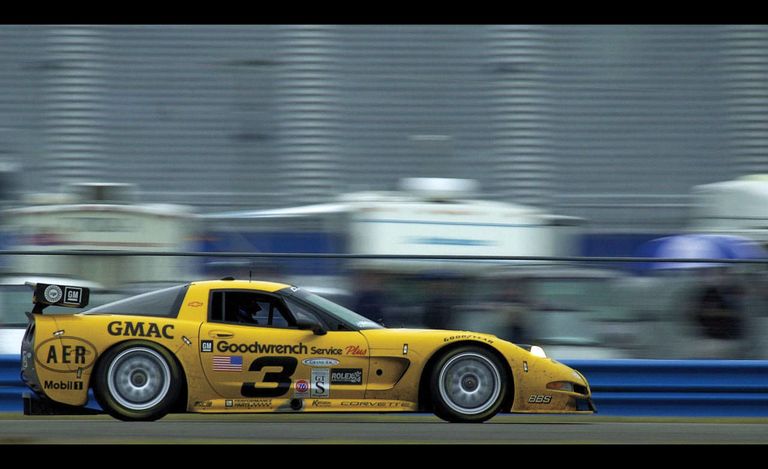

Dale Earnhardt's Corvette, photo courtesy of Road and Track


Back in the 1960s and '70s, teams consisted of two drivers; today, in both GT and prototype classes, four drivers is the norm: the team's two regulars plus a big name NASCAR hero such as Jimmie Johnson or Jeff Gordon...or an Indy winner like Sam Hornish Jr. or Dario Franchitti—and there's still a spot open for a guy who pays big bucks for his ride. In 1997, the Rob Dyson entry set some kind of record when they won using seven drivers—I understand they were lining up spectators for a turn at the wheel when, mercifully, the race ended. (Just kidding, Rob.) Chip Ganassi's cars have won four times, including 2011 with Joey Hand, Graham Rahal, Memo Rojas and Scott Pruett—a formidable quartet, as good as any at Le Mans. The win was Scott's fourth; another and he'll tie Haywood.

The next generation of the Daytona Prototype, dubbed DPG3, will go into action at the 2012 Rolex. Their bodies will be allowed to have what is being called "brand character." For example: Alex Gurney and Jon Fogarty run a Chevrolet engine, and under the new rules they will be allowed to have a body that suggests a Corvette. I have seen some artists' renderings of the new look, and it's good.
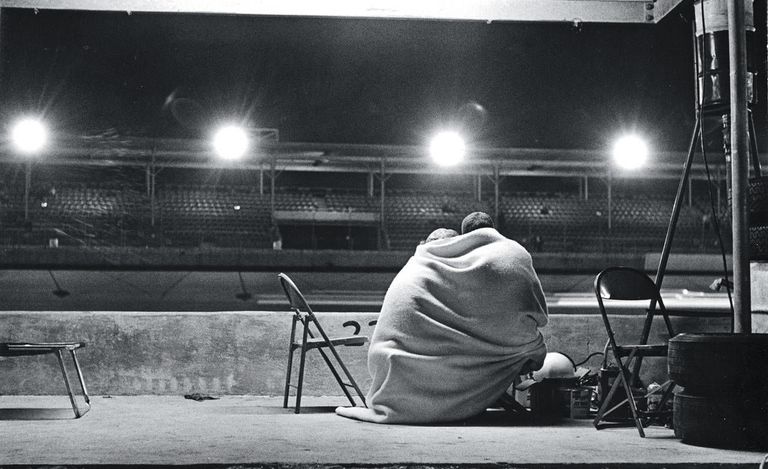

Daytona at night, photo courtesy of Road and Track


Also in the works is a series-within-the-series. The idea is to link Daytona to shorter events at Indianapolis (over the weekend of the Brickyard 400) and Watkins Glen (a France-owned track), re-creating—after 40 years—a second Triple Crown, complete with its own prize money and points system. Instead of Daytona-Sebring-Le Mans, it will be Daytona-Indy-The Glen. Exciting? I think so.

The heart of the new Triple Crown will, of course, be Daytona, now entering its second half-century and well into its third golden era. A chicane near the end of the long back straight was intended to reduce the risk on the banking, but it seems Daytona's essential character never changes: The curbing is temporary (so it can be removed for NASCAR races), and slower cars drop their wheels over it, scattering gravel into the racing line, leaving the drivers of the faster cars to wonder if they may have a slow puncture on their hands. As John Andretti, who won in 1989, put it: "They just replaced one hazard with another."

When I think of Daytona, I think of a race that extracts a toll on anyone who enters it, a race in which winning has never come easily. It seems oddly appropriate, then, that Dan Gurney won the first race by coasting silently across the line.

As you may know, the Rolex 24 at Daytona will be run this weekend, January 26th-27th, which with the running of the Daytona 500 the week before, signals the start of Motor Racing Season.  We here at l’art et l’automobile have been waiting as patiently as possible for racing season to start again, which admittedly has not been very patient, and Formula E just isn’t cutting it. That’s why we’re celebrating the beginning of the Racing Season, and in order to extend our celebrations to you, we have gathered all of our Daytona and Endurance Racing Artwork, Collectibles and Memorabilia and are presenting them to you. Please head over to our website and tour the Gallery and perhaps you can find an item that will assist in your celebration of the beginning of the Motorsports Season.

Enjoy the race and the season,

Jacques Vaucher

Remember we have a wide variety of items in our gallery, so do not hesitate to contact us if you are looking for something in particular.

And as always, be sure to Like and Share on Facebook, Follow us on Twitter, share a photo on Instagram and read our Newsfeed.

Thursday, October 18, 2018

U.S. Grand Prix and Formula 1

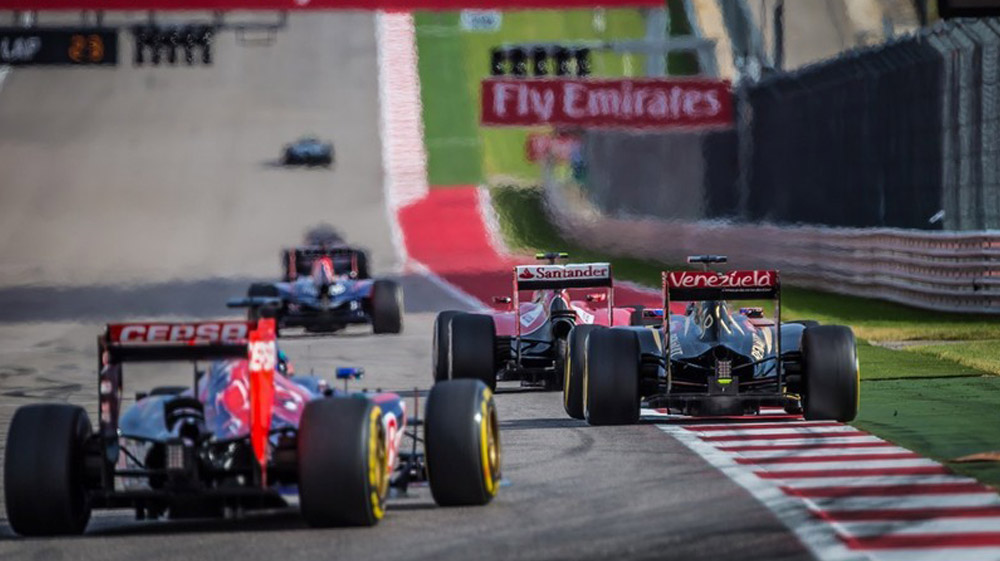
Formula 1 returns to the United States at the Circuit of the Americas


After decades of trying, Formula One may finally be growing in America


written by Sophie Bearman and Mike Larson, edited by James Karthauser


For over 70 years, Formula One has been a premier global sport, with opulent, multi-day races held in countries across the world.

Formula One’s events are wildly popular — everywhere, that is, except for the United States. But that could be changing sooner than most think.

European roots


Italian racer Giuseppe Farina wins the world’s first Formula One Grand Prix in 1950. Photo courtesy of CNBC


Since its founding, Formula One has been an international organization.

The first world championship was held in 1950 at Silverstone in the United Kingdom. The winning driver, Italian racer Giuseppe Farina, drove a supercharged Alfa Romeo in front of 120,000 cheering spectators — including England’s reigning monarch, King George VI.

That European race set the stage for Formula One’s global presence, excluding America.

Headwinds in America


Formula One has a storied history in the United States. Mario Andretti sat on the pole for his first F1 start at Watkins Glen in 1968
Formula One has a storied history in the United States. Mario Andretti sat on the pole for his first
 F1 start at Watkins Glen in 1968. Photo By Lat Photographic

Logistically, it’s hard to be a Formula One fan in America. Most of the races take place in Europe, so watching live events often means waking up at the crack of dawn. The U.S. also has its own motor sports to watch like IndyCar and NASCAR, which has been around since the 1940s.

Peter Habicht is the founder of Formula One's largest fan group in America, located in San Francisco. The group has about 2,500 members.

“We have a difficult time following a lot of the European races because they go on at about five in the morning, so it’s a challenging proposition to get a group together, usually at a sports bar, to watch a live start of a race,” said Habicht.

Unlike basketball or football, Formula One racing provides very few American drivers to cheer on: The last American to win a race was Mario Andretti, and that was at the Dutch Grand Prix in 1978.

“The sport, under prior stewardship, began to move wherever the money was the highest," said Leo Hindery, InterMedia Partners managing partner and a former race car driver.

"And that left Formula One in places like Kuala Lumpur, Malaysia, Bahrain, Abu Dhabi, Singapore, Shanghai, none of which is bad for the sport except for in the process of doing that, they neglected to maintain a footprint here in the United States,” said Hindery, a Formula One promoter.

In 2005, the U.S. Grand Prix didn't turn out as Formula One might have hoped. Media reports at the time called it a disaster. At the very last minute, fourteen cars were forced to withdraw due to safety concerns. Most fans left the event feeling disappointed and cheated of their money. The race they’d come to see didn’t deliver.
“It was a low point, for sure, in American Formula One history,” said Habicht.

Improving relations with the US


Ayrton Senna leads the field at the United States Grand Prix at Phoenix in 1989.
Ayrton Senna leads the field at the United States Grand Prix at Phoenix in 1989. Photo By Lat Photographic


Still, the future of Formula One in America may be getting brighter. Competitor NASCAR has had an undeniably rough few years, which could be a boon for Formula One. More importantly, Formula One has had a significant change in leadership: In early 2017, it was acquired by Liberty Media, a U.S. company, for $8 billion.

Formula One’s new CEO, Chase Carey, has high hopes for the sport in America, telling CNBC at the time of the acquisition that he wanted to make the races feel more like Super Bowl events with mobile content, and behind-the-scenes access available for fans.

“Put an organization in place that lets us make these events everything they can be, reaches out across digital media that we're not connecting to today [and] build a marketing organization that connects to fans [and] enables fans to connect to the sport,” said Carey.

One year later and expansion in America is already happening: a new Miami street circuit Grand Prix will be added to the calendar in 2019. The race would be in addition to the U.S. Grand Prix. Hindery predicted there will be a race in the Northeast, possibly New Jersey, within the next two to three years as well.

America's untapped market


Fans greet racer Lewis Hamilton of Mercedes and Great Britain during the United States Formula One Grand Prix in 2017.
Fans greet racer Lewis Hamilton of Mercedes and Great Britain during the United States Formula One
Grand Prix in 2017.  Photo courtesy of CNBC

There’s a lot of money to be gained from ticket sales, advertisers and sponsors in America. U.S. consumers shelled out $56 billion to attend sporting events in 2016, according to a study by CreditCards.com.

“You have 325 million people in the United States which, just in sheer numbers, is an audience you shouldn’t leave behind,” explained Hindery.

Formula One could use the economic boost. In 2012, FinanceAsia, a Hong Kong-based financial news publication, reported Formula One's valuation was $9.1 billion. That means over the four-year period between that valuation and the subsequent $8 billion purchase, it lost 12 percent of its value.

However, it’s not a sure thing that Formula One will catch on in the States. U.S. Grand Prix attendance fell in 2017 by 4.4 percent from the year prior. And there are no American drivers racing in Formula One this year.

But if there’s ever a time for Formula One to capture America’s hearts, it’s now. With NASCAR struggling and new American F1 leadership, it’s possible the pastime can make a permanent mark on U.S. soil.

U.S. Grand Prix history review as Austin prepares for Formula One


Stirling Moss at the 1960 United States Grand Prix at Riverside.
Stirling Moss at the 1960 United States Grand Prix at Riverside. Photo By Lat Photographic


On Sunday October 22nd, Formula 1 returns to the U.S. for the first time with the U.S. Grand Prix in Austin, Texas, at the brand new, world-class race track, the Circuit of the Americas.  Having resumed Formula 1 racing in 2007, bringing the sport back to the U.S. for the first time since 2007 at Indianapolis Motor Speedway, this race should be an enormous boon to the push for the sport in America.

Although F1 has had a long and at times troubled relationship with the American market, the sport also has a rich history here. Since 1950, the U.S. has hosted 62 F1 events, including races at Watkins Glen, Sebring, the streets of Detroit and several others. As some F1 fans prepare to head to Austin while others plan to watch the U.S. Grand Prix on television, here's a quick recap of F1 racing's American history.

1950-1960—Indianapolis 500: OK, technically this was not a traditional Formula One race, let alone a road-course race. But 11 times from 1950-1960, the Indianapolis 500 counted as a round of the world championship, with points scored at Indy adding to F1 drivers' season tally.

1959—Sebring: In 1959, the U.S. hosted two F1 races for the first time. In addition to the Indy 500, F1 added the United States Grand Prix to its schedule. The race, held at Sebring International Raceway in Florida, was the ninth and final round of the 1959 season.

1960—Riverside: In 1960, the United States Grand Prix moved from Sebring to the famous—and today much missed—Riverside International Raceway in Riverside, Calif. Promoters had a difficult time drumming up interest for the Sebring race the previous year, and had similar problems with the Riverside race. It wasn't until the following year when F1 moved to Watkins Glen International in upstate New York that American fans started to embrace Grand Prix racing.

1961-1980—Watkins Glen: After running the United States Grand Prix at two different venues in 1959 and 1960, the event finally found a somewhat permanent home in 1961. Originally, Daytona International Speedway was supposed to host the 1961 event, but an agreement couldn't be made. In the end, F1 went to Watkins Glen, where it remained for almost 20 years.

1976-1983—Long Beach: After a 16-year hiatus, F1 returned to the West Coast in 1976. Dubbed the United States Grand Prix West, the race found a home in Long Beach for seven seasons. The Long Beach races also marked the first time a city street circuit was used in the U.S., and the event is credited with having a major impact on turning the city around and increasing its desirability as a place to live. Of course, when F1 left after the 1983 race, Long Beach continued to host the CART World Series, and today hosts the Izod IndyCar Series and American Le Mans Series. But it was F1 that started the city's ongoing affair with auto racing.

1981-1982—Las Vegas: F1 left Watkins Glen after the 1980 running of the United States Grand Prix. The U.S. did continue to host the final race of the F1 season, but in Las Vegas. For two seasons, F1 participated in the Caesars Palace Grand Prix, which featured a surprisingly decent—if rather flat—track layout in the parking lot of the famous Las Vegas hotel. When F1 did not return to Las Vegas, the CART World Series added the race to its schedule in 1983 and 1984.

1982-1988—Detroit: The year 1982 marked the first and only time that three F1 races have appeared in the United States during a single season. In addition to races in Long Beach and Las Vegas, downtown Detroit hosted its own street race. The circuit was bumpy—no surprise to Michigan drivers—tight and demanding. Alas, F1 could not come to an agreement with the host city for 1989, whereupon CART once again added Detroit to its schedule.

1984—Dallas: Although this weekend's U.S. Grand Prix marks F1's first visit to Austin, the series is no stranger to Texas. In 1984, Fair Park in Dallas was converted to an F1 circuit to host the Dallas Grand Prix. The race turned out to be a one-off event, and it was plagued when high ambient temperatures caused the track surface to break apart. Drivers said it was the roughest circuit they had encountered, and the race was a significant physical challenge for the Grand Prix aces. Keke Rosberg won the race, but Nigel Mansell put on a memorable show by hitting a wall on the final lap, coming to a stop and attempting to push his car over the finish line. Instead he collapsed, exhausted by the heat on the rough circuit.

1989-1991—Phoenix: After the final race in Detroit in 1988, F1 wanted a new venue. It came down to either Laguna Seca in California and the streets of Phoenix, and Phoenix got the nod. From 1989-1991, the United States Grand Prix found its home in Arizona, and the first event, held in June, roasted drivers and spectators with temperatures exceeding 100 degrees. The organizers learned a lesson; Phoenix's next two races were held in March.
1992-1999—Hiatus: There were no F1 races held in the U.S. during this time period, and some began to wonder if the sport would ever return. And then along came Indianapolis . . .

The 2007 United States Grand Prix at Indianapolis Motor Speedway. Photo By Lat Photographic


2000-2007—Indianapolis: After a nine-year absence, F1 came back to the U.S. in a huge way and to much fanfare in 2000. The series returned to its American roots, racing at Indianapolis Motor Speedway, after then-Speedway boss Tony George invested millions to build a road course inside the world-famous oval. Not only that, but George dropped millions more to construct modern F1-spec garages, offices and a new pagoda and media center on the oval's front straight.

That first year, in 2000, the venue offered the largest F1 crowd in history as more than 250,000 fans flooded the giant facility, and it looked like a smash hit that would cement the series in the U.S.

However, the race—and F1 in particular—suffered major backlash in 2005 when cars using Michelin tires were forced to withdraw due to concerns their tires would fail on the Speedway's banking. With 14 entries using Michelins, that left only six cars on Bridgestone tires to start the race. Fans were not impressed.

Still, Indy hosted two more races, and though the crowds fell off significantly, the attendance was still strong compared to other F1 events around the world. Nevertheless, George found F1 boss Bernie Ecclestone's financial demands for 2008 too high to make a profit, and the U.S. bid goodbye to Grand Prix racing yet again.

U.S. Grand Prix Winners

2007, Indianapolis: Lewis Hamilton, McLaren-Mercedes

2006, Indy: Michael Schumacher, Ferrari

2005, Indy: Michael Schumacher, Ferrari

2004, Indy: Michael Schumacher, Ferrari

2003, Indy: Michael Schumacher, Ferrari

2002, Indy: Rubens Barrichello, Ferrari

2001, Indy: Mika Häkkinen, McLaren-Mercedes

2000, Indy: Michael Schumacher, Ferrari

1991, Phoenix: Ayrton Senna, McLaren-Honda

1990, Phoenix: Ayrton Senna, McLaren-Honda

1989, Phoenix: Alain Prost McLaren-Honda

1988, Detroit: Ayrton Senna, McLaren-Honda

1987, Detroit: Ayrton Senna, Lotus-Honda

1986, Detroit: Ayrton Senna, Lotus-Renault

1985, Detroit: Keke Rosberg, Williams-Honda

1984, Dallas: Keke Rosberg, Williams-Honda

1984, Detroit: Nelson Piquet, Brabham-BMW

1983, Detroit: Michele Alboreto, Tyrrell-Ford

1983, Long Beach: John Watson, McLaren-Ford

1982, Detroit: John Watson, McLaren-Ford

1982, Las Vegas: Michele Alboreto, Tyrrell-Ford

1982, Long Beach: Niki Lauda, McLaren-Ford

1981, Las Vegas: Alan Jones, Williams-Ford

1981, Long Beach: Alan Jones, Williams-Ford

1980, Long Beach: Nelson Piquet, Brabham-Ford

1980, Watkins Glen: Alan Jones, Williams-Ford

1979, Long Beach: Gilles Villeneuve, Ferrari

1979, Watkins Glen: Gilles Villeneuve, Ferrari

1978, Long Beach: Carlos Reutemann, Ferrari

1978, Watkins Glen: Carlos Reutemann, Ferrari

1977, Long Beach: Mario Andretti, Lotus-Ford

1977, Watkins Glen: James Hunt, McLaren-Ford

1976, Long Beach: Clay Regazzoni, Ferrari

1976, Watkins Glen: James Hunt, McLaren-Ford

1975, Watkins Glen: Niki Lauda, Ferrari

1974, Watkins Glen: Carlos Reutemann, Brabham-Ford

1973, Watkins Glen: Ronnie Peterson, Lotus-Ford

1972, Watkins Glen: Jackie Stewart, Tyrrell-Ford

1971, Watkins Glen: Francois Cevert, Tyrrell-Ford

1970, Watkins Glen: Emerson Fittipaldi, Lotus-Ford

1969, Watkins Glen: Jochen Rindt, Lotus-Ford

1968, Watkins Glen: Jackie Stewart, Matra-Ford

1967, Watkins Glen, Jim Clark, Lotus-Ford

1966, Watkins Glen: Jim Clark, Lotus-BRM

1965, Watkins Glen: Graham Hill, BRM

1964, Watkins Glen: Graham Hill, BRM

1963, Watkins Glen: Graham Hill, BRM

1962, Watkins Glen: Jim Clark, Lotus-Climax

1961, Watkins Glen: Innes Ireland, Lotus-Climax

1960, Riverside: Stirling Moss, Lotus-Climax

1959, Sebring: Bruce McLaren, Cooper-Climax


At l'art et l'automobile, we are Formula 1 fans of a ravenous nature, and wish to celebrate our love of the sport with you, as well as to assist you in your collecting of Formula 1 artwork and memorabilia.

Enjoy looking through the collection and tell us which ones you would like to own. Please Tour the gallery at arteauto.com, and perhaps add a piece to your collection.

Enjoy the Race,


Jacques Vaucher

For more great automotive artwork and memorabilia, don't forget to browse the many other categories on our WEBSITE. Remember we also have many more items in our gallery, do not hesitate to contact us if you are looking for something in particular.

And as always, be sure to Like and Share on Facebook, Follow us on Twitter, share a photo on Instagram and read our Blogs.

Thursday, August 2, 2018

Monterey Car Week Unrestrained

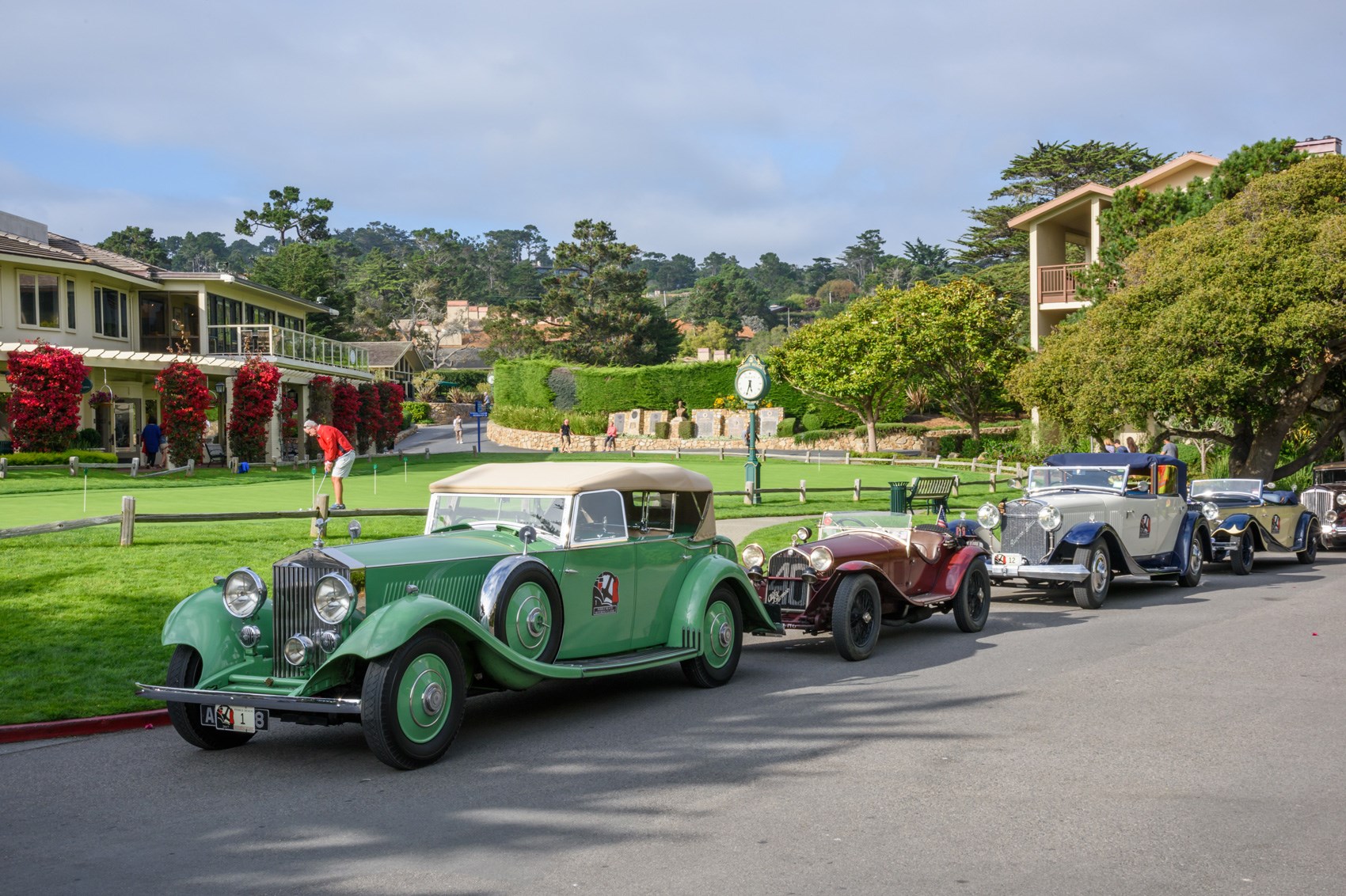
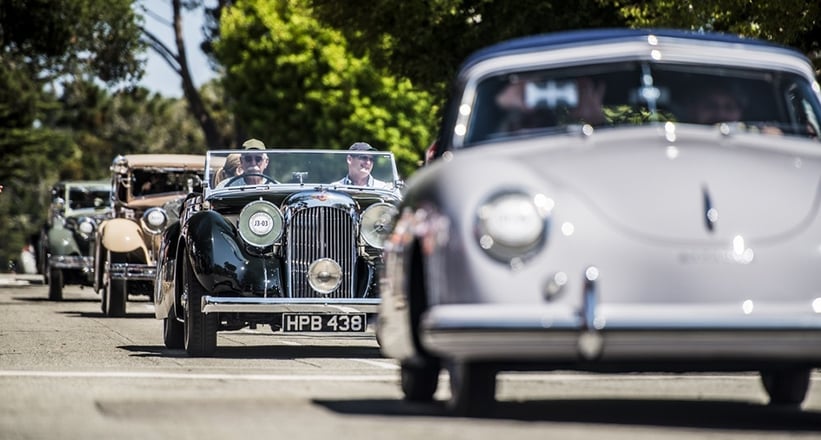
The Motoring Classic convoying down a California Highway on its way to the 68th annual Pebble Beach Concours d'Elegance

How to do it all and do it large, for under $5,000 a day

by Carl Bomstead edited by James Kathauser


 Having attended Pebble for the past 25 years or so, I’ve watched costs continue to escalate and have always dreaded the arrival of the credit-card bill that documented what a great time my wife and I had. But not this time. For the purposes of this exercise, the only caveat is try to keep it under $5,000 a day.

Now, of course, this doesn’t include any car purchases — just everything else.

Arriving in style


The Motoring Classic arrives at the 68th Annual Pebble Beach Concours d'Elegance Courtesy of AutoNXT
The Motoring Classic arrives at the 68th Annual Pebble Beach Concours d'Elegance
Courtesy of AutoNXT


My first call is to Tour Master extraordinaire AlMcEwan, who is the majordomo for the famed Pebble Beach Motoring Classic. The tour is a nine-day, 1,500 mile extravaganza that leaves from Seattle, continues through the Oregon Cascades and then down the California coast, crossing the San Francisco Bay Bridge and arriving at the Pebble Beach Lodge on Wednesday afternoon. About 30 cars attend, and the requirement is that the cars have appeared on the lawn at Pebble Beach or are eligible to do so. The tour cost is $12,000 for a couple but is all-inclusive, including premium lodging, food and libations.

Fortunately, Al has an opening, and we quickly take care of the nancial arrangements.

Rolling tab: $12,000, and that’s before arriving in Monterey.


Where to sleep


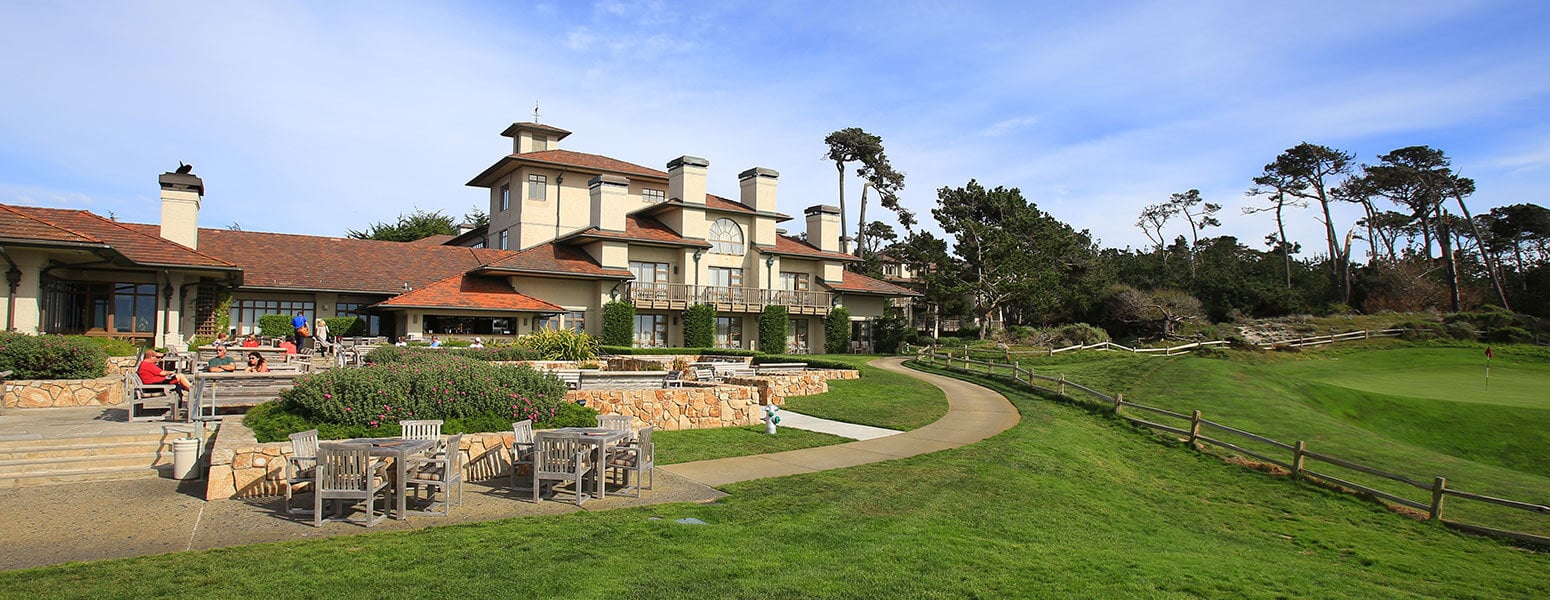
The newly renovated Pebble Beach Lodge borders the 18th hole and provides great accommodation for Concours Visitors Courtesy of Pebble Beach Resorts
The newly renovated Pebble Beach Lodge borders the 18th hole and provides great accommodation
for Concours Visitors.  Courtesy of Pebble Beach Resorts


Accommodations are always an issue during the week. I have my normal overpriced franchise motel reserved, but I’ve always wanted to stay at The Lodge. Checking with the powers that be at the concours of office tells me that there has been a cancellation at Casa Palmero, the boutique 24-room facility that resembles a Mediterranean villa. It is part of The Lodge and is renowned for its personal service, but it comes with a price. The Estate Studio that is available is $1,150 a night plus the taxes, gratuities and other fees. For Wednesday through Sunday, that’s around $6,200.

Rolling tab: $18,200.


Red cars and carpets


A Day at the Pebble Beach Concours d'Elegance Car Show Courtesy of Dwell
A Day at the Pebble Beach Concours d'Elegance Car Show
Courtesy of Dwell


I won’t have much time to relax, as my wife and I will be picked up at 5 p.m. on Wednesday for the McCall’s Motorworks Revival at the Monterey Jet Center. We have purchased Red Carpet tickets for $575 each and look forward to enjoying the “see and be seen” lifestyle event that features current super and vintage cars and aircraft, along with food and beverages from the local upscale providers.

McCall’s Motorworks Revival at the Monterey Jet Center
Thursday we will be participating in the Tour d’Elegance, so I will have my car ready to go at the Polo Field in time for scrutineering and renewing friendships. The majority of the entrants in the concours now participate in the Tour, which travels through 17-Mile Drive, often continues out to Laureles Grade and then down Highway One to scenic Bixby Bridge. It returns to Carmel, where the cars are parked along Ocean Avenue for all to enjoy. The cars always draw a crowd in Carmel, and this year will not be an exception.

We will get back to “Casa P” in time to unwind a bit before I gather my group of 10 or so friends and head out the Carmel Valley Road to the Baja Cantina and Hot Chili Nights — a gathering of 100 or more collector cars. The Baja Cantina is known for its Mexican food, but I’m also attracted to the automotive memorabilia that owner Pat Phinney has displayed throughout the restaurant. Dinner for the party? $600.

Rolling tab: $19,950.


Exclusive fun


The McCall’s Motorworks Revival at the Monterey Jet Center is an exclusive event hosted during the Festivities Courtesy of Autoweek
The McCall’s Motorworks Revival at the Monterey Jet Center is an exclusive event hosted
 during the Festivities.  Courtesy of Autoweek

Friday, my wife and I will be off to The Quail, A Motorsports Gathering, as we have found a pair of tickets on eBay for $1,500, which is an absolute bargain, as they are listed on StubHub starting at $1,950.

The Quail is a day of exciting motorcars, excellent food pavilions and refreshments from a variety of premium suppliers. It is also a lifestyle event, as you can find displays for anything from exotic cars to multimillion-dollar yachts and most anything in between.

We will need some time to unwind when we return to “Casa P,” then we will join friends and walk down to the Lodge for dinner at the Stillwater Bar and Grill, which overlooks the famed 18th fairway and Stillwater Cove. A smaller, more intimate evening. $500.

But it will be an early evening, as Saturday will find us in our transportation to Concorso Italiano at the Black Horse Golf Course. Concorso Italiano was first presented in 1985 and features all that is Italian. There will be close to 1,000 cars that are Italian in origin presented in a number of classes. Keith Martin is again scheduled to have microphone in hand as master of ceremonies as he interviews owners and presents the awards. Two CI Club tickets: $495 each.

The evening will find us at the Gala Dinner for Pebble Beach entrants, judges and sponsors. We are included as part of the Motoring Classic. The fare is always exceptional and the drink is all top-shelf. The band plays on, but we will duck into the Gooding auction taking place next door. Bidder credentials there are $200, in addition to the $300 we spent at RM Sotheby’s, $150 at Bonhams, $100 at Mecum, $200 at Russo and Steele, and $150 at Worldwide Auctioneers — gotta be ready in case a special car pops up that we need to own.

Rolling tab: $24,140


Concours Sunday


Lining up for the Prestigious Concours d'Elegance at Pebble Beach Courtesy of CAR Magazine
Lining up for the Prestigious Concours d'Elegance at Pebble Beach
Courtesy of CAR Magazine
Sunday morning will arrive early, as we will be at Dawn Patrol. There, the cars are greeted by Pebble Beach Concours Chairperson Sandra Button as they enter the field. It is also the best time for photos before it becomes too crowded. We have managed to acquire a pair of tickets for the Chairman’s Hospitality at the Lodge for $2,750 apiece, which provides VIP access credentials and access to the Stillwater Bar and Grill for viewing of the award ceremony. Food and beverages will, of course, be provided.

Grand Finale: Pebble Beach Concours d’Elegance
Following the Best of Show presentation, we will take the short walk to the Beach Club for the after-party, which is part of the Motoring Classic package. It is primarily for entrants and judges, as the winners will be congratulated and the others thanked for their participation. It will have been a long day, so it will hopefully be an early evening.

When we return to Casa Palmero, there will most likely be a celebration under way in the hosted bar, so plans for an early evening will probably go out the window.


Grand total: $29,540.


Cost per day: $5,908.


Of course, this all illustrates that you can’t see or do everything regardless of your budget — and speaking of budgets, I blew my $5,000-per-day plan, too. But what’s Monterey if not a time to splurge on the experience?

With this, I have an exciting Monterey Car Week planned. But my ever-skeptical wife asks if I’m sure the magazine is going to cover this expensive trip. Could my fantasy trip be just that — a fantasy?


Jacques in the Gallery of L'art et l'automobile
Monterey Week is coming quickly, August 17th to the 27th. The motoring world will be converging on the Peninsula at Pebble Beach. The 10 day long event will be packed with racetrack celebrities, Concours d’Elegance and automobile week, numerous manufacturers’ meetings, car club reunions, forums, vintage car auctions and so much more. But Carl forgot to go to the Race Track at Laguna Secca, where they hold great Vintage Car Races, namely the Rolex Monterey Motorsports Reunion held throughout Autoweek. Great fun but exhausting.

L’art et l’automobile’s very own Jacques Vaucher will as usual be exhibiting some of our latest vintage Automobile Memorabilia at the Spanish Bay Inn from Thursday the 23rd through Saturday the 25th. Make sure to please come by, have a chat with Jacques and Karen and peruse the collection in person.

In addition, Jacques has been invited to participate in the Pebble Beach Classic Car Forum on Friday afternoon at 3:30 pm, also at the Spanish Bay Inn. He will be collaborating in a talk on “collecting everything but cars” as part of the panel, for a discussion on all memorabilia surrounding car collecting.

Come Visit, and we hope to see you there.

Jacques Vaucher

For more great automotive memorabilia, don't forget to browse the many other categories on our WEBSITE. Remember we also have many more items in our gallery, do not hesitate to contact us if you are looking for something in particular.

And as always, be sure to Like and Share on Facebook, Follow us on Twitter, share a photo on Instagram and read our Blogs.

Thursday, July 19, 2018

The 7 most memorable German Grand Prix moments

Check out the seven most eye-catching and hair-raising moments that have happened at the German Grand Prix      (and one we at l'art et l'automobile feel they missed)

By James W Roberts edited by James Karthauser

The German Grand Prix has been held 75 times and has been part of the FIA Formula One World Championship since 1951, so it is safe to say that in that time a few pretty memorable events have occurred there.  Since the Second World War the race has been hosted by three venues:  Hockenheimring, the Nürburgring Nordschleife, and at a shorter version of the Nürburgring and there have been plenty of unforgettable moments.  Here are seven momentous German Grand Prix moments.

Max Verstappen’s dad turns up the heat

Hockenheim, 31st July 1994

Jos Verstappen's miraculous escape at Hockenheim
The 1994 F1 season saw the return of in-race refuelling and a few drivers and team bosses worried about the dangers of fuel spraying over red-hot F1 cars, but for the first eight races of the championship it was a case of so far so good.
…but then came the German Grand Prix.

On lap 47, Jos Verstappen stopped in the pits for fuel and tyres. As the refuelling mechanic inserted the fuel hose a clear liquid was seen spraying all over the car. An eerie calm followed before a huge explosion engulfed Verstappen’s Benetton B194 and his mechanics.  The cause? Benetton had fiddled with the refuelling components in an attempt to ensure a quicker stop.  Naughty.  The result? Thankfully, the ensuing fireball was quickly extinguished, Verstappen and a mechanic escaped with minor burns and Gerhard Berger went on to win a crazy race that was dogged by political squabbling and a first corner smash that eliminated ten cars on the spot.

First pole and first win for Webber

Nürburgring, 12th July 2009

Maiden win at Nurburgring 2009

By the time of the 2009 German Grand Prix Mark Webber was in his third season with Red Bull Racing and despite clocking up four podium finishes, his first Grand Prix victory eluded him.
That was until F1 returned to the reconfigured Nürburgring, under the banner of the German Grand Prix, for the first time since 1985.  Webber confirmed the promise he had been showing since coming into F1 back in 2002 and nailed pole position, the first of his career, ahead of the Brawn-Mercedes machines of Rubens Barrichello and Jenson Button.  In the race Webber led home a memorable Red Bull Racing one-two in front of Sebastian Vettel, sealing a hugely popular victory and becoming the first Australian to win a Grand Prix since Alan Jones triumphed in the 1981 Caesars Palace Grand Prix.

Piquet’s punch up

Hockenheim, 8th August 1982

Nelson Piquet
Nelson Piquet

Perhaps one of F1’s most bizarre (and comical) moments happened during the 1982 German Grand Prix at Hockenheim.  Reigning World Champion Nelson Piquet was easily leading the race in his BMW-powered Brabham and on lap 18 and approaching the newly installed Ostkurve chicane he caught the lapped car of backmarker Eliseo Salazar.
And the rest is history…

Piquet contro Salazar al GP Germania 1982


"Quite what Salazar thought he was doing…and I have to say that is an absolute disgrace," James Hunt, BBC commentator.  As Piquet went to pass Salazar the Columbian driver inexplicably hit Piquet’s Brabham from behind and sent both cars spinning out of the race.  The furious Piquet leaped from his car, confronted the hapless Salazar and shoved, punched and kicked him in an act of aggression rarely seen (in front of the cameras at least) in the civilised world of F1.


After the dust had settled the Brabham mechanics discovered that Piquet’s engine wouldn’t have lasted the race distance anyway.

Patrick Tambay’s emotional win

Hockenheim, 8th August 1982

Patrick Tambay
Patrick Tambay


The 1982 season was so full of drama and tragedy not even movie director Ron Howard could’ve come up with a crazier plot.  By the time of the German Grand Prix, F1 had witnessed a driver’s strike, the death of popular Ferrari driver Gilles Villeneuve, and in practice for the race at Hockenheim Ferrari suffered another catastrophic blow.  Didier Pironi, the man expected to win the driver’s title had a monumental airborne accident in practice, smashing his legs and ending his career.

Didier Pironi Crash 1982

On race day it was left to Villeneuve’s replacement Patrick Tambay to climb into the sole Ferrari, tackle the high-speed straights of Hockenheim and bring the number 27 car home to score a memorable and emotional win for the prancing horse.

Jackie Stewart’s finest hour

Nürburgring, 4th August 1968

Jackie Stewart in the rain at the Nürburgring

Back in the 1960s the original 13-odd mile long Nürburgring Nordschlife was a daunting prospect for any driver.

"The track is narrow, the undulations so pronounced, the bends so numerous, that you can hardly remember where you are on the circuit even on a clear day, but in fog and ceaseless spray you just have no idea at all," .Jackie Stewart.  Jackie Stewart called it ‘the green hell’ and his drive on that August afternoon at the German Grand Prix in appalling conditions has gone down as legend.

"When I left home to race at the German Grand Prix, I always used to pause at the end of my driveway and take a long look back at my house. I was never sure I would come home again."

 Epic Grand Prix Instagram


In heavy rain and fog, the Scottish driver, racing with a broken wrist, sailed his Matra-Ford in zero visibility through the spray to win the race a massive four minutes ahead of Graham Hill.  The skill and bravery Stewart displayed in a race he himself thought should have been cancelled remains one of the finest displays by any F1 driver ever.

Niki Lauda’s miraculous escape

Nürburgring, 1st August 1976

Niki Lauda at the 1976 German GP

The 1976 F1 season had it all. The British upstart James Hunt against the cool and calculated Austrian world champion Niki Lauda. McLaren Vs Ferrari.  And at the German Grand Prix that year, the notorious Nürburgring would be the scene for one of the most dramatic events in F1 history.
Reigning champion Lauda crashed at speed on lap two and as his Ferrari slewed to a halt burst into flames and was hit by two other cars. Grainy footage dramatically shows the Austrian trapped in his burning car as drivers Guy Edwards, Arturo Merzario, Brett Lunger and Harald Ertl heroically struggle to free him.

 Where is Palmer Instagram


Lauda suffered serious burns and almost fatal smoke inhalation. He was given the last rites by a priest, but in a super human feat of recovery was back at the wheel of his car two races later.

"I am bandaged, blind and dumb. A man appears: I understand it’s the priest. He speaks Latin, it sounds like a judgement, the last rites. It makes me so cross – I want to shout: HEY STOP, THIS IS THE WORST F***-UP YOU MAKE IN YOUR LIFE. I AM NOT GOING TO DIE."

Lauda bravely retired his car from the 1976 finale

When all was said and done, Lauda only lost the 1976 driver’s title by one point to Hunt and went on to regain his F1 crown in 1977.  F1 never returned to the original Nürburgring Nordschleife.

Schumacher’s first German Grand Prix win

Hockenheim, 30th July 1995

Michael Schumacher on the podium in 1995

The 1995 F1 season was the first where German fans could see a reigning world champion on home soil.  By the time of the 1995 German Grand Prix at Hockenheim, Michael Schumacher fever was everywhere, and as the championship battle heated up with British rival Damon Hill, the partisan crowd were desperate to see their new hero win.  On a hot summer day the capacity crowd basked in sun and scadenfreude as they witnessed Hill’s Williams spin off into the barriers leaving Schumacher and Benetton to make history.  The fact this happened right in front of the densely packed stadium section only added to the fan’s delight and Schumacher cruised to his first German Grand Prix victory and place one hand on the 1995 title.

Die Regenmeister - King of the Rain

Nurburgring, 23 July 1939

Rudolf Caracciola
Rudolf Caracciola

The German Grand Prix at Nurburgring would be one of the last races of the 1939 season, due to the outbreak of World War II in September, but as that event took place months before, contention was still as hot as ever.  

Rudolf Caracciola, the famous German Champion, took it upon himself to tally another win for Mercedes and for Germany.  In a pouring Deluge, Caracciola pushed his Mercedes Benz W154 from the third position to the winners circle, dealing with the weather and engine hardships.  Though he was suspicious that the Daimler-Benz Racing Team favored his Teammate Hermann Lang, he pulled out the victory and went on to become the German Road Racing Champion, proving once again his title of 'King of the Rain.'


This week marks the 77th running of the German Grand Prix. This biennial event has hosted Grand Prix and Formula 1 races since 1926 and is recently returning to the Formula 1 schedule as the Premier German Racing Event. 


 GP of Germany - Hockenheim 1983 poster by Carlo Demand 1939 German GP at the Nurburgring print by Carlo Demand, autographedGP of Germany Hockenheim 1994 official event poster
  Many prints, posters, brochures and memorabilia detailing the German Grand Prix over the years available at arteauto.com

We here at l'art et l'automobile are definitely not going to miss this illustrious event, and we very much hope that you will be joining us as well. To that end, we have gathered a collection of Artifacts and Memorabilia from this momentous race and are providing it to you, our followers. Follow this link to our Newsfeed, where you will find a sampling of the collection as well as a link to find all the German GP artwork and Automobilia we have to offer. Please feel free to tour the gallery here, and perhaps you will find something to add to your collection.

And as always, Like and Share us on Facebook, Follow us on Twitter, Share a Picture with us on Instagram and catch up on the rest of the blog below.

James Karthauser
Development and Social Media
l'art et l'automobile

Thursday, May 3, 2018

The 10 major classic car events you won’t want to miss in 2018


Classic Driver Magazine (edited by l'art et l'automobile)


With a new year comes a new opportunity to experience the very best classic car events in the world. It’s hard to choose our all-time favourite, especially when new ones keep popping up on the calendar every year, so here’s a list of our top 10 events we would be truly disappointed to miss in 2018…

Rétromobile, 7–11 February


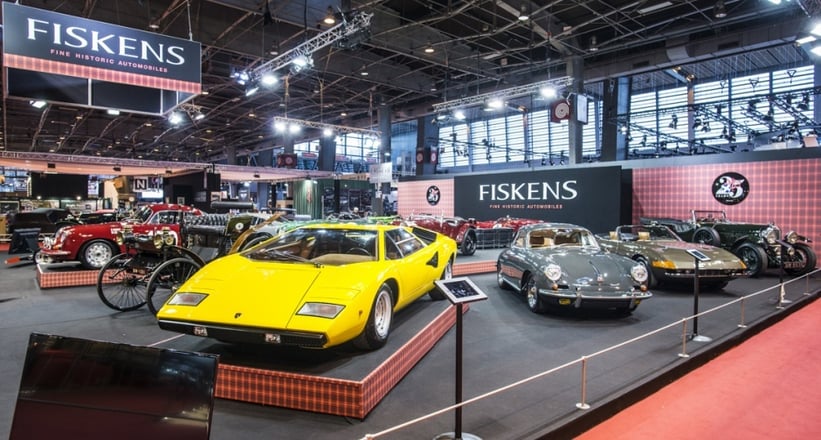
Slightly frayed red carpets, yellow-tinted spotlights, and the heady aroma of strong coffee, oil, and polished lacquer — Rétromobile in Paris might not be as, how can we say it, polished as other major events on the calendar, but that’s so much of the season-opening classic car extravaganza’s charm. In addition to numerous events, over 500 exhibitors will proudly display their wares, from classic cars to restoration services to must-have collectibles.

76th Goodwood Members’ Meeting, 17–18 March


With fewer passes available than any other Goodwood event, the Members’ Meeting has become more of an exclusive party for enthusiasts within the car world. For the historic racing fans, the event has plenty of competition, both on and off the track. With every attendee — from superstar to race driver to four-year-old — allocated to a house, everyone has the chance to win for their home team.

Tour Auto 2000 Optic, 23–28 April


Organised by Peter Auto, the 27th edition of the Tour Auto will bring together more than 230 classic cars for five days of racing along French roads and circuits. Beloved by all in the classic car world, from enthusiasts to dealers to historians, the start will be at the Grand Palais in Paris, as is tradition, but the circuits, final destination, and stage towns have yet to be revealed. Honouring Italian marques that are no longer produced, spectators along the route this year are sure to witness a spectacular sight.

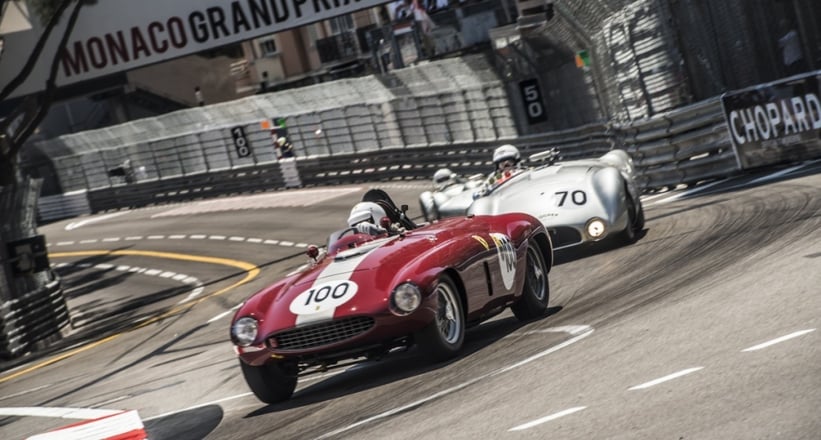
Grand Prix de Monaco Historique, 11–13 May


It’s said that there’s no greater thrill (or challenge) in contemporary motorsport than tackling the Monaco Grand Prix circuit in a competition car — watching it from the balcony of the Fairmont Hotel is a close second. Traditionally held biennially and two weeks before the modern F1 Grand Prix at the same locale, the Grand Prix de Monaco Historique sees the classic car world descend on the glamorous principality, at the invitation of the Automobile Club de Monaco (ACM), for some high-speed historic racing.

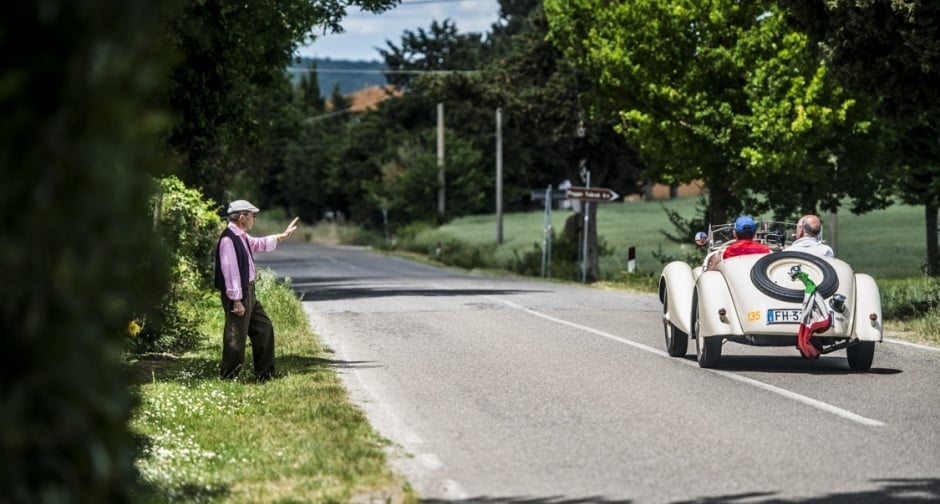
Mille Miglia, 16–19 May

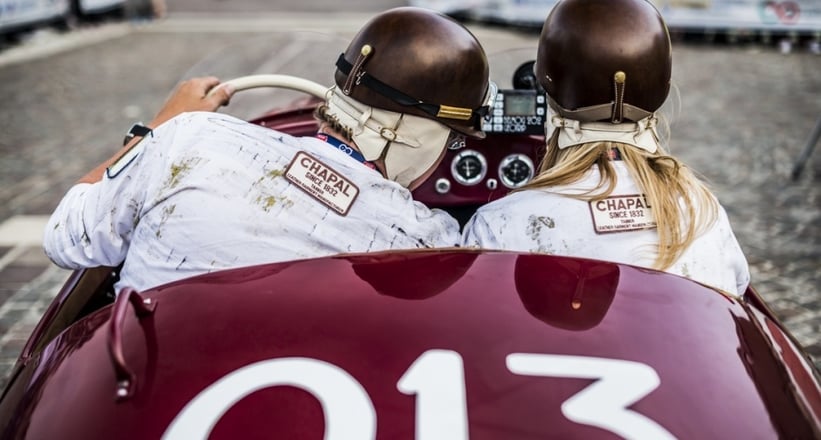
Celebrating its 91st anniversary and 36th modern edition this year, the legendary Mille Miglia is perhaps the only race in the world that unites not only classic car collectors and enthusiasts but also communities, as villages and cities along the route turn out to cheer on the competitors. This year will see over 450 entrants gather together to prepare for an unforgettable four-day, 1,000-mile journey throughout the beautiful Italian landscape. It’s a true test of stamina and endurance for both man and machine.

Concorso d'Eleganza Villa d'Este, 25–17 May


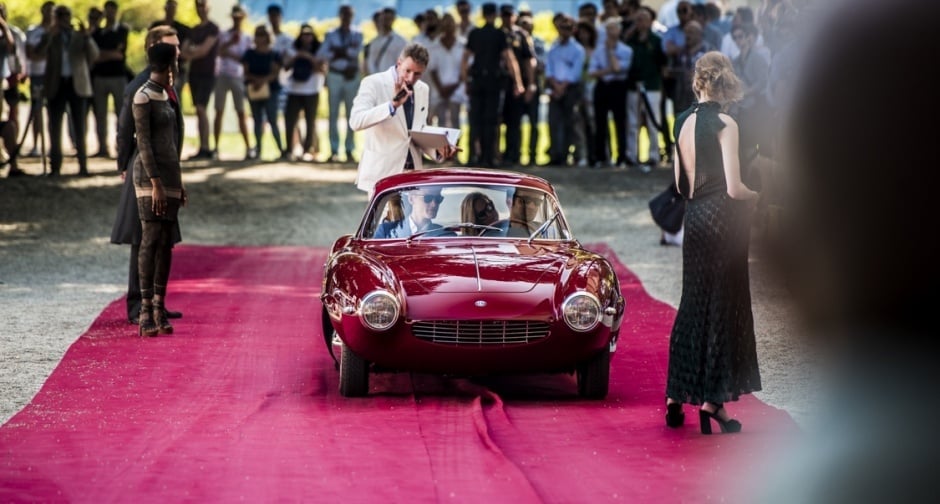
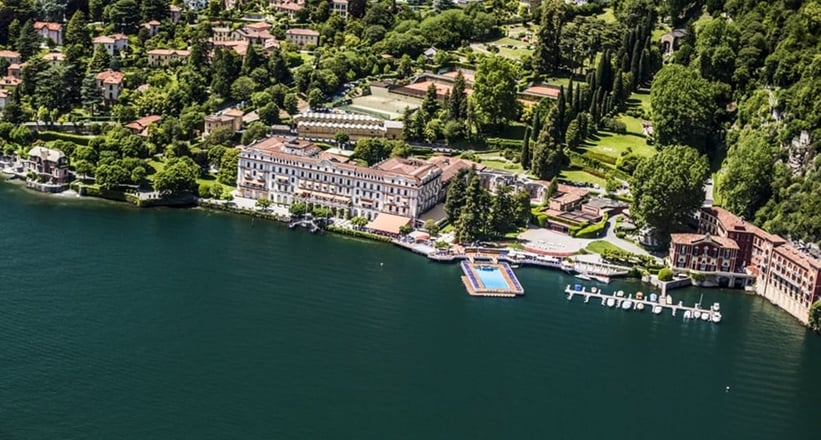
Once a year, the most beautiful and elegant classic automobiles assemble on the terrace of the Grand Hotel Villa d’Este on Lake Como. Sensual car bodies sparkle in the sun, Rivas rock gently on the waves, suave gentlemen and elegant ladies in light clothes stroll through the grounds — the Concorso d’Eleganza is, above all, a feast for the eyes. And yet, despite all La Grande Bellazza, it’s the eccentric stories and exalted tales that bounce around your head long after you’ve left the bubble of elegance.

Le Mans Classic, 6–8 July


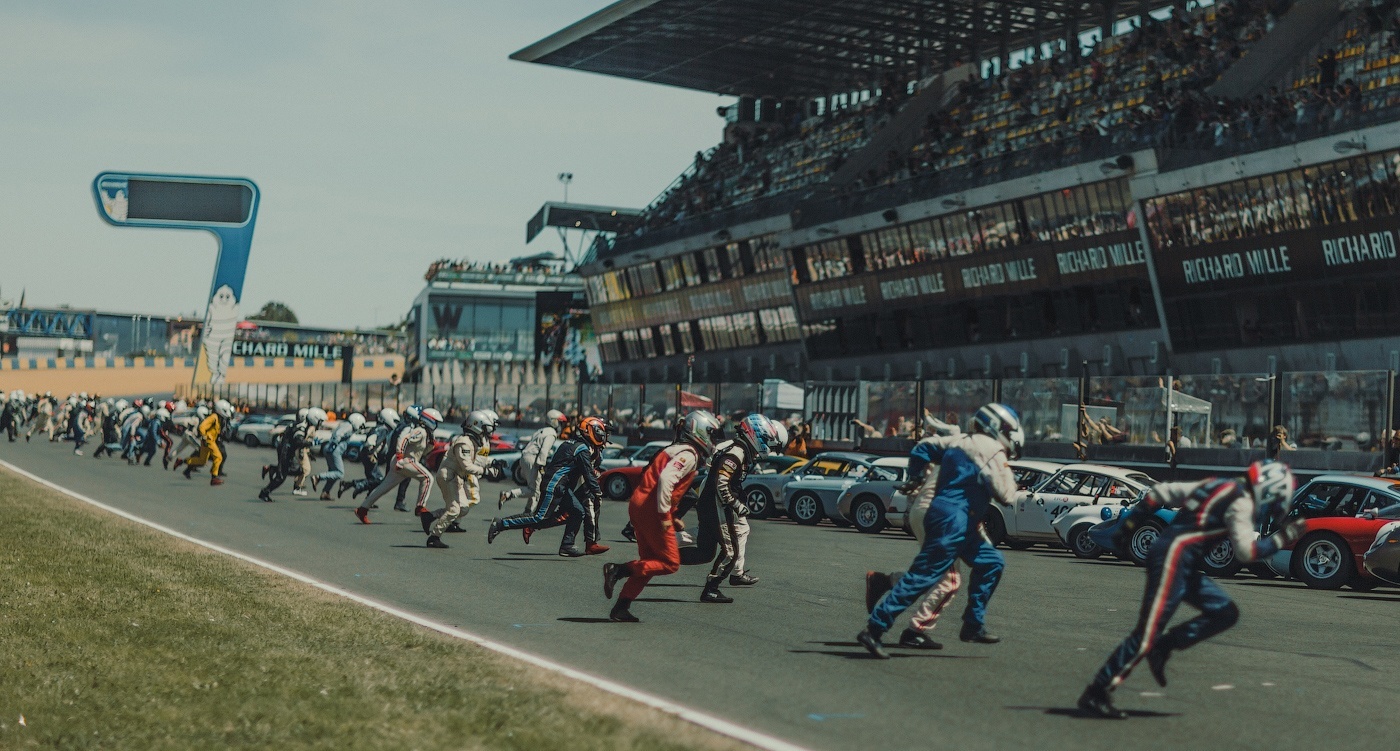
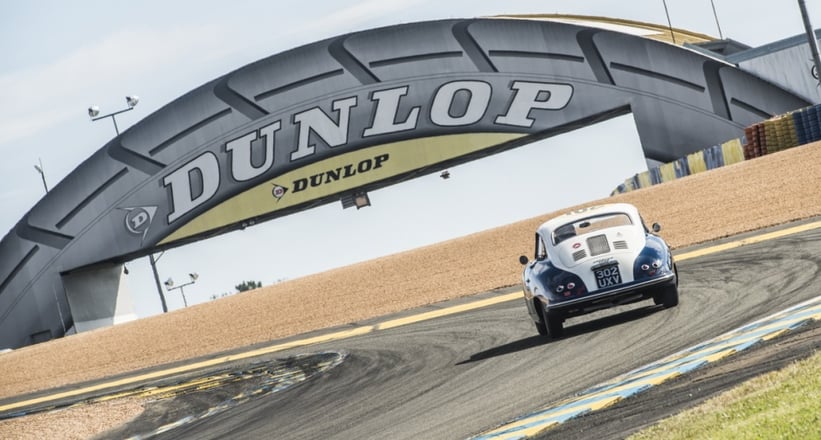
Distinctly French in flavour, steeped in history, and a vicious assault on the senses, the Le Mans Classic is the most special event in the historic motorsport calendar. Taking place every two years, the anticipation and excitement for this year’s event has been building since the summer of 2016. With over 700 historic racing cars competing day and night on the historic Circuit de la Sarthe, the retrospective always exceeds expectations.

Monterey Classic Car Week, 20–26 August


Monterey Classic Car Week is a jam-packed event, with something fun and exciting occurring every day. Although usually held on the third week of August, the event has been moved back one week this year, as the United States Amateur Championship returns to Pebble Beach the week prior. As a result, the Pebble Beach Concours d'Elegance will be held on 26 August and the Rolex Monterey Motorsports Reunion at Mazda Raceway Laguna Seca will be moved to 23–26 August.

Goodwood Revival, 7–9 September


Now in its 21st year, most of us are seasoned veterans of the event and put on airs as if we know exactly what to expect, but every year, as we cross the grounds of the Goodwood Estate and enter the vintage fun fair that is the Revival, we’re always left in awe at the magic laid before us by Lord March and his team. From the vintage outfits and delectable food to the Spitfires flying overhead and, of course, the historic racing on track, the Goodwood Revival never disappoints.

Porsche Rennsport Reunion, 27–30 September


Every three years, Porsche holds the Rennsport Reunion, the world’s largest gathering of Porsche race cars, drivers, engineers, and designers. Hosted by Porsche Cars North America and comprised of four days of on-track competition and a concours d’elegance, even the most casual of Porsche fans won’t want to miss this event, held at the Mazda Raceway Laguna Seca.

Photos: Rémi Dargegen, Peter Aylward, and Stefan Bogner for Classic Driver © 2017

We here at l'art et l'automobile encourage you to seek out and participate in events like these, especially when you come to our Social Media Channels and tell us all about them.  Make Sure to like, comment and share us on Facebook, Tweet us on Twitter, post photos on Instagram or Read the rest of the blog below.  


Jacques Vaucher
Owner and Curator
l'art et l'automobile