Showing posts with label History. Show all posts

Thursday, January 24, 2019

24 Hours of Daytona

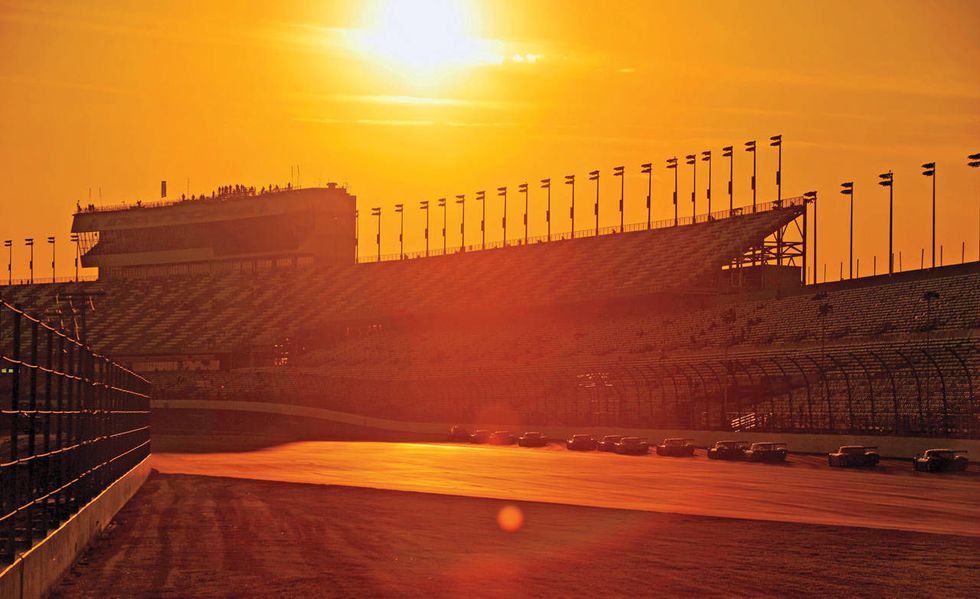
The Sun Sets on Daytona International Speedway, the setting for the Rolex 24 at Daytona


A Short history of a long race.


BY SAM POSE


Dan Gurney had a 2-minute lead at Daytona when the engine blew in his Lotus 19. "I knew it was very close to the end of the race," Dan recalls, "so I put the clutch in and let the car roll up to the line, stopping a few feet short of it." The finish line was on a banked part of the track. "I stopped in the upper lane, next to the starter's stand. I even got out of the car for a moment—I don't know why. Then the starter began waving the checkered flag. I turned left and just coasted down the banking, across the line."

To win.

That unusual finish took place a half-century ago in the Daytona Continental, a forerunner to the 24-hour race first held four years later in 1966. The course was part banking, part infield road course—a configuration new to racing. Overnight, Daytona, Sebring and Le Mans became what was informally known as endurance racing's Triple Crown. It would be hard to conceive of three races whose ambience differed more. The 12 Hours of Sebring, in central Florida, was held amid the vacant hangars and rusting World War II bombers of a little-used airfield; Le Mans—the doyen of the three—combined extreme danger with the intoxicating beauty of a long twilight rush through the pastoral French countryside. Daytona was all about the banking. It was intended for stock cars, not the fragile long-distance racers, and it was brutal, pounding the suspensions and leaving the drivers feeling as if they had just been in the ring with Mike Tyson. Derek Bell, who won both Daytona and Le Mans, thought Daytona was tougher; the banking never let you rest.
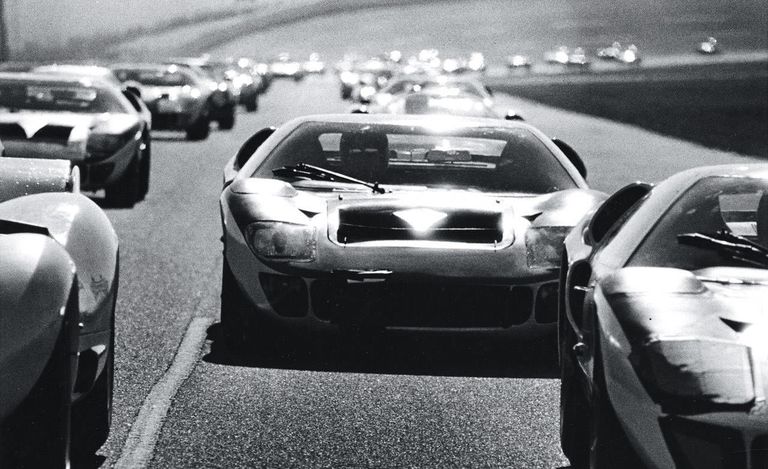
Ford GT40, photo courtesy of Road and Track


For one thing, you couldn't see where you were going. You looked left into the ground; right, and all you saw was the wall. Imagine racing inside a bowl: The road ahead didn't seem to curve but to climb; the impression was that you were always racing uphill. The big windshields of the NASCAR stockers allowed for good visibility, but in a 917 Porsche or a Ferrari 512, the knee-high roof blocked your view, so you scrunched down as best you could, craning your neck for a brief glimpse forward—many a driver ended his stint wracked with the pain of muscle cramps.

Only the middle two of the four lanes were usable, the bottom one too rough and the top, next to the wall, slippery with dust in the early hours, then with marbles as the race wore on. The idea was that cars in the slower classes would keep to the lower lane, leaving the high line for the fast boys, but out there on the banking, etiquette gave way to spur-of-the-moment expediency. Drivers of slow cars couldn't see behind them any better than those in the fast cars. When a Camaro, say, pulled out to pass, it would block the lane for a prototype bearing down on the scene with a closing rate of up to 70 mph. A split-second to decide: high or low? Nine out of 10 times it was too late to get on the brakes, and if you did there was the risk of losing control—the suspension settings were compromised, the flat infield turns calling for spring rates and ride heights that were the exact opposite of what you wanted for the banking. So there you were, the car crushed down onto the bumpstops, veering from lane to lane, centrifugal force pinning you in the seat and trying to drag your hands off the wheel, going 200 and unable to see much of anything—that was the banking experience. Oh, and for 10 hours, you got to do it in the night.
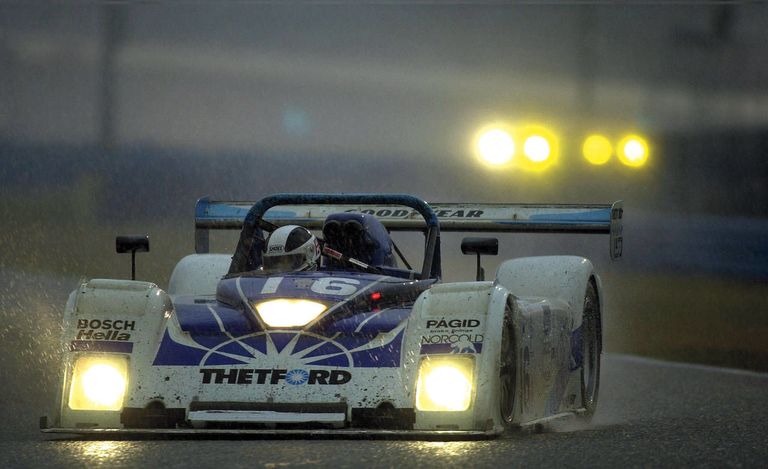

Dyson Riley & Scott Mk III, photo courtesy of Road and Track


The Daytona night is the longest in racing and often the coldest. Florida in February can be damp and freezing—parka weather. Along pit lane, crews jury-rigged plastic curtains to block the wind—in the daytime it looked like Shantytown, but at night it was quite beautiful, the translucent walls glowing in the dark. Inside the enclosures, men slumped on the concrete floor, fighting to stay awake.

The contrast between the stands packed with cheering NASCAR fans at the 500 and the same stands at night, empty except for a few fanatics frozen in place like lumps of coal, left no room for doubt as to the relative popularity of stock cars versus sports cars. The first year of the 24-hour race, Daytona's management sought to evoke the carnival atmosphere of Le Mans with a Ferris wheel, but although it revolved all night, its neon tubes bright yellow on the spokes, it failed to attract any customers—because there weren't any customers to attract. Attendance at Le Mans was close to 300,000; in those first years at Daytona the oft-repeated joke was that the drivers outnumbered the spectators.
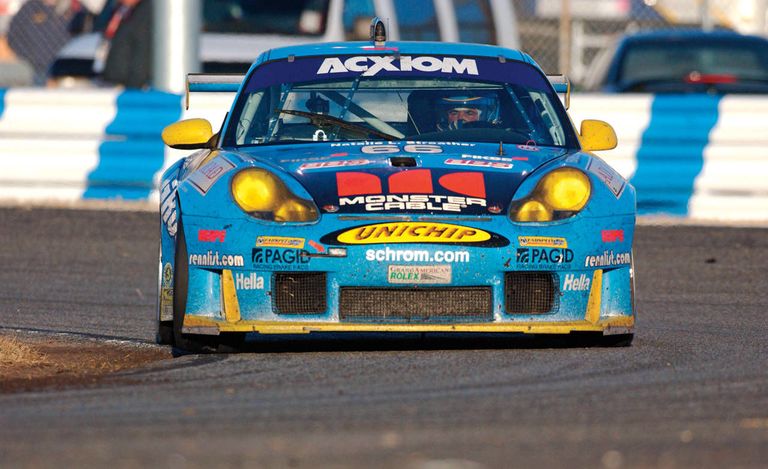

911 GT3 RS, photo courtesy of Road and Track


Despite the poor attendance, the race became an important fixture on the international calendar. There was the cachet of the name Daytona (even then the 500 was a big deal), plus 1966 was the height of the Ford versus Ferrari battle, which lent historical significance to the proceedings. Ford swept the 1966 race, with Ken Miles and Lloyd Ruby coming home first in a GT40 Mk II. The following year, Ferrari fought back, winning with their stunning 330 P4s. In 1968, Porsche scored the first of its record 22 wins, and 1969 saw Roger Penske's battered Lola—a victim of a crash on the banking—eke out a win. This was big-time racing, and Speedway President Bill France chose to absorb the losses at the gate in return for the international prestige.

I was in those races, and I actually looked forward to Daytona—especially when I got to drive a Ferrari for NART (Luigi Chinetti's North American Racing Team). True, every stint involved some lurid moment on the banking, and if you weren't on the banking you were scrabbling through the tight, utterly featureless corners of the infield portion of the lap, but it was a chance to race the top European Formula 1 drivers, who in those days also participated in sports car racing. Jackie Ickx, Pedro Rodríguez, Jo Siffert, Chris Amon, Lorenzo Bandini—these men were heroes to me, and somehow the suffering imposed by Daytona helped forge a bond with them, a sort of Brotherhood of the Banking.
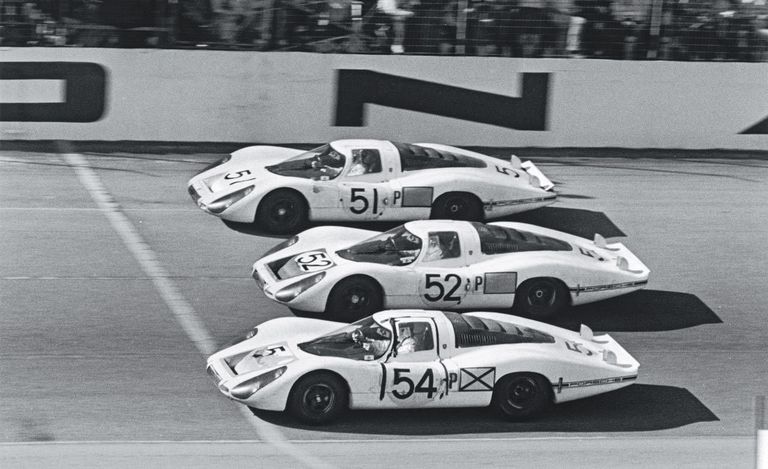

Porsche 907, photo courtesy of Road and Track

The epoch of the big 5-liter 917s and 512s ended with the 1971 season. The 1972 race, shortened to six hours, went to Ferrari's trim 3-liter sports racer—the last time the Ferrari factory would contest the race. The following year, 1973, saw a motley collection of sports racers upset by Peter Gregg's Porsche 911 RSR, which looked little different from the production 911s upon which it was based. Gregg was a brilliant but tightly wound Harvard grad who raced under the colors of Brumos Porsche, a dealership just up the road in Jacksonville. Peter's contacts at Weissach kept him a step ahead of the rest, but after the mighty prototypes and their swarms of engineers and mechanics, it was a letdown to see Daytona won by a car that looked as if it had just come from the showroom floor. Gregg's first victory was with Hurley Haywood, who would become the only driver to win Daytona five times. But it was Gregg, with four wins in five starts (including one for BMW), who defined an era—which ended with his suicide in 1980.

Through the 1980s, Porsche was the backbone of the race, and Daytona's prestige revived step by step as the German manufacturer supplied its many customers with ever faster cars—first the 935 and its derivatives, finally the superb Group C 962s, which were identical to the cars that were winning Le Mans. European aces such as Martin Brundle, Brian Redman and Rolf Stommelen filtered in along with Indy winners A.J. Foyt and Al Unser Jr. When Porsche finally had its fill of success, wins began going to such industry heavyweights as Jaguar, Nissan and Toyota, giving the race in the 1990s its second golden age. But only the factory-supported teams had a chance—the private teams were being driven out of the sport.
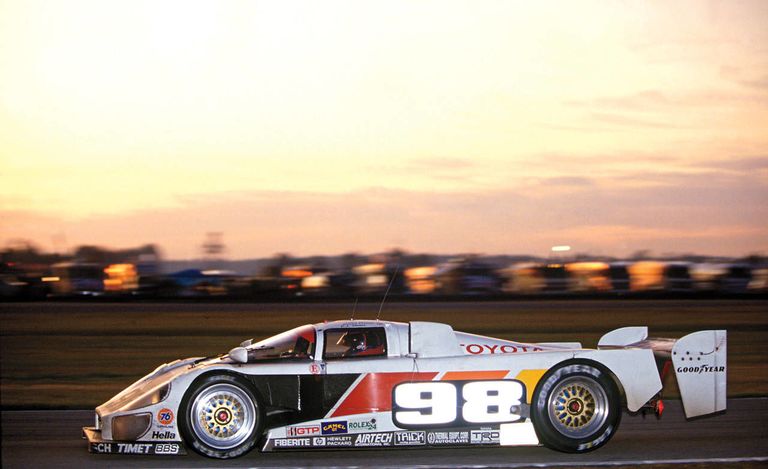

Dan Gurney's Eagle, photo courtesy of Road and Track


In 1999, the pressure for change was compelling enough to produce two new series, each backed by a man of great wealth and imagination. The American Le Mans Series, created by the inventor Don Panoz, established close ties with the French and adopted their rules. The other, sanctioned by the Grand American Road Racing Association, was the brainchild of Jim France. Jim was Bill France's son and part of the family's NASCAR dynasty, but he had a rogue gene: a passion for road racing. In 2000, Grand-Am took over Daytona's 24-hour classic and made it their marquee event. Both Panoz and France offered racing for prototypes and GT, but each took a different approach. Panoz's was caviar and champagne, while France's was burgers and beer.

Grand-Am promised NASCAR-style rules stability and rigid cost control—for example, no factory teams permitted and no in-season testing. The year 2003 saw the introduction of Daytona Prototype, a class with rules as tight as a spec series but open to a wide variety of engines, including Pontiac, Chevrolet, Lexus, Porsche and BMW. There were several chassis builders, too, of which Riley would become the most successful, winning at Daytona the last seven years. For safety and a better view of the banking, the rules mandated a bulbous greenhouse—and the big windshield, awkwardly mated to flat sides and a stubby nose, made for what most people agreed were ugly cars. But beauty is in the eye of the car owner, and the Daytona Prototype—and the prestigious series sponsor, Rolex, that went with it—was an attractive package. By 2006, 30 prototypes were on the grid for what was now called the Rolex 24. The GT cars did more than just fill out the fields; at first they were—embarrassingly—as fast as the new prototypes, forcing the organizers to invert the grid so as to have the prototypes up front at the start. A now-iconic Porsche 911 scored an upset victory, recalling the first win for Gregg and Haywood, exactly 30 years before.
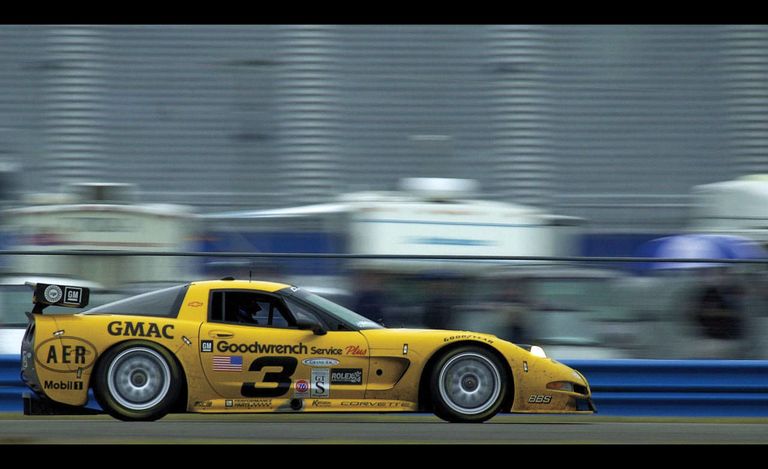

Dale Earnhardt's Corvette, photo courtesy of Road and Track


Back in the 1960s and '70s, teams consisted of two drivers; today, in both GT and prototype classes, four drivers is the norm: the team's two regulars plus a big name NASCAR hero such as Jimmie Johnson or Jeff Gordon...or an Indy winner like Sam Hornish Jr. or Dario Franchitti—and there's still a spot open for a guy who pays big bucks for his ride. In 1997, the Rob Dyson entry set some kind of record when they won using seven drivers—I understand they were lining up spectators for a turn at the wheel when, mercifully, the race ended. (Just kidding, Rob.) Chip Ganassi's cars have won four times, including 2011 with Joey Hand, Graham Rahal, Memo Rojas and Scott Pruett—a formidable quartet, as good as any at Le Mans. The win was Scott's fourth; another and he'll tie Haywood.

The next generation of the Daytona Prototype, dubbed DPG3, will go into action at the 2012 Rolex. Their bodies will be allowed to have what is being called "brand character." For example: Alex Gurney and Jon Fogarty run a Chevrolet engine, and under the new rules they will be allowed to have a body that suggests a Corvette. I have seen some artists' renderings of the new look, and it's good.
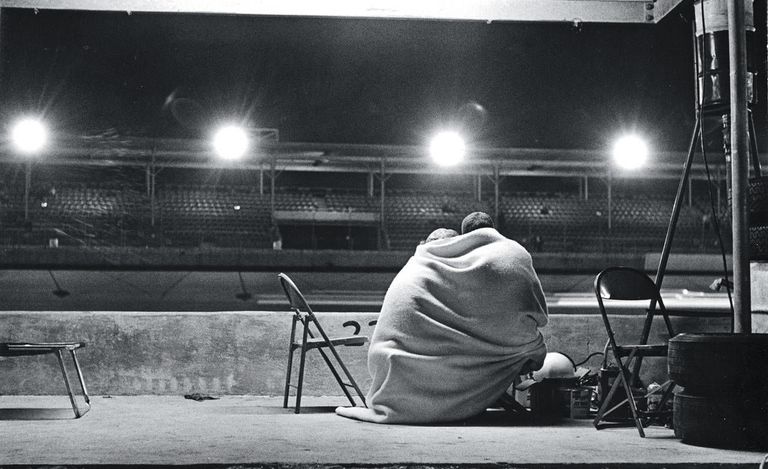

Daytona at night, photo courtesy of Road and Track


Also in the works is a series-within-the-series. The idea is to link Daytona to shorter events at Indianapolis (over the weekend of the Brickyard 400) and Watkins Glen (a France-owned track), re-creating—after 40 years—a second Triple Crown, complete with its own prize money and points system. Instead of Daytona-Sebring-Le Mans, it will be Daytona-Indy-The Glen. Exciting? I think so.

The heart of the new Triple Crown will, of course, be Daytona, now entering its second half-century and well into its third golden era. A chicane near the end of the long back straight was intended to reduce the risk on the banking, but it seems Daytona's essential character never changes: The curbing is temporary (so it can be removed for NASCAR races), and slower cars drop their wheels over it, scattering gravel into the racing line, leaving the drivers of the faster cars to wonder if they may have a slow puncture on their hands. As John Andretti, who won in 1989, put it: "They just replaced one hazard with another."

When I think of Daytona, I think of a race that extracts a toll on anyone who enters it, a race in which winning has never come easily. It seems oddly appropriate, then, that Dan Gurney won the first race by coasting silently across the line.

As you may know, the Rolex 24 at Daytona will be run this weekend, January 26th-27th, which with the running of the Daytona 500 the week before, signals the start of Motor Racing Season.  We here at l’art et l’automobile have been waiting as patiently as possible for racing season to start again, which admittedly has not been very patient, and Formula E just isn’t cutting it. That’s why we’re celebrating the beginning of the Racing Season, and in order to extend our celebrations to you, we have gathered all of our Daytona and Endurance Racing Artwork, Collectibles and Memorabilia and are presenting them to you. Please head over to our website and tour the Gallery and perhaps you can find an item that will assist in your celebration of the beginning of the Motorsports Season.

Enjoy the race and the season,

Jacques Vaucher

Remember we have a wide variety of items in our gallery, so do not hesitate to contact us if you are looking for something in particular.

And as always, be sure to Like and Share on Facebook, Follow us on Twitter, share a photo on Instagram and read our Newsfeed.

Thursday, December 20, 2018

How Fast is the Fastest?

History: December 18, 1898: First Land Speed Record Ever, In an Electric Car!


By MAJOR DAN edited by James Karthauser


The first vehicle to ever turn a wheel in France was powered by electricity and
the mind of engineer Charles Jeantaud. Photo Courtesey of The Right Reasons


A Brief History


On December 18, 1898, French race car driver Gaston de Chassaloup-Laubat set the first recognized World Record for Land Speed at an unimpressive 63.13 kilometers per hour (39.25 mph). (Note: For Land Speed Record we are referring to human steered vehicles powered by a motor of some type, and not considering bicycles or horseback riding.)


Digging Deeper


Gaston was driving a Jeantaud electric car for his record run, and at that time when automobiles were in their infancy it was not yet clear which means of propulsion would become preeminent, whether gasoline, electric, steam or diesel powered motors.

Over the next couple years Gaston and his arch rival Camille Janatzy would trade the record status back and forth in an ever increasing raising of the bar. When Janatzy set a new record in 1899 as the first man to drive a car over 100 kph (62 mph) the record stood for a whopping 3 years (105 kph/65 mph). Also in 1899, “Mile a Minute” Murphy rode a human powered bicycle over a 1 mile course in 57 seconds, over 60mph! (The current bicycle speed record is 167 mph.)

The record setting Jeantaud electric car was a chain drive primitive affair that produced only 36 horsepower. Steering was done with a vertical stick that was attached to history‘s first known steering wheel, when other cars were steered with a tiller. The car was rebuilt and won back the land speed record 2 more times, for a distinguished career of having set the Land Speed Record 3 times in all. In fact, the first 5 times the record was set it would be in electric cars, before steam powered cars eclipsed the electrics and finally gasoline powered cars became king of the hill.

The record attempt would first come to the United States in 1904 when Henry Ford drove one of his early creations to the record setting performance, this time on frozen Lake St. Clair near Detroit. By 1927, almost every Land Speed World Record set was accomplished in the United States, though not always by Americans. The current record is held by the Thrust SSC, a jet powered car, at a supersonic 763 mph, set in 1997. (Note: The Ford 999 was powered by an 18.9 liter/ 1150 cubic inch 4 cylinder engine!)


Designer Stefan Marjoram took on the ambitious project of creating a massive poster commemorating
and comparing history's official land-speed record holders. Photo Courtesy of Autoblog.com

What is the fastest you have ever driven a car? The fastest you have ever been in a car driven by someone else? Feel free to share your high speed stories.

We here at l'art et l'automobile have an extraordinary appreciation and yearning for acceleration and velocity.  A need for speed, if you will.  We also appreciate the historical achievements of the daredevils who risk it all on an ever expanding quest for maximum velocity, and of the artists who capture these men and moments rendered in paint or sculpture.  You can find a myriad of Artwork, Sculpture, Collectibles and Memorabilia depicting the pursuit of Acceleration in our Gallery, here at arteauto.com.  Perhaps there you can find something that will satisfy your Need for Speed.  
Cheers, 

Jacques Vaucher

Remember we have a wide variety of items in our gallery, so do not hesitate to contact us if you are looking for something in particular.

And as always, be sure to Like and Share on Facebook, Follow us on Twitter, share a photo on Instagram and read our Blogs.

Thursday, December 13, 2018

From moonshiners to millionaires

A Plymouth Superbird, one of the original aero-cars.  Courtesy of Snaplap


A look inside NASCAR history


by George Sugarcane, edited by James Karthauser


Though NASCAR of today is the American national motorsport, its earliest days were not as magnificent and romantic as those in Europe where car races attracted the blue-blooded and the otherwise rich. In the beginning, NASCAR was closely entangled with one clear, highly flammable and potentially poisonous liquid. And no, it’s not gasoline, but moonshine, whiskey’s unaged, unlicensed and frowned-upon cousin.

To understand NASCAR’s beginnings, we must travel back to 1920, when Eighteenth Amendment went into effect, prohibiting the use, production, importation and transportation of alcohol beverages. In the South, though, prohibition didn’t end in 1933; production and distribution of liquor were legal, the taxes were extremely high, so spirits were not affordable to the majority of Southerners.


NASCAR racing was far different from what we see today.  Courtesy of Snaplap
NASCAR racing was far different from what we see today. Courtesy of Snaplap


From moonshining to racing on weekends


With that in mind, local distilleries turned to the production of moonshine and young guys who were in charge of its transportation were the pioneering drivers of NASCAR. Their task was to outrun and outsmart the police while thundering through the backwoods, delivering liquor to the bars all the way from Louisiana to Virginia.

All that one driver needed to become a transporter was calmness, bravery, good knowledge of the terrain and a cheap car with a potent motor that was hard enough to handle the unpaved, bumpy and muddy Southern roads.

The choice was obvious: the 1940 Ford Deluxe Coupé; a cheap, small and durable two door automobile with the famous Flathead V8 engine producing up to 100 horsepower, a short wheelbase that could ensure sharp turning and a decent trunk for all that moonshine.

As soon as the police started upping their game, the dangers of moonshining suddenly became even greater and drivers were often arrested, serving prison sentences instead of racing during the weekends. To continue operating, both distillers and drivers had to resort to various modifications to ensure that their cars were still getting to the bars faster than the police.


Roy Hall standing to a typical moonshiner car turned stock racer.  Courtesy of Snaplap
Roy Hall standing to a typical moonshiner car turned stock racer.  Courtesy of Snaplap


Staying ahead of the law with upgrades


The earliest upgrades were of course all about horsepower and they later went as far as installing huge Cadillac engines. Very soon, they became even more ingenious, like brakes which could enable cars to corner even more swiftly by stopping just one side of the car, or switches that could turn off rear lights in the dark. That way, the moonshiner counterculture gave birth to the American hot rod.


Crash at a Daytona Beach race, one of the early NASCAR races.  Courtesy of Snaplap
Crash at a Daytona Beach race, one of the early NASCAR races.  Courtesy of Snaplap


NASCAR Series was founded as the governing body for dirt oval races


The greatest proof of driver’s quality was his freedom, but drivers soon found the need to distinguish themselves from their other moonshining colleagues. So, dirt oval races were the best weekend past-time and a chance to earn some extra money. The races quickly started gaining popularity both with the moonshiners and the crowds, and many races were organized throughout the South, often without any clear rules and highly variable prize money given away by shady promoters.

One of the guys that drove around the ovals was William Bill France, a D.C. racer and mechanic who moved to Florida. He felt the need to organize the sport and after a driver meeting in December of 1947 at the Streamline Hotel in Daytona Beach, the National Association for Stock Car Auto Racing, better known as NASCAR, was born. That way, the sandy beach in Florida became the home of NASCAR.


Early NASCAR races looked nothing like today.  Courtesy of Snaplap
Early NASCAR races looked nothing like today.  Courtesy of Snaplap


NASCAR history is written by moonshiners


The first NASCAR sanctioned race took place on Daytona Beach on February 15, 1948, while the first Strictly Stock race was held on June 19, 1949, in North Carolina, at the Charlotte Speedway. The first main series champion was Red Byron.

With NASCAR as the organizing body came the first sponsors, and the prizes were getting bigger, but the best drivers still held onto their perilous jobs in Southern backwoods. The pay of a moonshiner was still higher than the prize of a NASCAR race winner, so many ambitious racers still risked their freedom, often missing races because they served jail sentences.

The practice stretched all the way to the fifties, despite the fact that NASCAR was already an established organization. NASCAR legend and six-time Winston Cup owners’ championship winner Junior Johnson was a second generation moonshiner himself, and he is the most successful bootlegger-turned-racer. As he once stated, all the best racers on the dirt ovals were, in fact, moonshiners.


Junior Johnson, The Last American Hero.  Courtesy of Snaplap
Junior Johnson, The Last American Hero.  Courtesy of Snaplap


At first, the cars were strictly stock, but NASCAR Series allowed modifications through history


Very quickly, little Flathead Fords weren’t fast or agile enough to outrun the more-and-more powerful police cars, so, many moonshiners started switching to bigger cars with stronger V8 engines. That trend was mirrored on the tracks as well, where both the drivers and the racing fans benefited from the booming automotive industry. Full-size two door sedans were soon dominating the tracks, and one of the most iconic cars of that era was Hudson Hornet.

Driven by Marshall Teague, Herb Thomas and several other drivers including the Fonty Brothers, The Fabulous Hudson Hornet dominated the NASCAR ovals with 13 wins in 1951, 49 in 1952, and 46 in 1953.

The only early NASCAR requirement for entering the cars was that it had to be sold to the general public, and that’s how many strange cars ended up racing the ovals. With Detroit producing more and more powerful engines, the speed threshold was getting higher, so the cars started getting their first rulebook aftermarket modifications, mainly to improve durability and safety.


The Fabulous Hudson Hornet was perhaps the first legendary car of NASCAR.  Courtesy of Snaplap
The Fabulous Hudson Hornet was perhaps the first legendary car of NASCAR.  Courtesy of Snaplap


Aero Warriors, the most extreme cars of the 1960 and 1970 seasons


With the stakes being risen higher and higher, the oval race cars soon became mere platforms and bodyshells upon which various improvements were made. That moment occurred in 1966 when Holman Moody grafted a Ford Galaxie onto a Ford Fairlane. The following step was welding a tubular frame onto the Fairlane unibody, and the move was emulated by Petty’s team as well. That started the trend which evolved into a highly regulated platform system we know today.

The next big NASCAR moment came with the closer involvement of Detroit’s automotive companies which started purpose-building homologation vehicles for Grand National series. The most extreme evolution in the early NASCAR years was reflected in the so-called Aero Warriors, four heavily modified muscle cars with extreme aerodynamics built for the 1960 and 1970 seasons. Mopar built two of them, Dodge Charger Daytona and Plymouth Superbird while the other two came from Ford Motor Company: Ford Torino Talladega and Mercury Cyclone Spoiler II.


Aero Warriors: Four vehicles that revolutionized NASCAR.  Courtesy of Snaplap
Aero Warriors: Four vehicles that revolutionized NASCAR.  Courtesy of Snaplap


Building cars for NASCAR

By the late eighties, the cars stopped being specifically made for NASCAR by Detroit’s Big Three, and cars gradually became simple, highly modified bodyshells with visual cues taken from the current production models. The cars’ mechanics of the newest generations stock cars have been purpose-built and developed for NASCAR with no homologation needed to enter the competition.

One of the biggest upsets in NASCAR came in the 2000s when Toyota joined the series. So far, Toyota hasn’t won any manufacturers’ championships, but the 2015 Sprint Cup champion Kyle Busch drove a NASCAR Toyota Camry to the championship victory.


Kyle Busch drove a Toyota Camry to victory in 2015.  Courtesy of Snaplap
Kyle Busch drove a Toyota Camry to victory in 2015.  Courtesy of Snaplap


The tracks have evolved from dirt ovals to monumental stadiums


The first NASCAR-based track was the Darlington Raceway, an egg-shaped track built by Harold Brasington and the first asphalt track to host the NASCAR event in 1950.

After Darlington, many more speedways followed, but the birthplace of NASCAR had to wait for its asphalt track until 1959 when Daytona International Speedway was opened. The track was built by Charles Moneypenny and NASCAR founder Bill France, and the inaugural race at the new track was held on February 22, 1959. The winner of the race was Lee Petty, father of Richard Petty, who later became known as The King of NASCAR and seven-time Daytona 500 winner. Ever since that February in 1959, it has been the season-opening NASCAR event.

Year by year, stock racing became more and more popular. As the prohibition was finally over in the South, moonshiners could become professional racers with decent pays provided by growing sponsor pools and crowd-packed speedway grandstands.


The first Daytona 500, 1959.  Courtesy of Snaplap
The first Daytona 500, 1959.  Courtesy of Snaplap


Sponsors came and went, but the France family was always in charge of NASCAR


The main NASCAR series had several name changes from 1949 to today. At first, it was named Strictly Stock Series but changed its name to Grand National Series in 1950.

The name stuck until the first big sponsor came in 1971. It was R. J. Reynolds Tobacco Company who got the naming rights and the series became known as Winston Cup from 1971 to 2003. The longtime sponsorship ended with the wireless provider Nextel buying the naming rights for the 2004 season, renaming the NASCAR series to Nextel Cup. Nextel was acquired by Sprint Corporation in 2005, but the series was renamed Sprint Cup in 2008.


Bill France started the dynasty of NASCAR CEOs.  Courtesy of Snaplap
Bill France started the dynasty of NASCAR CEOs.  Courtesy of Snaplap


Changes in NASCAR ownership, tracks, and point system


In 1969, Bill France Sr. opened the Lincoln, Alabama-based Alabama International Motor Speedway, or as it’s best known, the Talladega Superspeedway. The track was longer and faster than the Daytona International Speedway and since its opening, Talladega has been among the most popular NASCAR venues.

One of the biggest NASCAR milestones was in 1972, the second year of Winston Cup era, when dirt tracks fell out from the schedule (although the last main series dirt event was held two years earlier, on September 30, 1970, and was won by Richard Petty), which marked the beginning of modern NASCAR.

In 1974, Bill France Senior passed the baton to his oldest son Bill France Junior. The new CEO commissioned Bob Latford to design a new point system, with equal points awarded for all races no matter their prize money or duration. The newly developed point system ensured that drivers had to run all the races to become champions, and it was used without change from 1975 until the Chase was instituted for the 2004 Nextel Cup season.

The France family is still in charge of NASCAR, with Bill’s son Brian France as its CEO since 2003, after a short presidency of Mike Helton, who was put in charge by Bill France Jr. after he was diagnosed with cancer in 2000 and resigned the position.

Video : the infamous 1979 Daytona 500 finish


The day that put NASCAR in the spotlight


However, the big breakthrough had to wait until the 1979 Daytona 500, the first flag-to-flag covered NASCAR race. A brawl between Cale Yarborough, Bobby and Donnie Allison that followed the end of the race crash really put NASCAR in the spotlight. That event was the defining moment in NASCAR history, drawing national attention to what would become the most popular American motorsport series.

The race winner was the six-time champion Richard Petty who claimed his seventh NASCAR main series title by the end of 1979, a record unmatched until 1994 by the late Dale Earnhardt. NASCAR’s popularity has significantly risen in the early and mid-nineties, which coincided with the demise of IndyCar.

The most popular drivers of the era, if not ever, were Dale Earnhardt and Jeff Gordon, two of the most accomplished racers besides Richard Petty. In the mid-2000s, NASCAR’s popularity started stagnating and slowly declining, but the new generations of drivers keep it alive, interesting and very well watched.


Jeff Gordon and Dale Earnhardt, NASCAR legends.  Courtesy of Snaplap
Jeff Gordon and Dale Earnhardt, NASCAR legends.  Courtesy of Snaplap


Continuing the legend of the American motorsport


NASCAR’s rise to national and international fame is the definitive automotive rags-to-riches story. It proves that all you really need to succeed are the people ready to drive the hell out of dirt ovals and the rumble of V8 engines to capture the ears and hearts of the rapidly expanding crowds. Simple, yet exciting as it is, NASCAR stock racing was, is, and forever will be the bona fide American motorsport and one of defining American sports in general.


Season-opening NASCAR race in its full glory.  Courtesy of Snaplap
Season-opening NASCAR race in its full glory.  Courtesy of Snaplap

We here at l'art et l'automobile have an unrivaled passion for motorsports and the art and memorabilia that celebrates motorsports.  So of course we look forward to the beginning of NASCAR season, and celebrate the history and adventure of NASCAR's creation, especially when the spirit moves us.  Wink wink.  Our hope is that you will celebrate with us and in that spirit, we wish to present our collection of NASCAR Artwork, Collectibles and Memorabilia.  Click here to read more about it.

Happy Holidays Race Fans,

Jacques Vaucher

For more great automotive memorabilia, don't forget to browse the many other categories on our Website. Remember we also have many more items in our gallery, do not hesitate to contact us if you are looking for something in particular.

And as always, be sure to Like and Share on Facebook, Follow us on Twitter, share a photo on Instagram and read our Blogs.

Thursday, December 6, 2018

Speed Lines by Porsche Panorama

The Final Targa print by Nicholas Watts, Autographed by Gijs Van Lennep

Delivering a fleeting moment in time at a very particular place.


By Michael Jordan, with addition from Jacques Vaucher


When you look at the work of Nicholas Watts, you once again realize that painters have a unique vision of every scene, and this gives them the ability to portray their work in a way that a photographer simply cannot.

To be sure, Watts has a deep respect for automotive machinery, and like a photographer, his realistic images give you a picture of what the cars really look like. Yet painting also gives him the opportunity to put the cars in context, capturing a moment in time that includes not only other cars but also the place where it happened. Through his paintings, Watts is able to tell the story that underlies the speed.

Carrera Panamericana 1952 print by Nicholas Watts, Autographed by Karl Kling, available at l'art et l'automobile.
Carrera Panamericana 1952 print by Nicholas Watts, Autographed by Karl Kling,
available at l'art et l'automobile.


Nicholas Watts is another British boy of the 1950s who grew up fascinated by cars. The fact that he lived practically within earshot of the Brands Hatch racing circuit inevitably drew him to motorsport. He started out as a draftsman at Vauxhall, which perhaps accounts for his ability to make the cars look right. He later went into the Royal Air Force as a specialist in navigation systems, which might have something to do with his dedication to making sure the details are correct. Working with both gouache on board and acrylic on canvas over the past 40 years, Watts has created an astonishing number of paintings and prints, and they cover an equally astonishing range of motorsport disciplines.

Raging Bulls giclee by Nicholas Watts, autographed, available at l'art et l'automobile.
Raging Bulls giclee by Nicholas Watts, autographed, available at l'art et l'automobile.


In this particular painting, we see the Martini-sponsored Porsche 911 RSR 2.8 that wild man Herbert Müller and Le Mans-winner Gijs van Lennep drove to a win at the Targa Florio in 1973, the last year that this race over the mountain roads of Sicily was included in the sports car world championship. Watts gives us a scene that juxtaposes the speed of the high-tech Porsche with the slow pace of a rustic Sicilian town. The proximity of the spectators shows us the spe- cial enthusiasm that always accompanied this event, as well as the danger that nally ended it.

Le Mans 1954 print by Nicholas Watts, autographed by 5 drivers, available at l'art et l'automobile.

The work of Nicholas Watts is available from many sources, a measure of both its enduring popularity and its relative affordability. We recommend l’art et l’automobile (arteauto.com), Jacques Vaucher’s legendary outlet for automotive art and collectibles. Vaucher has been in the eld since 1975, and he virtually invented the business in the U.S. Most important, Vaucher has a personal relationship with the artists he represents, and his ongoing blog is an entertaining window on the personalities in the eld.

Grand Prix of Japan 1976 acrylic painting by Nicholas Watts, available at l'art et l'automobile.


Richard Baron, Panorama’s creative director, notes, “Like Walter Gotschke and Michael Turner, Nicholas Watts is at the center of the great tradition of automotive art. His realistic style and unique perspectives have made things possible for younger automotive artists— photographers as well as painters.”

Many thanks to Porsche Panorama for Highlighting Nicholas Watts and his talent, as well as the mention of us and our website.

At l’art et l’automobile we have a deep appreciation for the artistry of vintage automobiles, but particularly for the artwork that celebrates them. Nicholas Watts is at the forefront of this sense of dedication to capturing the automotive world through the lens of paint and canvas. To celebrate this fact, we have collected all our pieces by this wonderful artist and present them to you. Find out more about this collection here or enjoy looking through the gallery at arteauto.com, and perhaps add a piece to your collection.

Jacques Vaucher

For more great automotive memorabilia, don't forget to browse the many other categories on our Website. Remember we also have many more items in our gallery, do not hesitate to contact us if you are looking for something in particular.

And as always, be sure to Like and Share on Facebook, Follow us on Twitter, share a photo on Instagram and read our Blogs.

Thursday, November 29, 2018

Ford's Assembly Line Turns 105: How It Really Put the World on Wheels


It was this innovation—not the Model T itself—that cemented the automobile's future.


Originally Published April 2013 by Tony Swan, edited by James Karthauser


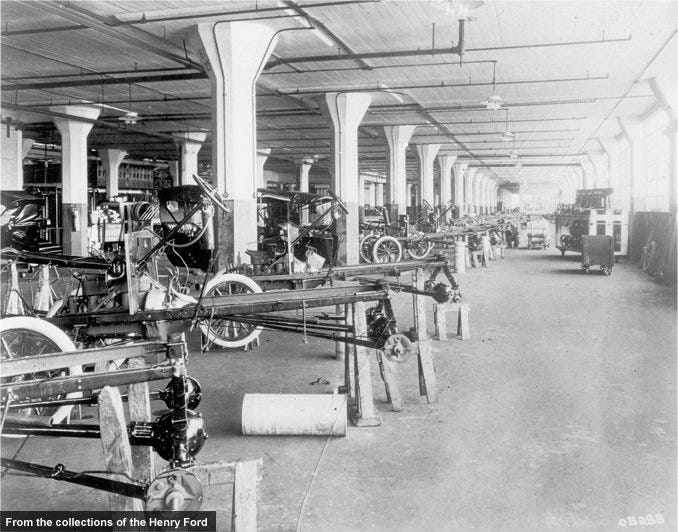
Before the advent of the moving assembly line, Ford and other automakers used variations of the station-build approach. Rather than the car coming to individual workers, a team of workers came to the car. Ford produced Model Ts in this manner for three years at its new Highland Park plant before adopting the assembly line.
Before the advent of the moving assembly line, Ford and other automakers used variations of the
station-build approach. Rather than the car coming to individual workers, a team of workers came
to the car. Ford produced Model Ts in this manner for three years at its new Highland Park plant
before adopting the assembly line.  Photo courtesy of Aaron Kiley


When modern drivers think about the Ford Model T—if they think about it at all—they perhaps dimly perceive it as the car that changed the world. That is correct, of course, as far as it goes. But this month, the Ford Motor Company is quietly commemorating a T-related centennial that was the true source of that seismic shift in mobility: the automotive assembly line. The Model T just happened to be the product it was used to build.

Indeed, the innovations could very well have been made by some other company and involved some other car. But in April 1913, led by production boss Charlie “Cast Iron” Sorensen, Ford began taking its first tentative steps toward a moving line that used conveyor belts to stream components past workers who performed one or two tasks each. This pioneering manufacturing process made automobiles affordable to just about anyone and became the template for the entire industry.

Prior to 1913, Ford and virtually every other automaker assembled whole cars at a station with a team of workers working together to complete a single example, usually from start to finish. Like other companies, Ford had made numerous refinements to the process, achieving impressive production totals at the Piquette Avenue plant where the Model T was born in October 1908.

When deciding to implement the assembly line, neither Sorensen nor Henry Ford nor anyone else involved had the benefit of time-motion studies. They simply reasoned that moving the component at a fixed rate past each station would reduce the number of workers required to build the cars, reduce the time required for assembly, increase volume, and allow the company to control the pace.

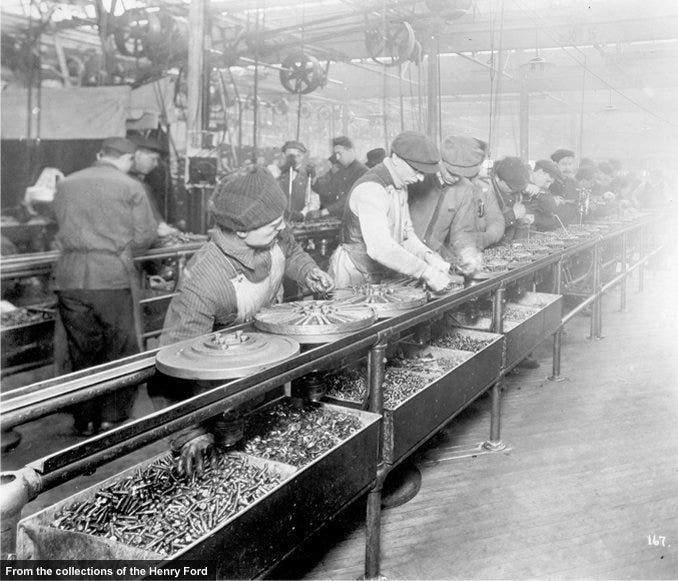
The guinea pig was the T’s magneto, a component that supplied ignition energy to the engine before generators became common. A complex and innovative component that was one of the early Model T’s technological advantages, Ford’s magneto was integrated with the engine’s flywheel and involved many pieces. Under the old system, each magneto was assembled by one worker. On average, that worker could assemble 35 of them in a nine-hour shift, or roughly one every 15 minutes.

After some tinkering with the line rate and other factors, Sorensen and his cohorts achieved results that were probably startling even to them. Starting with 29 workers performing 29 different tasks, the experiment reduced assembly time by about seven minutes per unit. And with more refinements, Sorensen was able to reduce the magneto-line workforce to 14 and cut assembly time to five minutes.

Ford’s transition to moving assembly lines began in April 1913 with the integrated (and complex) flywheel/magneto. With each worker assigned to complete a few specific tasks rather than build the entire unit, Ford reduced magneto assembly time from about 15 minutes to 5, and the required workforce decreased from 29 to 14.
Ford’s transition to moving assembly lines began in April 1913 with the integrated (and complex)
flywheel/magneto. With each worker assigned to complete a few specific tasks rather than build
the entire unit, Ford reduced magneto assembly time from about 15 minutes to 5, and the required
workforce decreased from 29 to 14.  Photo courtesy of Aaron Kiley

FULL SPEED AHEAD


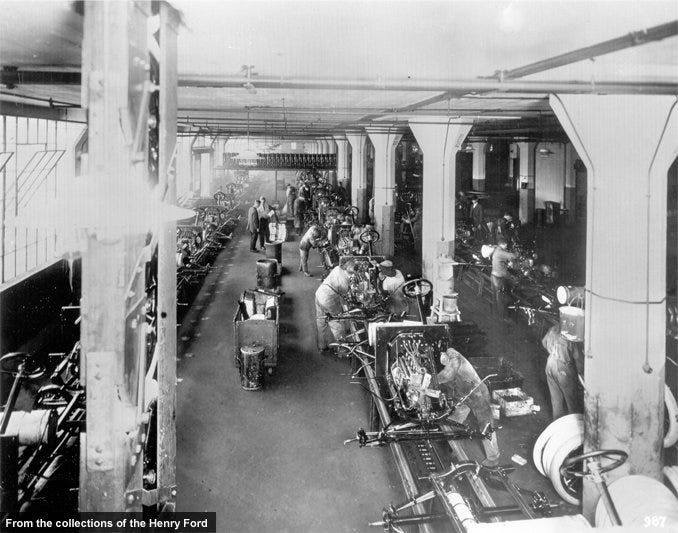
It didn’t take long for Sorensen to apply the moving-line principle to all aspects of Model T production. Engine assembly time was cut from almost 10 hours to less than four. The team tackled chassis assembly in August and quickly cut completion time from 12 hours to six. It was down to slightly less than three hours by October, then to 2.3 in December.

By October, Ford’s vast plant in Highland Park, Michigan, was a maze of conveyors, powered drive belts, overhead traveling cranes, and hundreds of machine tools. Moving assembly went into full swing. And the efficiencies established on a small scale with the magneto line translated directly to total production, which exploded.

Four years prior, while construction crews were at work on the gigantic Highland Park facility, the Piquette work teams assembled 10,660 Model Ts, keeping Ford atop the manufacturing standings ahead of Buick. In Highland Park’s immense spaces, production for 1910 rose to 19,050, despite various hiccups associated with settling into the new facility. By 1912, output was up to 68,773.

But those numbers were dwarfed by the results of the moving assembly line. The process netted 170,211 examples in 1913, 202,667 in 1914, well over half a million in 1916, and 735,020 in 1917. All U.S. industrial output was down in 1918, a casualty of the final year of World War I, as well as the economic downturn that followed in its wake. But the market rebounded in 1920, and Model T production topped one million cars for the first time, at 1,301,067. Output peaked at 2,011,125 in 1923, followed by almost two million units in 1924 and ’25 before demand finally began to tail off.

Verging on obsolescence and dowdy compared with many competitors, the T finally went out of production on May 26, 1927. Although final tallies vary, the generally accepted total stands at just over 15 million built.

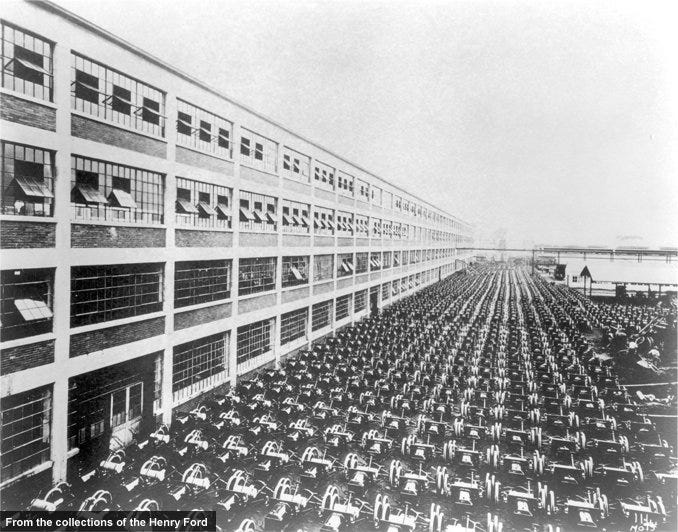
Even as Ford’s moving assembly line was still in its infancy, Model T production was ramping up exponentially. This August 1913 photo shows 1000 completed chassis at the Highland Park plant—one day’s production. By 1916, the plant was cranking out 2000 per day. And in 1926, the factory hit an all-time high with 9000 in one day.
Even as Ford’s moving assembly line was still in its infancy, Model T production was ramping
up exponentially. This August 1913 photo shows 1000 completed chassis at the Highland Park
plant—one day’s production. By 1916, the plant was cranking out 2000 per day. And in 1926, the
factory hit an all-time high with 9000 in one day. Photo courtesy of Aaron Kiley

THE PAYOFF


Henry Ford’s much publicized Model T mission was to “build a car for the great multitude,” and the key to the quest was economies of scale, making the car affordable to as many potential customers as possible.

When the car made its debut, it was innovative, simple, rugged, and easily repaired by owners with even modest mechanical skills. But it wasn’t exactly cheap: $825 for a basic Runabout, the least expensive model, and $850 for the five-passenger Touring version. The pricing didn’t include extras such as a top or side curtains and actually increased to $900 and $950 for 1910.

But as production numbers soared, the prices went down. Ford charged $600 in 1913 for a Touring T, $440 in 1915, and $360 in 1917. Pricing bottomed out at $290 for a 1925 Touring model (the Runabout cost $30 less) and ramped up slightly in the last year and a half of the Model T’s long life.

The assembly innovations at Highland Park did not go unnoticed. The multiple buildings of Ford’s big facility regularly welcomed visitors, and it wasn’t long before competitors began adopting the techniques developed there. So by the end of the Model T’s 19-year run, it was fair to say that Ford really had put the world on wheels.


Chassis construction was the final step in Ford’s transition from static to moving assembly. This 1914 photo shows in-progress chassis on the line. The moving lines cut the Model T's final assembly time in half, from 12 hours to six. Continual adjustments and refinements kept reducing final assembly time until nearly four more hours were saved.
Chassis construction was the final step in Ford’s transition from static to moving assembly. This 1914
photo shows in-progress chassis on the line. The moving lines cut the Model T's final assembly time
in half, from 12 hours to six. Continual adjustments and refinements kept reducing final assembly time
until nearly four more hours were saved. Photo courtesy of Aaron Kiley


THE $5 DAY AND SOCIAL CHANGE


One of the more noteworthy chapters in the moving-assembly story was Ford’s announcement on January 5, 1914, that the company was increasing its wage rate to $5 per eight-hour workday—more than double the existing rate for the then-standard nine-hour day.

Ford was already racking up huge profits, and the new policy could be interpreted as altruistic, although other automakers received the news with clenched jaws. There was open speculation that Henry was only aiming to ensure that his workers could afford to buy the products they were assembling.

But Ford’s motives were far more pragmatic. Assembly-line work—performing the same tasks every day for long hours at a stretch—was mind-numbingly dull, and the company found itself beset with unacceptable turnover in its labor pool. In 1913, for example, Ford was forced to hire more than 52,000 workers to sustain a workforce of about 14,000.

There were strings attached to that $5 bill. The basic wage was $2.34. To qualify for the additional $2.66, a worker had to meet company standards for clean living, including sobriety, no gambling, thrift, and a happy home environment. Ford actually formed a sociological department whose staff members visited homes to assess workers’ worthiness for the full five bucks.

That policy would provoke torch-bearing mobs and militant picket lines today, but it was acceptable in 1914 and produced dramatic reductions in absenteeism and turnover. Moreover, the $5 day attracted job seekers from all over the country, particularly the South, permanently changing the demographics of Detroit.

Other changes were even more profound. The availability of an affordable, durable automobile put the dream of unlimited personal mobility within reach of a broad swath of society, setting the stage for the rise of the suburbs and the establishment of a national highway network. Automobiles were no longer a novelty when the Model T made its first appearance, but they were far from universal. By the time the last T left the line, the automobile was fully integrated into everyday life, and the world would never be the same.

The tedium of moving-assembly-line work proved to be more than many employees could tolerate. Massive turnover prompted Ford to announce the celebrated $5 workday in January 1914. The $5 day, roughly double existing wages, attracted workers from all over the country. Here, an estimated 10,000 applicants brave early January weather in hopes of employment.
The tedium of moving-assembly-line work proved to be more than many employees could
tolerate. Massive turnover prompted Ford to announce the celebrated $5 workday in January
1914. The $5 day, roughly double existing wages, attracted workers from all over the country.
Here, an estimated 10,000 applicants brave early January weather in hopes of employment.
Photo courtesy of Aaron Kiley


Model T Myths


The Model T moving assembly was Henry Ford’s idea. Not really. As production honcho Charlie Sorensen observed in his memoirs, “Henry Ford is generally regarded as the father of mass production. He was not. He was the sponsor of it. Mr. Ford had nothing to do with originating, planning, and carrying out the assembly line. He encouraged the work. His vision to try unorthodox methods was an example to us.”

All Model Ts were black. Not true. The “any color you want, as long as it’s black” ethic began in 1913. Folklore says the black color was a Japanese lacquer chosen for its fast-drying properties. Also not true. The black paint was cheaper and more durable. Ford restored colors to the Model T palette in 1926.

The Model T was all-new. Not quite. It was innovative and included the extensive use of vanadium steel, which was stronger and lighter than ordinary steel; an integrated flywheel/magneto; and a monoblock four-cylinder engine with a removable cylinder head. It was also lightweight, at about 1200 pounds. But for all that, it was an evolution of the highly successful Model N (1906–08).

1913 – Ford Highland Park Plant- First Moving Assembly Line, Photo courtesy of Western Slope Auto.com
1913 – Ford Highland Park Plant- First Moving Assembly Line,
Photo courtesy of Western Slope Auto.com


The Model T never changed. Wrong. Ford made a number of mechanical and cosmetic running changes to the T over the years, including the introduction of safety glass in 1926, an industry first. But the Model T failed to change in key ways. It retained its two-speed planetary transmission long after competitors were offering three-speed gearboxes with shift levers, the cooling system was via thermosyphon (meaning no water pump), and electric starting wasn’t even an option until 1919.

The Model T was hard to drive. Quite the opposite. Compared with other cars of the day, it was easy once a driver acquired minimal skill in advancing or retarding the spark. The hard part was cranking the T’s engine to life. It was prone to backfires, accounting for a good many fractured limbs over the years. For more, check out our feature "How to Drive a Model T."

We here at l'art et l'automobile have a passion for how the legendary automobiles of the past were envisioned, designed and built, just as intense as our passion for how they are celebrated and rendered into art and memorabilia.  We would like to honor Ford's monumental achievement, bring the automobile to the mainstream consumer through the use of the assembly line, by sharing a little history on the subject, that will hopefully enlighten you just a little bit more on the amazing history of our shared love; the automobile.  

Cheers and Happy Holidays, 

Jacques Vaucher

Remember, this week we are hosting our Special 12 days of Christmas Online Auction, which opens for bidding December 1st at 12pm (noon) and Closes at noon on December 13th.  This Auction contains many exciting, recently acquired pieces of Artwork, Memorabilia and Collectibles that would be perfect for filling your stockings or going under your tree this Holiday Season.  Viewing has already begun at arteautoauction.com, so you definitely don't be a Grinch or you might get scrooged out of these amazing items.  


Also, for great automotive artwork and memorabilia, don't forget to browse the many categories on our WEBSITE. Remember we also have many more items in our gallery, do not hesitate to contact us if you are looking for something in particular. Also be sure to check out our Newsfeed, which has details on our collection of Ford Artwork, and Memorabilia.

And as always, be sure to Like and Share on Facebook, Follow us on Twitter, or share a photo on Instagram.  

Thursday, November 1, 2018

The Dangerous Life of Juan Manuel Fangio


They Call Him 'El Maestro' for a Reason


article courtesy of Grandprixhistory.org, with excerpts from Erik Shilling of Jalopnik,
edited by James Karthauser


Stories about Juan Manuel Fangio, the one of the greatest Formula One drivers ever, are pretty well-trod at this point—there’s the famous 1957 German Grand Prix win, the fact that he was in his forties in his prime, the fact that he won 24 of the 51 grands prix he competed in. Less talked about is just how terrifying those races were.

Affectionately known as "bandy legs" by his many fans, Juan Manuel Fangio was born in Balcarce, Argentina the son of an Italian immigrant in 1911. After military service he opened his own garage and would race in local events. These "local" events were not the weekend meetings that occur all over England but long-distance races held over mostly dirt roads up and down South America. Fangio's first race at eighteen was in a Ford taxi. One particular race, which he won in 1940, the Gran Premio del Norte was almost 10,000 kilometres long. This race between Buenos Aires, up through the Andes to Lima, Peru and back again took nearly two weeks with stages held each day. No mechanics were allowed and any repairs would have to be completed by either the driver or co-driver at the end of each stage. Following many successes driving all makes of American modified stock cars; Fangio was sponsored by the government and sent to Europe to continue his career after the end of World War II. It was not until 1949 at the age of 37 that he achieved regular success on the European circuit. In 1950 he was given a drive at Alfa Romeo. Battling with his teammate Nino Farina he ended up in second place but the die had been cast.

The next year Fangio won the first of his five titles. 1952 saw him suffer his first major accident, at Monza, when he broke his neck and had to miss the rest of the season. The accident may have been caused by a promise Fangio had made to take part at the race in Monza after his race in Budapest. Because he missed the connecting flight he had to drive himself the whole night from Paris to Monza. Only half an hour before the race began he arrived and took up his starting position completely overtired. He had promised to race at Monza following a race in Belfast but due to missed connections he found himself driving all night from Paris only to arrive at the circuit one half hour prior to the race. Having to start from the back of the grid he made a rare mistake and the Maserati he was driving went into a big slide. Being extremely tired his reactions were not what they would normally have been and he could not regain control of the car before it hit an earthen bank and somersaulted in the air. Fangio was thrown out and would spend the next few hours hovering near death. The following year he returned at the wheel of a Maserati and finished the season in second place. Fangio always made it his policy to garner the loyalty of the team mechanics. He told them that they would receive ten percent of any winnings. During practice for the Italian Grand Prix he complained of a severe vibration but come race day the problem had completely disappeared. The mechanics had switched cars in the middle of the night and given Fangio's vibrating car to his teammate Bonetto.

In 1954 he moved to the Mercedes team and won his second World Championship. Fangio drove twelve Grands Prix for Mercedes winning eight times. This began a string of four straight titles. In 1955 he won a particularly brutal race at the Argentine Grand Prix. The three-hour race was run during a grueling heat wave. With a track temperature of over 135º few drivers other than Fangio were able to complete the race.

In 1957 the championship arrived at the German Grand Prix at the Nurburgring where it was generally acknowledge by the Grand Prix Circus that this would be Fangio's last season. He was determined to finish on top. Fangio and Hawthorn qualified one-two and the race looked set for an epic battle. The Maserati 250F Fangio drove in that German Grand Prix win made 270 horsepower from its six-cylinder, or enough to go nearly as fast as modern race cars (in a straight line, at least.) What was different was the downforce, tires, and brakes. The car produced little to no downforce, had far inferior brakes, and had tires that were as grippy as an ice cube.  Fangio started the race on half tanks and it was incumbent on him to build a large enough margin that would allow him to pit yet retained his lead. This he started to do, blistering the track at a record pace but Hawthorn and Collins in the Ferraris had other ideas. On the twelfth lap Fangio dove into the pits.

Even though everyone in the Maserati pits was prepared, the pit stop cost Fangio the lead when both Collins and Hawthorn thundered past. Finally the work was done and Fangio re-entered the fray. All seamed loss as Fangio was now 45 seconds behind the leading duo and few thought that even the great Fangio could make up this difference. Fangio was one of the few as he began chopping off large chunks of the gap to the leaders. In the Ferrari pit panic took hold as they pleaded for their drivers to go ever faster. Fangio would later say that he drove faster than he ever wanted to drive again. The lap record came tumbling down and he would soon be lapping at a faster average speed than that with which he had qualified! Both Collins and Hawthorn continued to race at a furious pace. Peter Lewis, the famous British journalist said that "he (Fangio) might almost have been pulling them backwards on the end of a rope for on the twentieth lap Fangio sliced eleven seconds off their lead. Fangio caught Collins first and passed him on the inside but the Englishman returned the favor and pushed Fangio back into third." The second time Fangio drew alongside and then slowly drew away. Just the Collins was hit in the eye by a stone thrown up by the Maserati's rear wheel but was saved by his goggles. Now it was Hawthorn's turn and still Fangio came on; actually driving straight on in one corner to force his way past Hawthorn. They would finish three seconds apart with Collins coming in third. The victory gave Fangio an unassailable lead in what would become his fifth and final World Championship.


So ended the maestro's greatest race. The Legendary racer had set nine lap records in his quest for victory, including seven in successive laps.  He said afterward that he had “conquered” the ‘Ring, and that the experience on the whole was absolutely terrifying.
“Even now, these many years later, I can feel fear when I think of that race,” he said. “Only I knew what I had done, the chances I had taken.
“The Nurburgring, you know, was always my favourite circuit, without any doubt. I loved it, all of it, and I think that day I conquered it. On another day, it might have conquered me, who knows? But I believe that day I took myself and the car to the limit - and perhaps a little bit more. I had never driven like that before, and I knew I never would again.”
Fangio had clinched the driver’s championship at the ‘Ring, and would only race four more F1 grands prix.

In 1958, driving his last race, the French Grand Prix he finished fourth and retired. His Maserati was not competitive that day and was about to be lapped by the race leader Mike Hawthorn. As a mark of respect for the great man known as "the maestro" by his peers Hawthorn braked and allowed Fangio to cross the line ahead of him. Getting out of the car after the race he said to his mechanic simply, "It is finished." Juan-Manuel Fangio was famous for winning a race at the slowest possible speed. His record of wins against starts will probably never be matched. 


Many consider Juan Manuel Fangio to be the greatest driver of all time. Several highly successful later drivers, such as Jim Clark, Alain Prost, Ayrton Senna and Michael Schumacher, have been compared with Fangio, however the qualities required for success, levels of competition, and racing rules have changed over time. His record of five World Championship titles stood for 45 years before German driver Michael Schumacher surpassed it in 2003. In his home country of Argentina, Fangio is revered as one of the greatest sportsmen the nation has ever produced. He lived until he was 84, but his memory and achievements live on, probaably embodied best by this quote:
You must always strive to be the best, but you must never believe that you are.
—Juan Manuel Fangio
At l'art et l'automobile, we follow racing, whether it be Formula, Indy or Le Mans, almost as if it were a religion.  And if one man were to be sanctified in the Church of Speed, it would be St. Fangio.   To celebrate a the life of El Maestro, we have gathered a selection of our Fangio Artwork and Memorabilia and are presenting them here to you.  Enjoy looking through the collection and tell us which ones you would like to own. Please Tour the gallery at arteauto.com, and perhaps add a piece to your collection.

All our best from the staff at l’art et l’automobile,

Jacques Vaucher

For more great automotive artwork and memorabilia, don't forget to browse the many other categories on our WEBSITE. Remember we also have many more items in our gallery, do not hesitate to contact us if you are looking for something in particular.

And as always, be sure to Like and Share on Facebook, Follow us on Twitter, or share a photo on Instagram.

Thursday, October 18, 2018

U.S. Grand Prix and Formula 1

Formula 1 returns to the United States at the Circuit of the Americas


After decades of trying, Formula One may finally be growing in America


written by Sophie Bearman and Mike Larson, edited by James Karthauser


For over 70 years, Formula One has been a premier global sport, with opulent, multi-day races held in countries across the world.

Formula One’s events are wildly popular — everywhere, that is, except for the United States. But that could be changing sooner than most think.

European roots


Italian racer Giuseppe Farina wins the world’s first Formula One Grand Prix in 1950. Photo courtesy of CNBC


Since its founding, Formula One has been an international organization.

The first world championship was held in 1950 at Silverstone in the United Kingdom. The winning driver, Italian racer Giuseppe Farina, drove a supercharged Alfa Romeo in front of 120,000 cheering spectators — including England’s reigning monarch, King George VI.

That European race set the stage for Formula One’s global presence, excluding America.

Headwinds in America


Formula One has a storied history in the United States. Mario Andretti sat on the pole for his first F1 start at Watkins Glen in 1968
Formula One has a storied history in the United States. Mario Andretti sat on the pole for his first
 F1 start at Watkins Glen in 1968. Photo By Lat Photographic

Logistically, it’s hard to be a Formula One fan in America. Most of the races take place in Europe, so watching live events often means waking up at the crack of dawn. The U.S. also has its own motor sports to watch like IndyCar and NASCAR, which has been around since the 1940s.

Peter Habicht is the founder of Formula One's largest fan group in America, located in San Francisco. The group has about 2,500 members.

“We have a difficult time following a lot of the European races because they go on at about five in the morning, so it’s a challenging proposition to get a group together, usually at a sports bar, to watch a live start of a race,” said Habicht.

Unlike basketball or football, Formula One racing provides very few American drivers to cheer on: The last American to win a race was Mario Andretti, and that was at the Dutch Grand Prix in 1978.

“The sport, under prior stewardship, began to move wherever the money was the highest," said Leo Hindery, InterMedia Partners managing partner and a former race car driver.

"And that left Formula One in places like Kuala Lumpur, Malaysia, Bahrain, Abu Dhabi, Singapore, Shanghai, none of which is bad for the sport except for in the process of doing that, they neglected to maintain a footprint here in the United States,” said Hindery, a Formula One promoter.

In 2005, the U.S. Grand Prix didn't turn out as Formula One might have hoped. Media reports at the time called it a disaster. At the very last minute, fourteen cars were forced to withdraw due to safety concerns. Most fans left the event feeling disappointed and cheated of their money. The race they’d come to see didn’t deliver.

“It was a low point, for sure, in American Formula One history,” said Habicht.

Improving relations with the US


Ayrton Senna leads the field at the United States Grand Prix at Phoenix in 1989.
Ayrton Senna leads the field at the United States Grand Prix at Phoenix in 1989. Photo By Lat Photographic


Still, the future of Formula One in America may be getting brighter. Competitor NASCAR has had an undeniably rough few years, which could be a boon for Formula One. More importantly, Formula One has had a significant change in leadership: In early 2017, it was acquired by Liberty Media, a U.S. company, for $8 billion.

Formula One’s new CEO, Chase Carey, has high hopes for the sport in America, telling CNBC at the time of the acquisition that he wanted to make the races feel more like Super Bowl events with mobile content, and behind-the-scenes access available for fans.

“Put an organization in place that lets us make these events everything they can be, reaches out across digital media that we're not connecting to today [and] build a marketing organization that connects to fans [and] enables fans to connect to the sport,” said Carey.

One year later and expansion in America is already happening: a new Miami street circuit Grand Prix will be added to the calendar in 2019. The race would be in addition to the U.S. Grand Prix. Hindery predicted there will be a race in the Northeast, possibly New Jersey, within the next two to three years as well.

America's untapped market


Fans greet racer Lewis Hamilton of Mercedes and Great Britain during the United States Formula One Grand Prix in 2017.
Fans greet racer Lewis Hamilton of Mercedes and Great Britain during the United States Formula One
Grand Prix in 2017.  Photo courtesy of CNBC

There’s a lot of money to be gained from ticket sales, advertisers and sponsors in America. U.S. consumers shelled out $56 billion to attend sporting events in 2016, according to a study by CreditCards.com.

“You have 325 million people in the United States which, just in sheer numbers, is an audience you shouldn’t leave behind,” explained Hindery.

Formula One could use the economic boost. In 2012, FinanceAsia, a Hong Kong-based financial news publication, reported Formula One's valuation was $9.1 billion. That means over the four-year period between that valuation and the subsequent $8 billion purchase, it lost 12 percent of its value.

However, it’s not a sure thing that Formula One will catch on in the States. U.S. Grand Prix attendance fell in 2017 by 4.4 percent from the year prior. And there are no American drivers racing in Formula One this year.

But if there’s ever a time for Formula One to capture America’s hearts, it’s now. With NASCAR struggling and new American F1 leadership, it’s possible the pastime can make a permanent mark on U.S. soil.

U.S. Grand Prix history review as Austin prepares for Formula One


Stirling Moss at the 1960 United States Grand Prix at Riverside.
Stirling Moss at the 1960 United States Grand Prix at Riverside. Photo By Lat Photographic


On Sunday October 22nd, Formula 1 returns to the U.S. for the first time with the U.S. Grand Prix in Austin, Texas, at the brand new, world-class race track, the Circuit of the Americas.  Having resumed Formula 1 racing in 2007, bringing the sport back to the U.S. for the first time since 2007 at Indianapolis Motor Speedway, this race should be an enormous boon to the push for the sport in America.

Although F1 has had a long and at times troubled relationship with the American market, the sport also has a rich history here. Since 1950, the U.S. has hosted 62 F1 events, including races at Watkins Glen, Sebring, the streets of Detroit and several others. As some F1 fans prepare to head to Austin while others plan to watch the U.S. Grand Prix on television, here's a quick recap of F1 racing's American history.

1950-1960—Indianapolis 500: OK, technically this was not a traditional Formula One race, let alone a road-course race. But 11 times from 1950-1960, the Indianapolis 500 counted as a round of the world championship, with points scored at Indy adding to F1 drivers' season tally.

1959—Sebring: In 1959, the U.S. hosted two F1 races for the first time. In addition to the Indy 500, F1 added the United States Grand Prix to its schedule. The race, held at Sebring International Raceway in Florida, was the ninth and final round of the 1959 season.

1960—Riverside: In 1960, the United States Grand Prix moved from Sebring to the famous—and today much missed—Riverside International Raceway in Riverside, Calif. Promoters had a difficult time drumming up interest for the Sebring race the previous year, and had similar problems with the Riverside race. It wasn't until the following year when F1 moved to Watkins Glen International in upstate New York that American fans started to embrace Grand Prix racing.

1961-1980—Watkins Glen: After running the United States Grand Prix at two different venues in 1959 and 1960, the event finally found a somewhat permanent home in 1961. Originally, Daytona International Speedway was supposed to host the 1961 event, but an agreement couldn't be made. In the end, F1 went to Watkins Glen, where it remained for almost 20 years.

1976-1983—Long Beach: After a 16-year hiatus, F1 returned to the West Coast in 1976. Dubbed the United States Grand Prix West, the race found a home in Long Beach for seven seasons. The Long Beach races also marked the first time a city street circuit was used in the U.S., and the event is credited with having a major impact on turning the city around and increasing its desirability as a place to live. Of course, when F1 left after the 1983 race, Long Beach continued to host the CART World Series, and today hosts the Izod IndyCar Series and American Le Mans Series. But it was F1 that started the city's ongoing affair with auto racing.

1981-1982—Las Vegas: F1 left Watkins Glen after the 1980 running of the United States Grand Prix. The U.S. did continue to host the final race of the F1 season, but in Las Vegas. For two seasons, F1 participated in the Caesars Palace Grand Prix, which featured a surprisingly decent—if rather flat—track layout in the parking lot of the famous Las Vegas hotel. When F1 did not return to Las Vegas, the CART World Series added the race to its schedule in 1983 and 1984.

1982-1988—Detroit: The year 1982 marked the first and only time that three F1 races have appeared in the United States during a single season. In addition to races in Long Beach and Las Vegas, downtown Detroit hosted its own street race. The circuit was bumpy—no surprise to Michigan drivers—tight and demanding. Alas, F1 could not come to an agreement with the host city for 1989, whereupon CART once again added Detroit to its schedule.

1984—Dallas: Although this weekend's U.S. Grand Prix marks F1's first visit to Austin, the series is no stranger to Texas. In 1984, Fair Park in Dallas was converted to an F1 circuit to host the Dallas Grand Prix. The race turned out to be a one-off event, and it was plagued when high ambient temperatures caused the track surface to break apart. Drivers said it was the roughest circuit they had encountered, and the race was a significant physical challenge for the Grand Prix aces. Keke Rosberg won the race, but Nigel Mansell put on a memorable show by hitting a wall on the final lap, coming to a stop and attempting to push his car over the finish line. Instead he collapsed, exhausted by the heat on the rough circuit.

1989-1991—Phoenix: After the final race in Detroit in 1988, F1 wanted a new venue. It came down to either Laguna Seca in California and the streets of Phoenix, and Phoenix got the nod. From 1989-1991, the United States Grand Prix found its home in Arizona, and the first event, held in June, roasted drivers and spectators with temperatures exceeding 100 degrees. The organizers learned a lesson; Phoenix's next two races were held in March.

1992-1999—Hiatus: There were no F1 races held in the U.S. during this time period, and some began to wonder if the sport would ever return. And then along came Indianapolis . . .

The 2007 United States Grand Prix at Indianapolis Motor Speedway. Photo By Lat Photographic


2000-2007—Indianapolis: After a nine-year absence, F1 came back to the U.S. in a huge way and to much fanfare in 2000. The series returned to its American roots, racing at Indianapolis Motor Speedway, after then-Speedway boss Tony George invested millions to build a road course inside the world-famous oval. Not only that, but George dropped millions more to construct modern F1-spec garages, offices and a new pagoda and media center on the oval's front straight.

That first year, in 2000, the venue offered the largest F1 crowd in history as more than 250,000 fans flooded the giant facility, and it looked like a smash hit that would cement the series in the U.S.

However, the race—and F1 in particular—suffered major backlash in 2005 when cars using Michelin tires were forced to withdraw due to concerns their tires would fail on the Speedway's banking. With 14 entries using Michelins, that left only six cars on Bridgestone tires to start the race. Fans were not impressed.

Still, Indy hosted two more races, and though the crowds fell off significantly, the attendance was still strong compared to other F1 events around the world. Nevertheless, George found F1 boss Bernie Ecclestone's financial demands for 2008 too high to make a profit, and the U.S. bid goodbye to Grand Prix racing yet again.

U.S. Grand Prix Winners

2007, Indianapolis: Lewis Hamilton, McLaren-Mercedes

2006, Indy: Michael Schumacher, Ferrari

2005, Indy: Michael Schumacher, Ferrari

2004, Indy: Michael Schumacher, Ferrari

2003, Indy: Michael Schumacher, Ferrari

2002, Indy: Rubens Barrichello, Ferrari

2001, Indy: Mika Häkkinen, McLaren-Mercedes

2000, Indy: Michael Schumacher, Ferrari

1991, Phoenix: Ayrton Senna, McLaren-Honda

1990, Phoenix: Ayrton Senna, McLaren-Honda

1989, Phoenix: Alain Prost McLaren-Honda

1988, Detroit: Ayrton Senna, McLaren-Honda

1987, Detroit: Ayrton Senna, Lotus-Honda

1986, Detroit: Ayrton Senna, Lotus-Renault

1985, Detroit: Keke Rosberg, Williams-Honda

1984, Dallas: Keke Rosberg, Williams-Honda

1984, Detroit: Nelson Piquet, Brabham-BMW

1983, Detroit: Michele Alboreto, Tyrrell-Ford

1983, Long Beach: John Watson, McLaren-Ford

1982, Detroit: John Watson, McLaren-Ford

1982, Las Vegas: Michele Alboreto, Tyrrell-Ford

1982, Long Beach: Niki Lauda, McLaren-Ford

1981, Las Vegas: Alan Jones, Williams-Ford

1981, Long Beach: Alan Jones, Williams-Ford

1980, Long Beach: Nelson Piquet, Brabham-Ford

1980, Watkins Glen: Alan Jones, Williams-Ford

1979, Long Beach: Gilles Villeneuve, Ferrari

1979, Watkins Glen: Gilles Villeneuve, Ferrari

1978, Long Beach: Carlos Reutemann, Ferrari

1978, Watkins Glen: Carlos Reutemann, Ferrari

1977, Long Beach: Mario Andretti, Lotus-Ford

1977, Watkins Glen: James Hunt, McLaren-Ford

1976, Long Beach: Clay Regazzoni, Ferrari

1976, Watkins Glen: James Hunt, McLaren-Ford

1975, Watkins Glen: Niki Lauda, Ferrari

1974, Watkins Glen: Carlos Reutemann, Brabham-Ford

1973, Watkins Glen: Ronnie Peterson, Lotus-Ford

1972, Watkins Glen: Jackie Stewart, Tyrrell-Ford

1971, Watkins Glen: Francois Cevert, Tyrrell-Ford

1970, Watkins Glen: Emerson Fittipaldi, Lotus-Ford

1969, Watkins Glen: Jochen Rindt, Lotus-Ford

1968, Watkins Glen: Jackie Stewart, Matra-Ford

1967, Watkins Glen, Jim Clark, Lotus-Ford

1966, Watkins Glen: Jim Clark, Lotus-BRM

1965, Watkins Glen: Graham Hill, BRM

1964, Watkins Glen: Graham Hill, BRM

1963, Watkins Glen: Graham Hill, BRM

1962, Watkins Glen: Jim Clark, Lotus-Climax

1961, Watkins Glen: Innes Ireland, Lotus-Climax

1960, Riverside: Stirling Moss, Lotus-Climax

1959, Sebring: Bruce McLaren, Cooper-Climax


At l'art et l'automobile, we are Formula 1 fans of a ravenous nature, and wish to celebrate our love of the sport with you, as well as to assist you in your collecting of Formula 1 artwork and memorabilia.

Enjoy looking through the collection and tell us which ones you would like to own. Please Tour the gallery at arteauto.com, and perhaps add a piece to your collection.

Enjoy the Race,


Jacques Vaucher

For more great automotive artwork and memorabilia, don't forget to browse the many other categories on our WEBSITE. Remember we also have many more items in our gallery, do not hesitate to contact us if you are looking for something in particular.

And as always, be sure to Like and Share on Facebook, Follow us on Twitter, share a photo on Instagram and read our Blogs.