Showing posts with label Racing. Show all posts

Thursday, January 24, 2019

24 Hours of Daytona

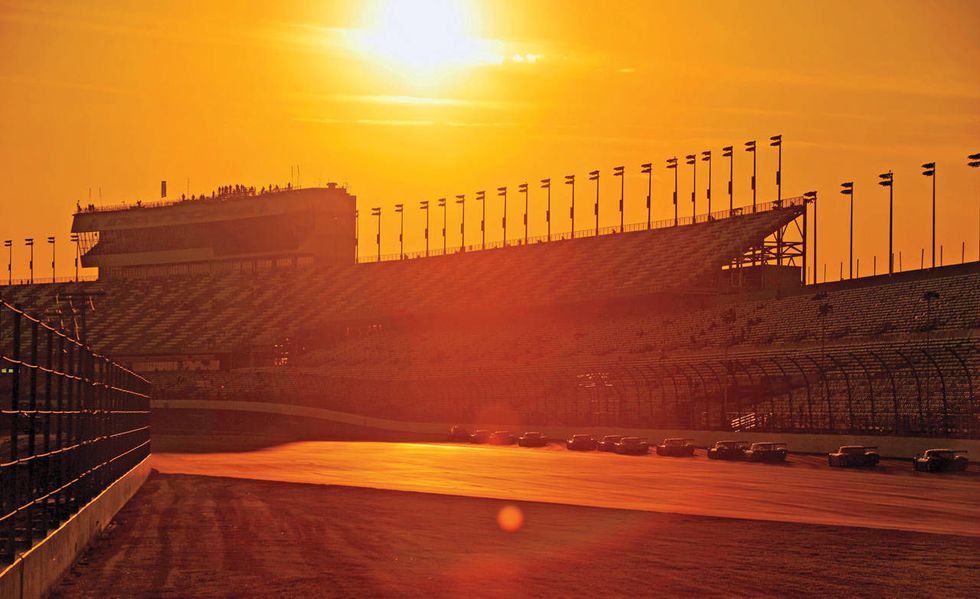
The Sun Sets on Daytona International Speedway, the setting for the Rolex 24 at Daytona


A Short history of a long race.


BY SAM POSE


Dan Gurney had a 2-minute lead at Daytona when the engine blew in his Lotus 19. "I knew it was very close to the end of the race," Dan recalls, "so I put the clutch in and let the car roll up to the line, stopping a few feet short of it." The finish line was on a banked part of the track. "I stopped in the upper lane, next to the starter's stand. I even got out of the car for a moment—I don't know why. Then the starter began waving the checkered flag. I turned left and just coasted down the banking, across the line."

To win.

That unusual finish took place a half-century ago in the Daytona Continental, a forerunner to the 24-hour race first held four years later in 1966. The course was part banking, part infield road course—a configuration new to racing. Overnight, Daytona, Sebring and Le Mans became what was informally known as endurance racing's Triple Crown. It would be hard to conceive of three races whose ambience differed more. The 12 Hours of Sebring, in central Florida, was held amid the vacant hangars and rusting World War II bombers of a little-used airfield; Le Mans—the doyen of the three—combined extreme danger with the intoxicating beauty of a long twilight rush through the pastoral French countryside. Daytona was all about the banking. It was intended for stock cars, not the fragile long-distance racers, and it was brutal, pounding the suspensions and leaving the drivers feeling as if they had just been in the ring with Mike Tyson. Derek Bell, who won both Daytona and Le Mans, thought Daytona was tougher; the banking never let you rest.
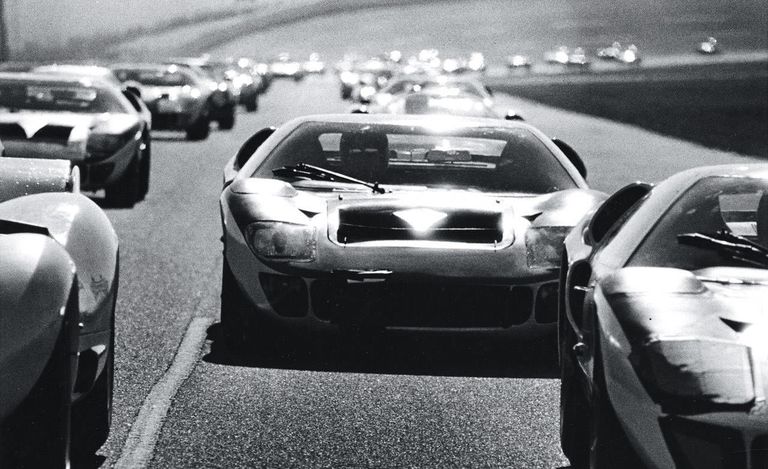
Ford GT40, photo courtesy of Road and Track


For one thing, you couldn't see where you were going. You looked left into the ground; right, and all you saw was the wall. Imagine racing inside a bowl: The road ahead didn't seem to curve but to climb; the impression was that you were always racing uphill. The big windshields of the NASCAR stockers allowed for good visibility, but in a 917 Porsche or a Ferrari 512, the knee-high roof blocked your view, so you scrunched down as best you could, craning your neck for a brief glimpse forward—many a driver ended his stint wracked with the pain of muscle cramps.

Only the middle two of the four lanes were usable, the bottom one too rough and the top, next to the wall, slippery with dust in the early hours, then with marbles as the race wore on. The idea was that cars in the slower classes would keep to the lower lane, leaving the high line for the fast boys, but out there on the banking, etiquette gave way to spur-of-the-moment expediency. Drivers of slow cars couldn't see behind them any better than those in the fast cars. When a Camaro, say, pulled out to pass, it would block the lane for a prototype bearing down on the scene with a closing rate of up to 70 mph. A split-second to decide: high or low? Nine out of 10 times it was too late to get on the brakes, and if you did there was the risk of losing control—the suspension settings were compromised, the flat infield turns calling for spring rates and ride heights that were the exact opposite of what you wanted for the banking. So there you were, the car crushed down onto the bumpstops, veering from lane to lane, centrifugal force pinning you in the seat and trying to drag your hands off the wheel, going 200 and unable to see much of anything—that was the banking experience. Oh, and for 10 hours, you got to do it in the night.
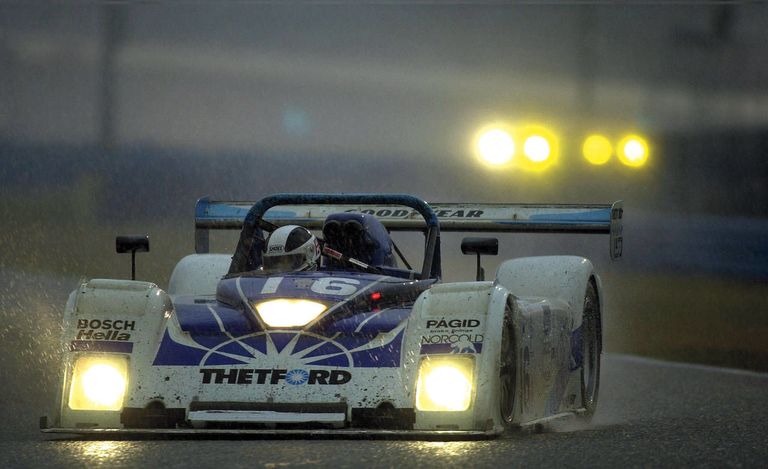

Dyson Riley & Scott Mk III, photo courtesy of Road and Track


The Daytona night is the longest in racing and often the coldest. Florida in February can be damp and freezing—parka weather. Along pit lane, crews jury-rigged plastic curtains to block the wind—in the daytime it looked like Shantytown, but at night it was quite beautiful, the translucent walls glowing in the dark. Inside the enclosures, men slumped on the concrete floor, fighting to stay awake.

The contrast between the stands packed with cheering NASCAR fans at the 500 and the same stands at night, empty except for a few fanatics frozen in place like lumps of coal, left no room for doubt as to the relative popularity of stock cars versus sports cars. The first year of the 24-hour race, Daytona's management sought to evoke the carnival atmosphere of Le Mans with a Ferris wheel, but although it revolved all night, its neon tubes bright yellow on the spokes, it failed to attract any customers—because there weren't any customers to attract. Attendance at Le Mans was close to 300,000; in those first years at Daytona the oft-repeated joke was that the drivers outnumbered the spectators.
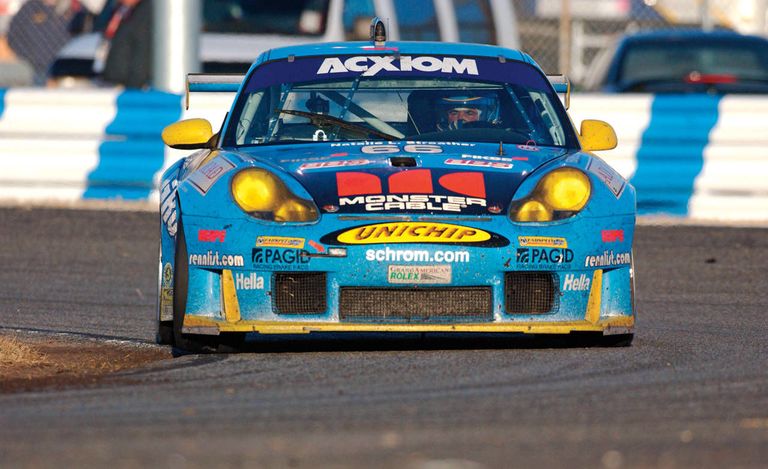

911 GT3 RS, photo courtesy of Road and Track


Despite the poor attendance, the race became an important fixture on the international calendar. There was the cachet of the name Daytona (even then the 500 was a big deal), plus 1966 was the height of the Ford versus Ferrari battle, which lent historical significance to the proceedings. Ford swept the 1966 race, with Ken Miles and Lloyd Ruby coming home first in a GT40 Mk II. The following year, Ferrari fought back, winning with their stunning 330 P4s. In 1968, Porsche scored the first of its record 22 wins, and 1969 saw Roger Penske's battered Lola—a victim of a crash on the banking—eke out a win. This was big-time racing, and Speedway President Bill France chose to absorb the losses at the gate in return for the international prestige.

I was in those races, and I actually looked forward to Daytona—especially when I got to drive a Ferrari for NART (Luigi Chinetti's North American Racing Team). True, every stint involved some lurid moment on the banking, and if you weren't on the banking you were scrabbling through the tight, utterly featureless corners of the infield portion of the lap, but it was a chance to race the top European Formula 1 drivers, who in those days also participated in sports car racing. Jackie Ickx, Pedro Rodríguez, Jo Siffert, Chris Amon, Lorenzo Bandini—these men were heroes to me, and somehow the suffering imposed by Daytona helped forge a bond with them, a sort of Brotherhood of the Banking.
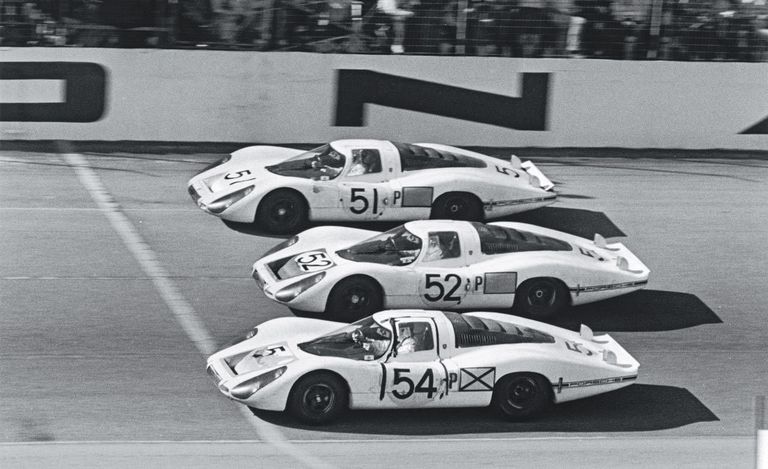

Porsche 907, photo courtesy of Road and Track

The epoch of the big 5-liter 917s and 512s ended with the 1971 season. The 1972 race, shortened to six hours, went to Ferrari's trim 3-liter sports racer—the last time the Ferrari factory would contest the race. The following year, 1973, saw a motley collection of sports racers upset by Peter Gregg's Porsche 911 RSR, which looked little different from the production 911s upon which it was based. Gregg was a brilliant but tightly wound Harvard grad who raced under the colors of Brumos Porsche, a dealership just up the road in Jacksonville. Peter's contacts at Weissach kept him a step ahead of the rest, but after the mighty prototypes and their swarms of engineers and mechanics, it was a letdown to see Daytona won by a car that looked as if it had just come from the showroom floor. Gregg's first victory was with Hurley Haywood, who would become the only driver to win Daytona five times. But it was Gregg, with four wins in five starts (including one for BMW), who defined an era—which ended with his suicide in 1980.

Through the 1980s, Porsche was the backbone of the race, and Daytona's prestige revived step by step as the German manufacturer supplied its many customers with ever faster cars—first the 935 and its derivatives, finally the superb Group C 962s, which were identical to the cars that were winning Le Mans. European aces such as Martin Brundle, Brian Redman and Rolf Stommelen filtered in along with Indy winners A.J. Foyt and Al Unser Jr. When Porsche finally had its fill of success, wins began going to such industry heavyweights as Jaguar, Nissan and Toyota, giving the race in the 1990s its second golden age. But only the factory-supported teams had a chance—the private teams were being driven out of the sport.
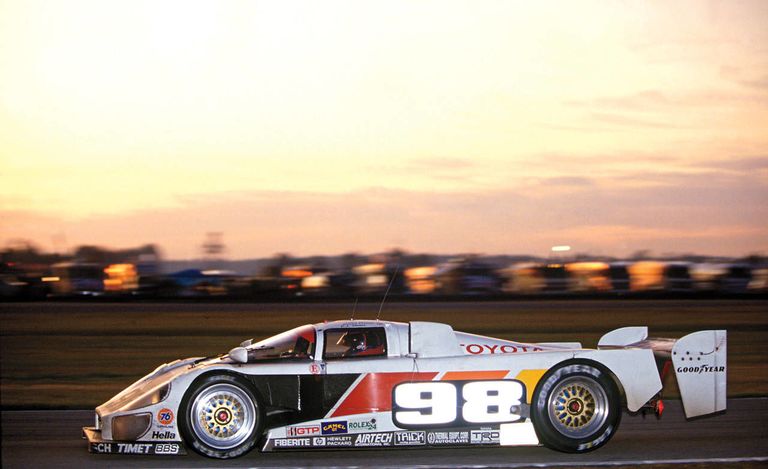

Dan Gurney's Eagle, photo courtesy of Road and Track


In 1999, the pressure for change was compelling enough to produce two new series, each backed by a man of great wealth and imagination. The American Le Mans Series, created by the inventor Don Panoz, established close ties with the French and adopted their rules. The other, sanctioned by the Grand American Road Racing Association, was the brainchild of Jim France. Jim was Bill France's son and part of the family's NASCAR dynasty, but he had a rogue gene: a passion for road racing. In 2000, Grand-Am took over Daytona's 24-hour classic and made it their marquee event. Both Panoz and France offered racing for prototypes and GT, but each took a different approach. Panoz's was caviar and champagne, while France's was burgers and beer.

Grand-Am promised NASCAR-style rules stability and rigid cost control—for example, no factory teams permitted and no in-season testing. The year 2003 saw the introduction of Daytona Prototype, a class with rules as tight as a spec series but open to a wide variety of engines, including Pontiac, Chevrolet, Lexus, Porsche and BMW. There were several chassis builders, too, of which Riley would become the most successful, winning at Daytona the last seven years. For safety and a better view of the banking, the rules mandated a bulbous greenhouse—and the big windshield, awkwardly mated to flat sides and a stubby nose, made for what most people agreed were ugly cars. But beauty is in the eye of the car owner, and the Daytona Prototype—and the prestigious series sponsor, Rolex, that went with it—was an attractive package. By 2006, 30 prototypes were on the grid for what was now called the Rolex 24. The GT cars did more than just fill out the fields; at first they were—embarrassingly—as fast as the new prototypes, forcing the organizers to invert the grid so as to have the prototypes up front at the start. A now-iconic Porsche 911 scored an upset victory, recalling the first win for Gregg and Haywood, exactly 30 years before.
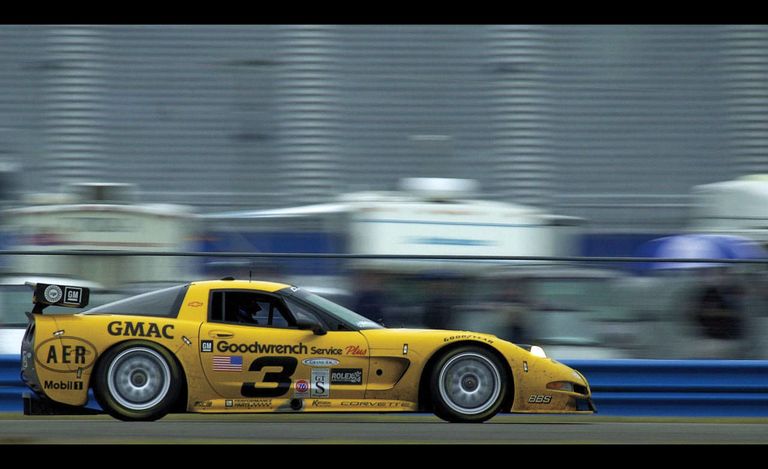

Dale Earnhardt's Corvette, photo courtesy of Road and Track


Back in the 1960s and '70s, teams consisted of two drivers; today, in both GT and prototype classes, four drivers is the norm: the team's two regulars plus a big name NASCAR hero such as Jimmie Johnson or Jeff Gordon...or an Indy winner like Sam Hornish Jr. or Dario Franchitti—and there's still a spot open for a guy who pays big bucks for his ride. In 1997, the Rob Dyson entry set some kind of record when they won using seven drivers—I understand they were lining up spectators for a turn at the wheel when, mercifully, the race ended. (Just kidding, Rob.) Chip Ganassi's cars have won four times, including 2011 with Joey Hand, Graham Rahal, Memo Rojas and Scott Pruett—a formidable quartet, as good as any at Le Mans. The win was Scott's fourth; another and he'll tie Haywood.

The next generation of the Daytona Prototype, dubbed DPG3, will go into action at the 2012 Rolex. Their bodies will be allowed to have what is being called "brand character." For example: Alex Gurney and Jon Fogarty run a Chevrolet engine, and under the new rules they will be allowed to have a body that suggests a Corvette. I have seen some artists' renderings of the new look, and it's good.
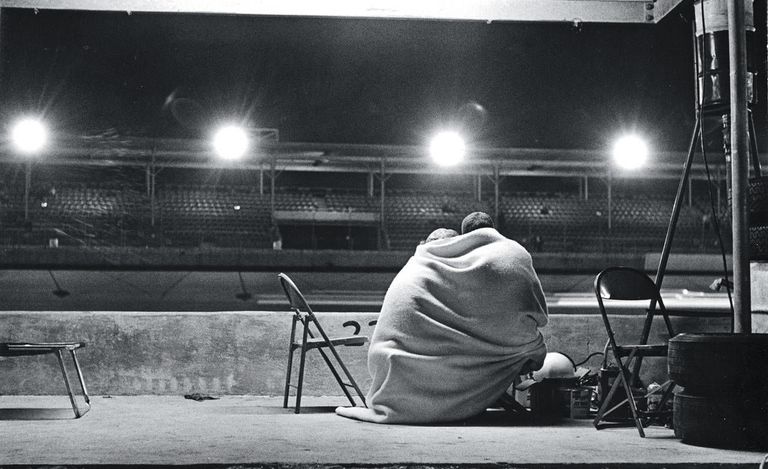

Daytona at night, photo courtesy of Road and Track


Also in the works is a series-within-the-series. The idea is to link Daytona to shorter events at Indianapolis (over the weekend of the Brickyard 400) and Watkins Glen (a France-owned track), re-creating—after 40 years—a second Triple Crown, complete with its own prize money and points system. Instead of Daytona-Sebring-Le Mans, it will be Daytona-Indy-The Glen. Exciting? I think so.

The heart of the new Triple Crown will, of course, be Daytona, now entering its second half-century and well into its third golden era. A chicane near the end of the long back straight was intended to reduce the risk on the banking, but it seems Daytona's essential character never changes: The curbing is temporary (so it can be removed for NASCAR races), and slower cars drop their wheels over it, scattering gravel into the racing line, leaving the drivers of the faster cars to wonder if they may have a slow puncture on their hands. As John Andretti, who won in 1989, put it: "They just replaced one hazard with another."

When I think of Daytona, I think of a race that extracts a toll on anyone who enters it, a race in which winning has never come easily. It seems oddly appropriate, then, that Dan Gurney won the first race by coasting silently across the line.

As you may know, the Rolex 24 at Daytona will be run this weekend, January 26th-27th, which with the running of the Daytona 500 the week before, signals the start of Motor Racing Season.  We here at l’art et l’automobile have been waiting as patiently as possible for racing season to start again, which admittedly has not been very patient, and Formula E just isn’t cutting it. That’s why we’re celebrating the beginning of the Racing Season, and in order to extend our celebrations to you, we have gathered all of our Daytona and Endurance Racing Artwork, Collectibles and Memorabilia and are presenting them to you. Please head over to our website and tour the Gallery and perhaps you can find an item that will assist in your celebration of the beginning of the Motorsports Season.

Enjoy the race and the season,

Jacques Vaucher

Remember we have a wide variety of items in our gallery, so do not hesitate to contact us if you are looking for something in particular.

And as always, be sure to Like and Share on Facebook, Follow us on Twitter, share a photo on Instagram and read our Newsfeed.

Thursday, January 10, 2019

Art Deco Style meets Classic Auto Design

Alain and his Camero, Courtesy of http://www.alainlevesque.ca


Alain Lévesque from Hemmings Classic Car


February, 2010 - Mark J. McCourt


Alain working on one of his classic pieces
In the wide spectrum of talented artists, only a handful have developed an instantly recognizable, totally unique style that is incomparably their own. In the focused world of automotive fine art, there is no one who paints like Québec, Canada, native Alain Lévesque, and because of this, his art is sought and celebrated around the world.

"I was very young when I first became interested in automobiles, probably four or five," he recalls. "It was well before I started school. It was probably because my father was so enthusiastic about automobiles; this could have been how I tried to capture my parents' interest. I had a hard time finishing my schoolwork because I was drawing cars in my books. My friends asked me all the time, 'Hey Alain, draw me a Corvette, draw me a Ferrari.'"

Alain pursued graphic design in college, studying at the Université du Québec in Montréal in the 1980s. He later went to work for a publishing company, creating numerous acclaimed poster designs for events like the Montréal World Film Festival and the Americas Cycling Grand Prix.

A 1989 work trip provided the seed that would start him on a new track, one that combined his talent with his passion. "I found an automotive art gallery in the St. James area of London; I'd never seen an art gallery with this specialty before, and seeing these paintings and sculptures--this was the first time that I associated art and automobiles. I was really amazed, it was like a parallel world for me," he explains.

The gallery's owner, Simon Khachadourian, soon commissioned Alain to produce two pieces; the artist returned to London six months later to deliver them. "It was quite exciting for me to get into this world and realize that it was possible to live as an artist with the automobile as my main subject." Alain also soon found representation closer to home, beginning a 20-year working relationship with Jacques Vaucher and his l'art et l'automobile galleries in America.

l'art et l'automobile large poster by Alain  Lévesque. available at arteauto.com
l'art et l'automobile large poster by Alain 
Lévesque. Available at arteauto.com
It was Khachadourian who first made Alain aware of a major influence behind his trademark abstract interpretive style: "My style is well established now, but I had to work hard to get there--I was developing it at university. Mr. Khachadourian told me my pieces were typical of 'Italian Futurism.' I wasn't really conscious as to the root of my style, and he told me about this art movement, explaining that it was part of the avant-garde art movement of the early 20th century, like the Bauhaus and Cubist movements of the same period. Cubism is well known, and I knew a lot of attention has been paid to Bauhaus because of its importance in avant-garde, but not much is said about Italian Futurism, especially in Europe, due to its political connection with Mussolini. We don't have the same reflections here in North America.

"Mr. Khachadourian offered me a huge reference book on Italian Futurism, and from that I realized how deeply I was inspired by this without knowing it; I developed my style from there more consciously," he continues. "I'd rather be expressive than descriptive. To me, the interest is in the way the subject is treated, rather than in the subject itself. That my work appears as a total abstraction does not bother me, as long as it is able to communicate an idea. The automobile becomes a pretext to create."

Many of Alain's recent pieces have been commissioned, so the first step for him is to learn about the particular car in question before starting his design. "I have to ask the client or representative to tell me about the car's era, where it was created and who owned it. From there, I'll do two or three rough pencil drawings that I send to the client to give him a wide spectrum of options. He might like some of the first with a bit of the third, so I'll construct a new image, this time painted in color using gouache, to give him an idea of the palette. When he agrees with the design and canvas, I move on to the final thing.

Jacques Vaucher, owner of l'art et l'automobile, stands next to one of Alain's works, A room divider detailing a classic Bugatti Dashboard.  Available at arteauto.com
Jacques Vaucher, owner of l'art et l'automobile, stands next to one of Alain's works, A room divider detailing a classic Bugatti Dashboard.  Available at arteauto.com

"For years, I worked with gouache and airbrush. I still use the airbrush technique, as it's a good tool for strong graphic designs. I now sometimes use acrylic, but more and more, I prefer working in oil paint because of the quality of the rendering of the shades. Oil is so rich in terms of color, and it gives you the opportunity to work with the shading over a long period of time--more so than acrylic, which dries very quickly," he explains.

Because of his unique style and vision, Alain has been a favorite of concours organizers when it comes to creating original artwork. He has painted at the request of automakers like Porsche and Daimler-Chrysler, has exhibited at Detroit's Meadow Brook Concours d'Elegance since 1995, and has even exhibited alongside the Automotive Fine Arts Society at their annual show at the Pebble Beach Concours d'Elegance. Despite these prestigious showings and commissions, he continues to challenge himself with new and different themes: "My goal is to convey the essence of the automobile, not to illustrate it."

De Soto
"This piece was commissioned by Barrett-Jackson in 2003. They asked me to create an image inspired by typical American fins, a witness of what was the glorious bold American automobile industry era."
1963 Riviera
"Among the masterpieces of Bill Mitchell's legacy, with the Sting Ray and the Toronado, the Riviera's powerful personality makes you feel like you can almost have a conversation with her."
1956 Lincoln
"Working on a commissioned painting of the mighty Batmobile, I felt that I had to return to the classic to find out where the beast was hidden..." 
Cord
"Since my work is related to the Streamline and Art Deco era, it was a natural for me to bring that car in. The Cord's radical design is a signature of the boldness and creativity of the 1920s and 1930s." 
Miller
"Created for the Indianapolis 500 competition in the 1920s, the Miller 91 belongs to the 'Machine Age' era. Dramatically graphic, it recalls the powerful majesty of the Hoover Dam."

Alain redefines the automobile with avant guarde futurism.

I first met Alain in the '80's, and after collaborating on a few shows in New York we became fast friends and have worked together ever since. I immediately enjoyed his work the moment I saw it and have partnered with Alain in order to help share his beautiful artwork with collectors around the world. To celebrate Alain's artistic accomplishments, we here at l'art et l'automobile have gathered all of his artwork we have in the gallery, and present it here to you.

We invite you to view the Alain Lévesque gallery and acquire one of these magnificent pieces for you to display proudly.

Enjoy,

Jacques Vaucher

For more great automotive artwork and memorabilia, don't forget to browse the many other categories on our WEBSITE. Remember we also have many more items in our gallery, do not hesitate to contact us if you are looking for something in particular.


And as always, be sure to Like and Share on Facebook, Follow us on Twitter, share a photo on Instagram and read our Blogs.

Thursday, December 27, 2018

Spray It Again Dan

Dan Sprays the Crowd with Moët in a moment of true celebration. Photo Courtesy of All American Racers


Dan Gurney’s 1967 Champagne Week


story and photos by Eoin Young, edited by James Karthauser


It was a Champagne week for Daniel Sexton Gurney back in mid-summer 1967, when he won the Le Mans 24-hours for Ford one Sunday and was a winner again the next weekend when he took the laurels in the Belgian Grand Prix in his own Eagle.

Dan Gurney prepares a surprise for the audience that would go on to unexpectedly start a tradition. Photo Courtesy of Dyler.com
Dan Gurney prepares a surprise for the audience that would go on to unexpectedly start a tradition.
Photo Courtesy of Dyler.com


Dan Gurney was the first driver to spray the champers about rather than swigging it after he and A.J. Foyt had won at Le Mans. “I was so stoked that when they handed me the magnum of Moët I shook the bottle and began spraying at the photographers, drivers, Henry Ford II, Carroll Shelby and their wives. It was a very special moment.” Gurney made Champagne history when he sprayed the bubbly and the moment was captured on a special ‘Spray it Again, Dan’ fan poster.

This classic moment was memorialized in this beautiful poster, 'Spray it Again Dan,' available at arteauto.com
This classic moment was memorialized in this beautiful poster, 'Spray it Again Dan,'
available at arteauto.com


“What I did with the Champagne was totally spontaneous. I had no idea it would start a tradition. I was beyond caring and just got caught up in the moment. It was one of those once-in-a-lifetime occasions where things turned out perfectly...I thought this hard-fought victory needed something special.” “LIFE” photographer Flip Schulke, was a popular chap on the racing scene and Dan had hauled him up on to the stage before he started spraying the Champagne. “I took one photo and then ducked,” Schulke recalled. “When it was over Dan handed me the empty bottle and autographed it.

AJ Foyt (right) and Dan Gurney (left) on victory stand.   Photo Courtesy of Ford Archive
AJ Foyt (right) and Dan Gurney (left) on victory stand.
Photo Courtesy of Ford Archive


That original Moët Champagne bottle is now in pride of place in the conference room at All American Racers headquarters. Schulke had converted it to a table lamp and used it in his Florida home for 30 years before returning it to Gurney with the comment “You did it...you should have it!” Dan and Evi removed the lampshade, took the electrics out, and had a special glass case made to preserve the famous bottle.

Ford Mk IV winning at Le Mans 1967.  Photo Courtesy of All American Racers
Ford Mk IV winning at Le Mans 1967.  Photo Courtesy of All American Racers


Gurney and Foyt drove their way into Le Mans history with the red 7-litre Mk IV Ford, specially modified with a bump on the roof to accommodate the lanky Dan. They raised the race record by 10mph to 135mph average for the 24 hours, covering a total of 3,250 miles. It was also the first time that an American car and driver combination had won at Le Mans.


Dan Gurney takes the chequer to win the Belgian Grand Prix at Spa in 1967 in his Eagle-Westlake V12.  Photo Courtesy of All American Racers
Dan Gurney takes the chequer to win the Belgian Grand Prix at Spa in 1967 in his Eagle-Westlake V12. 
Photo Courtesy of All American Racers

Dan won at Spa in his own 3-litre V12 Eagle- Weslake. The 3-litre Cosworth-Ford V8s had arrived to win first time out at Zandvoort in Jim Clark’s works Lotus 49, and the two new cars bracketed the Eagle on the front row at Spa. Clark stormed into an immediate lead with Jackie Stewart second in the unloved H16 BRM with Gurney third. Gurney was moving in on Stewart when Clark pitted with a blown spark plug and Gurney also stopped to warn of fluctuating fuel pressure but there was nothing the crew could do so he was sent back out, now in second place, 16sec behind Stewart. Dan was now in attack mode, lowering the lap record as he chased down Stewart and went into the lead with seven laps left.

It was Moët that Dan sprayed in those days and it was Moët that was presented at races thereafter on a gratis basis, Moët et Chandon presumably figuring that giving their bubbles free was financial involvement enough. But Bernie Ecclestone decided that ‘free’ was a word with which he was uncomfortable. He put the naming rights for the official alcoholic fizz in Formula 1 up for bids, and G.H. Mumm won.

Dan Guarney at speed on the way to winning the  Belgian Grand Prix at Spa.  Photo Courtesy of  All American Racers
Dan Guarney at speed on the way to winning the
Belgian Grand Prix at Spa.  Photo Courtesy of
All American Racers
Dan might have been the first racer to spray the bubbly after a race win, but G.H. Mumm Champagne had arrived in motor racing eighty years earlier when Raymond Mays christened his Brescia Bugatti Cordon Rouge.

Mays had been winning sprints and hillclimbs with the elegant lightweight Type 13 Bugattis that were in production from 1910 to 1926. In the 1930s Mays would create the ERA (English Racing Automobiles) racing marque and in the late 1940s he was the man behind BRM (British Racing Motors). The first BRM was a screaming 1500cc V16 which sounded far better than its racing record would read but a BRM would win the 1962 World Championship in the hands of Graham Hill. Gurney had a dismal summer with BRM in 1960 with a best result of 10th at Silverstone.

In a 1973 interview, Mays told me the story about dining with his engineer friend, Amherst Villiers, in a London restaurant in 1923 when a Champagne label caught his eye. “I had just won a speed trial in the Bugatti and we were celebrating over dinner with a bottle of Champagne. It occurred to me that the striking red and gold Cordon Rouge label on the bottle was just what I needed as a racing name for my Bugatti, and I suppose that was really where sponsorship in racing started.” At the time of the interview, Mays was 73 and still active as Director of Racing for the Marlboro-BRM team.

That night in 1923, Mays asked the waiter if he could steam the label off the bottle as a guide for the name to be painted on the bonnet of his Bugatti and he wrote to the head office of the G.H. Mumm Champagne company, makers of Cordon Rouge in Reims, asking for their permission for him to borrow their brand name for his French racing car. The company replied immediately, delighted with the idea, and despatched three cases of Champagne to toast their new association with success.

Pleased with this double result from the bubbly company, Mays wrote to the makers of Cordon Bleu Cognac but while he received permission to use the name on his ‘other’ Brescia, he was never offered any brandy!

In fact this was inadvertently a first venture into the world of commercial sponsorship in motorsport that has led to the wheel turning full circle. Cordon Rouge Champagne is now the official bubby in Grand Prix racing for presentation and spraying on the Formula 1 rostrums.

Tom Wheatcroft arranged with Raymond Mays to open his motor racing museum at Donington Park in 1974, linking with the UK importers of G.H. Mumm Champagne – half a century after Mays ‘discovered’ the label – and the bubbles started spraying in vintage racing circles with a replica of a Brescia Bugatti used in major store promotions. A special Cordon Rouge Classic Bugatti hillclimb was held by the Bugatti Owners’ Club at Prescott on June 2, 1974 and the winner at six vintage meetings during the summer was presented with a Jereboam of Cordon Rouge and each finisher received a bottle.

Cordon Rouge Champagne had already been the toast of society for half a century when Mays, the young Cambridge graduate made racing history by being the first to carry what amounted to a commercial sponsor’s name on his racing car. That the ‘sponsor’ was a top Champagne company only added to the flair of Mays’ talent as a racing driver. With ‘Cordon Rouge’ he was to dominate speed trials and hillclimbs all over England during the summer of 1924.

Mays, the son of a prominent wool brokerage family from Bourne, Lincolnshire, leapt to prominence in speed events in 1921, while still at Cambridge. He drove a speed model Hillman in those days and had such instant success that he invested everything in a new Brescia Bugatti for the 1922 season. Once again he excelled and during 1923 the Bugatti was run in much modified trim. The speed and engineering so impressed Ettore Bugatti that Mays was provided with a second Brescia for the season of 1924, thus providing him with the need to differentiate between his two Bugattis.

Raymond Mays in the Cordon Rouge Brescia Bugatti.  Photo Courtesy of All American Racers
Raymond Mays in the Cordon Rouge Brescia Bugatti.
 Photo Courtesy of All American Racers
The Brescia was a 1500cc 16-valve 4-cylinder sporting car, the competition models being Type 13s in the Bugatti numbering system. They won the voiturette race at Brescia in 1921 to earn the title and Mays made his debut with his Brescia at the Laindon hillclimb, facing Leon Cushman and Eddie Hall in similar cars and placed second in his class. By the end of the 1922 season Mays and the striking blue-grey Bugatti had become extremely competitive. During the winter of 1922-23 Mays began a modification programme on the Bugatti working with Amherst Villiers, a brilliant engineering friend from Cambridge days. Mays wanted a ‘super hillclimb car’ and Villiers designed new pistons and camshaft and made other modifications to boost the Bugatti’s engine from a rev limit of 4300rpm to over 6000rpm – an almost unheard of figure in those days. Running specially-brewed RD2 alcohol fuel – it cost over six shillings a gallon in those days which was regarded as insanely expensive – Mays found that he had the super-car he wanted, but there were development problems with bearings.

Villiers was also an accomplished painter having produced portraits of subjects as diverse as Graham Hill and James Bond creator, Ian Fleming. It was Villiers who designed a fictional car to the fit the role of Chitty Chitty Bang Bang which Fleming was using as the theme for a children’s book. His painting of Mays at speed in the Brescia Bugatti was used by G.H. Mumm in a presentation and a poster for the Prescott Hillclimb that summer.

M. Lefrere in Bugatti’s London agency, was most impressed and at the Show he gave Mays a personal letter of introduction to Le Patron, Ettore Bugatti. Bugatti invited the young Englishman to the Molsheim factory, emphasising that he bring his Brescia with him.

Mays senior was delighted at his son’s newfound success and financed the trip to Molsheim, taking the modified car for Bugatti’s inspection. Ettore stood worked long and hard on the cars, Mays helping on evenings away from the wool business. Bleu was potentially faster than Rouge with its later engine, but it mixed success with misfortune, winning at South Harting and throwing a rear wheel at Caerphilly. After this hair-raising ‘moment’ the car was set aside for axle shaft changes, while Rouge howled from strength to strength, winning all over the country.

Dan Gurney with the original Moët bottle in the All American Racers’ boardroom.  Photo Courtesy of All American Racers
Dan Gurney with the original Moët bottle
in the All American Racers’ boardroom.
The Brescia Bugattis finally ran out of hours and engines and Mays moved on but he had brought Champagne and sponsorship to motor racing, making history as he did so. Dan Gurney might have been the first driver to spray the crowd after a race win in 1967, but Bernie Ecclestone made an extra little bit of history, whether he realised it or not, by bringing Cordon Rouge back into the motorsport winner’s circle!

We here at l'art et l'automobile hope that your holiday season has been filled with laughter and joy, and if you're of the particular frame of mind, filled with champaign toasts and the occasional dousing.  We hope you have enjoyed this little taste of Racing History, and that your spirits rise like the bubbles from the champaign flutes.

We also wish to toast Dan Gurney, who's accomplishments and exploits have not only gone down in racing history, but who's jovial spirit and gleeful nature have given us a much lauded tradition that racers still honor and celebrate to this day.

Cheers to Dan and Cheers to you this holiday season!

Jacques Vaucher

Remember we have a wide variety of items in our gallery, so do not hesitate to contact us if you are looking for something in particular.

And as always, be sure to Like and Share on Facebook, Follow us on Twitter, share a photo on Instagram and read our Newsfeed.

Thursday, December 20, 2018

How Fast is the Fastest?

History: December 18, 1898: First Land Speed Record Ever, In an Electric Car!


By MAJOR DAN edited by James Karthauser


The first vehicle to ever turn a wheel in France was powered by electricity and
the mind of engineer Charles Jeantaud. Photo Courtesey of The Right Reasons


A Brief History


On December 18, 1898, French race car driver Gaston de Chassaloup-Laubat set the first recognized World Record for Land Speed at an unimpressive 63.13 kilometers per hour (39.25 mph). (Note: For Land Speed Record we are referring to human steered vehicles powered by a motor of some type, and not considering bicycles or horseback riding.)


Digging Deeper


Gaston was driving a Jeantaud electric car for his record run, and at that time when automobiles were in their infancy it was not yet clear which means of propulsion would become preeminent, whether gasoline, electric, steam or diesel powered motors.

Over the next couple years Gaston and his arch rival Camille Janatzy would trade the record status back and forth in an ever increasing raising of the bar. When Janatzy set a new record in 1899 as the first man to drive a car over 100 kph (62 mph) the record stood for a whopping 3 years (105 kph/65 mph). Also in 1899, “Mile a Minute” Murphy rode a human powered bicycle over a 1 mile course in 57 seconds, over 60mph! (The current bicycle speed record is 167 mph.)

The record setting Jeantaud electric car was a chain drive primitive affair that produced only 36 horsepower. Steering was done with a vertical stick that was attached to history‘s first known steering wheel, when other cars were steered with a tiller. The car was rebuilt and won back the land speed record 2 more times, for a distinguished career of having set the Land Speed Record 3 times in all. In fact, the first 5 times the record was set it would be in electric cars, before steam powered cars eclipsed the electrics and finally gasoline powered cars became king of the hill.

The record attempt would first come to the United States in 1904 when Henry Ford drove one of his early creations to the record setting performance, this time on frozen Lake St. Clair near Detroit. By 1927, almost every Land Speed World Record set was accomplished in the United States, though not always by Americans. The current record is held by the Thrust SSC, a jet powered car, at a supersonic 763 mph, set in 1997. (Note: The Ford 999 was powered by an 18.9 liter/ 1150 cubic inch 4 cylinder engine!)


Designer Stefan Marjoram took on the ambitious project of creating a massive poster commemorating
and comparing history's official land-speed record holders. Photo Courtesy of Autoblog.com

What is the fastest you have ever driven a car? The fastest you have ever been in a car driven by someone else? Feel free to share your high speed stories.

We here at l'art et l'automobile have an extraordinary appreciation and yearning for acceleration and velocity.  A need for speed, if you will.  We also appreciate the historical achievements of the daredevils who risk it all on an ever expanding quest for maximum velocity, and of the artists who capture these men and moments rendered in paint or sculpture.  You can find a myriad of Artwork, Sculpture, Collectibles and Memorabilia depicting the pursuit of Acceleration in our Gallery, here at arteauto.com.  Perhaps there you can find something that will satisfy your Need for Speed.  

Cheers, 

Jacques Vaucher

Remember we have a wide variety of items in our gallery, so do not hesitate to contact us if you are looking for something in particular.

And as always, be sure to Like and Share on Facebook, Follow us on Twitter, share a photo on Instagram and read our Blogs.

Thursday, December 6, 2018

Speed Lines by Porsche Panorama

The Final Targa print by Nicholas Watts, Autographed by Gijs Van Lennep

Delivering a fleeting moment in time at a very particular place.


By Michael Jordan, with addition from Jacques Vaucher


When you look at the work of Nicholas Watts, you once again realize that painters have a unique vision of every scene, and this gives them the ability to portray their work in a way that a photographer simply cannot.

To be sure, Watts has a deep respect for automotive machinery, and like a photographer, his realistic images give you a picture of what the cars really look like. Yet painting also gives him the opportunity to put the cars in context, capturing a moment in time that includes not only other cars but also the place where it happened. Through his paintings, Watts is able to tell the story that underlies the speed.

Carrera Panamericana 1952 print by Nicholas Watts, Autographed by Karl Kling, available at l'art et l'automobile.
Carrera Panamericana 1952 print by Nicholas Watts, Autographed by Karl Kling,
available at l'art et l'automobile.


Nicholas Watts is another British boy of the 1950s who grew up fascinated by cars. The fact that he lived practically within earshot of the Brands Hatch racing circuit inevitably drew him to motorsport. He started out as a draftsman at Vauxhall, which perhaps accounts for his ability to make the cars look right. He later went into the Royal Air Force as a specialist in navigation systems, which might have something to do with his dedication to making sure the details are correct. Working with both gouache on board and acrylic on canvas over the past 40 years, Watts has created an astonishing number of paintings and prints, and they cover an equally astonishing range of motorsport disciplines.

Raging Bulls giclee by Nicholas Watts, autographed, available at l'art et l'automobile.
Raging Bulls giclee by Nicholas Watts, autographed, available at l'art et l'automobile.


In this particular painting, we see the Martini-sponsored Porsche 911 RSR 2.8 that wild man Herbert Müller and Le Mans-winner Gijs van Lennep drove to a win at the Targa Florio in 1973, the last year that this race over the mountain roads of Sicily was included in the sports car world championship. Watts gives us a scene that juxtaposes the speed of the high-tech Porsche with the slow pace of a rustic Sicilian town. The proximity of the spectators shows us the spe- cial enthusiasm that always accompanied this event, as well as the danger that nally ended it.

Le Mans 1954 print by Nicholas Watts, autographed by 5 drivers, available at l'art et l'automobile.

The work of Nicholas Watts is available from many sources, a measure of both its enduring popularity and its relative affordability. We recommend l’art et l’automobile (arteauto.com), Jacques Vaucher’s legendary outlet for automotive art and collectibles. Vaucher has been in the eld since 1975, and he virtually invented the business in the U.S. Most important, Vaucher has a personal relationship with the artists he represents, and his ongoing blog is an entertaining window on the personalities in the eld.

Grand Prix of Japan 1976 acrylic painting by Nicholas Watts, available at l'art et l'automobile.


Richard Baron, Panorama’s creative director, notes, “Like Walter Gotschke and Michael Turner, Nicholas Watts is at the center of the great tradition of automotive art. His realistic style and unique perspectives have made things possible for younger automotive artists— photographers as well as painters.”

Many thanks to Porsche Panorama for Highlighting Nicholas Watts and his talent, as well as the mention of us and our website.

At l’art et l’automobile we have a deep appreciation for the artistry of vintage automobiles, but particularly for the artwork that celebrates them. Nicholas Watts is at the forefront of this sense of dedication to capturing the automotive world through the lens of paint and canvas. To celebrate this fact, we have collected all our pieces by this wonderful artist and present them to you. Find out more about this collection here or enjoy looking through the gallery at arteauto.com, and perhaps add a piece to your collection.

Jacques Vaucher

For more great automotive memorabilia, don't forget to browse the many other categories on our Website. Remember we also have many more items in our gallery, do not hesitate to contact us if you are looking for something in particular.

And as always, be sure to Like and Share on Facebook, Follow us on Twitter, share a photo on Instagram and read our Blogs.

Thursday, November 8, 2018

Wear your colors, proud!


What, no polka dots? The expected and the unexpected among international racing colors


Daniel Strohl of Hemmings on Sep 25th, 2018, edited by James Karthauser


Our recent story on the dubious legend of how Germany got its silver auto racing color got us looking for original source materials to see if we could establish timelines for not just Germany’s national racing color but for all designated racing colors. As the stories go, not all of the racing colors were set in stone from the beginning, and it took a few decades of revisions to hammer them all out, by which time corporate logos pretty much rendered the colors moot.

Our research is ongoing and perhaps interminable, but we did get some help in the comments to that story from commenter Nick, who pointed out an article in the October 1928 edition of the Allgemeine Automobil-Zeitung in which the Association Internationale des Automobile Clubs Reconnus laid out not only the formulas for upcoming races but also the agreed-upon racing colors for 23 different countries.

Granted, the list is just for a certain time period and is incomplete — the article itself pointed that out, with color schemes undecided for Brazil, Chile, Cuba, Denmark, Greece, Luxembourg, Norway, Netherlands, Uruguay, and Yugoslavia — but after translating it, we saw that the AIACR went to great lengths to differentiate different countries on the racetrack not only with various colors but also with stripes, number/bubble combinations, and even patterns.

So we took the translated list to Josh Skibbee, one of our graphic artists, to have him take a whack at reproducing the various schemes. We had to go back and forth on some of the details quite a bit. For example, the designations call for Streifen, which translates to stripe, streak, or band; on a modern car, we’d apply those lengthwise along the top of the hood, but our research shows that in the late 1920s stripes were applied transversely across the hood and hood sides, an interpretation that makes more sense when considering that the designation for Ireland specifically calls for a horizontal stripe around the body and hood.

Some of the schemes (like Sweden’s) weren’t exactly clear to us even after some debate, some seem contrary to traditional notions of a country’s colors (why didn’t Switzerland get the scheme assigned to Portugal?), and some (like Lithuania’s) might be questionable to modern observers. But, hey, original sources don’t always tell us exactly what we expect. So, in alphabetical order:

Argentina: blue body, yellow hood, black stripes, red number on white field
Austria: blue body and hood, white stripes, white number on blue field
Belgium: yellow, black number
Bulgaria: green body, white hood, red number on white field
Czechoslovakia: white body, blue and white hood, red stripes, blue number
Egypt: light violet, red number on white field
Estonia: lower body and hood blue, upper body and hood white, black stripes, black number on white field
Finland: black, blue number on white field
France: blue, white number
Germany: white, red number
Great Britain: green, white number
Hungary: body white (fore) and green (aft), red hood, black number
Ireland: green with orange horizontal stripes around the hood and body, white number
Italy: red, white number
Latvia: black body, white hood, black number on white field
Lithuania: yellow and green checkered body and hood, red number
Poland: white body and hood, red stripes, red number
Portugal: red body and hood, white stripes, white number
Romania: marine blue body and hood, red stripes, yellow number
Spain: red body chassis and springs, yellow hood, black number on yellow field
Sweden: lower body and hood blue, upper body and hood yellow, three blue horizontal stripes on the upper part of the hood, white number
Switzerland: red body, white hood, red stripes, blue number
United States: white hood and body, blue stripes, blue number on white field

Also not included in this list are the national racing colors for Latveria (Doom demands an apology for this insult!), Ruritania, and Vulgaria. Wakanda remained unknown to the outside world at the time.

At l'art et l'automobile, we have always.

Enjoy looking through the collection and tell us which ones you would like to own. Please Tour the gallery at arteauto.com, and perhaps add a piece to your collection.

All our best from the staff at l’art et l’automobile,

Jacques Vaucher

For more great automotive artwork and memorabilia, don't forget to browse the many other categories on our WEBSITE. Remember we also have many more items in our gallery, do not hesitate to contact us if you are looking for something in particular.

And as always, be sure to Like and Share on Facebook, Follow us on Twitter, or share a photo on Instagram.