Showing posts with label Vintage Car Posters. Show all posts

Thursday, January 10, 2019

Art Deco Style meets Classic Auto Design

Alain and his Camero, Courtesy of http://www.alainlevesque.ca


Alain Lévesque from Hemmings Classic Car


February, 2010 - Mark J. McCourt


Alain working on one of his classic pieces
In the wide spectrum of talented artists, only a handful have developed an instantly recognizable, totally unique style that is incomparably their own. In the focused world of automotive fine art, there is no one who paints like Québec, Canada, native Alain Lévesque, and because of this, his art is sought and celebrated around the world.

"I was very young when I first became interested in automobiles, probably four or five," he recalls. "It was well before I started school. It was probably because my father was so enthusiastic about automobiles; this could have been how I tried to capture my parents' interest. I had a hard time finishing my schoolwork because I was drawing cars in my books. My friends asked me all the time, 'Hey Alain, draw me a Corvette, draw me a Ferrari.'"

Alain pursued graphic design in college, studying at the Université du Québec in Montréal in the 1980s. He later went to work for a publishing company, creating numerous acclaimed poster designs for events like the Montréal World Film Festival and the Americas Cycling Grand Prix.

A 1989 work trip provided the seed that would start him on a new track, one that combined his talent with his passion. "I found an automotive art gallery in the St. James area of London; I'd never seen an art gallery with this specialty before, and seeing these paintings and sculptures--this was the first time that I associated art and automobiles. I was really amazed, it was like a parallel world for me," he explains.

The gallery's owner, Simon Khachadourian, soon commissioned Alain to produce two pieces; the artist returned to London six months later to deliver them. "It was quite exciting for me to get into this world and realize that it was possible to live as an artist with the automobile as my main subject." Alain also soon found representation closer to home, beginning a 20-year working relationship with Jacques Vaucher and his l'art et l'automobile galleries in America.

l'art et l'automobile large poster by Alain  Lévesque. available at arteauto.com
l'art et l'automobile large poster by Alain 
Lévesque. Available at arteauto.com
It was Khachadourian who first made Alain aware of a major influence behind his trademark abstract interpretive style: "My style is well established now, but I had to work hard to get there--I was developing it at university. Mr. Khachadourian told me my pieces were typical of 'Italian Futurism.' I wasn't really conscious as to the root of my style, and he told me about this art movement, explaining that it was part of the avant-garde art movement of the early 20th century, like the Bauhaus and Cubist movements of the same period. Cubism is well known, and I knew a lot of attention has been paid to Bauhaus because of its importance in avant-garde, but not much is said about Italian Futurism, especially in Europe, due to its political connection with Mussolini. We don't have the same reflections here in North America.

"Mr. Khachadourian offered me a huge reference book on Italian Futurism, and from that I realized how deeply I was inspired by this without knowing it; I developed my style from there more consciously," he continues. "I'd rather be expressive than descriptive. To me, the interest is in the way the subject is treated, rather than in the subject itself. That my work appears as a total abstraction does not bother me, as long as it is able to communicate an idea. The automobile becomes a pretext to create."

Many of Alain's recent pieces have been commissioned, so the first step for him is to learn about the particular car in question before starting his design. "I have to ask the client or representative to tell me about the car's era, where it was created and who owned it. From there, I'll do two or three rough pencil drawings that I send to the client to give him a wide spectrum of options. He might like some of the first with a bit of the third, so I'll construct a new image, this time painted in color using gouache, to give him an idea of the palette. When he agrees with the design and canvas, I move on to the final thing.

Jacques Vaucher, owner of l'art et l'automobile, stands next to one of Alain's works, A room divider detailing a classic Bugatti Dashboard.  Available at arteauto.com
Jacques Vaucher, owner of l'art et l'automobile, stands next to one of Alain's works, A room divider detailing a classic Bugatti Dashboard.  Available at arteauto.com

"For years, I worked with gouache and airbrush. I still use the airbrush technique, as it's a good tool for strong graphic designs. I now sometimes use acrylic, but more and more, I prefer working in oil paint because of the quality of the rendering of the shades. Oil is so rich in terms of color, and it gives you the opportunity to work with the shading over a long period of time--more so than acrylic, which dries very quickly," he explains.

Because of his unique style and vision, Alain has been a favorite of concours organizers when it comes to creating original artwork. He has painted at the request of automakers like Porsche and Daimler-Chrysler, has exhibited at Detroit's Meadow Brook Concours d'Elegance since 1995, and has even exhibited alongside the Automotive Fine Arts Society at their annual show at the Pebble Beach Concours d'Elegance. Despite these prestigious showings and commissions, he continues to challenge himself with new and different themes: "My goal is to convey the essence of the automobile, not to illustrate it."

De Soto
"This piece was commissioned by Barrett-Jackson in 2003. They asked me to create an image inspired by typical American fins, a witness of what was the glorious bold American automobile industry era."
1963 Riviera
"Among the masterpieces of Bill Mitchell's legacy, with the Sting Ray and the Toronado, the Riviera's powerful personality makes you feel like you can almost have a conversation with her."
1956 Lincoln
"Working on a commissioned painting of the mighty Batmobile, I felt that I had to return to the classic to find out where the beast was hidden..." 
Cord
"Since my work is related to the Streamline and Art Deco era, it was a natural for me to bring that car in. The Cord's radical design is a signature of the boldness and creativity of the 1920s and 1930s." 
Miller
"Created for the Indianapolis 500 competition in the 1920s, the Miller 91 belongs to the 'Machine Age' era. Dramatically graphic, it recalls the powerful majesty of the Hoover Dam."

Alain redefines the automobile with avant guarde futurism.

I first met Alain in the '80's, and after collaborating on a few shows in New York we became fast friends and have worked together ever since. I immediately enjoyed his work the moment I saw it and have partnered with Alain in order to help share his beautiful artwork with collectors around the world. To celebrate Alain's artistic accomplishments, we here at l'art et l'automobile have gathered all of his artwork we have in the gallery, and present it here to you.

We invite you to view the Alain Lévesque gallery and acquire one of these magnificent pieces for you to display proudly.

Enjoy,

Jacques Vaucher

For more great automotive artwork and memorabilia, don't forget to browse the many other categories on our WEBSITE. Remember we also have many more items in our gallery, do not hesitate to contact us if you are looking for something in particular.


And as always, be sure to Like and Share on Facebook, Follow us on Twitter, share a photo on Instagram and read our Blogs.

Thursday, October 4, 2018

Razzia’s Niche

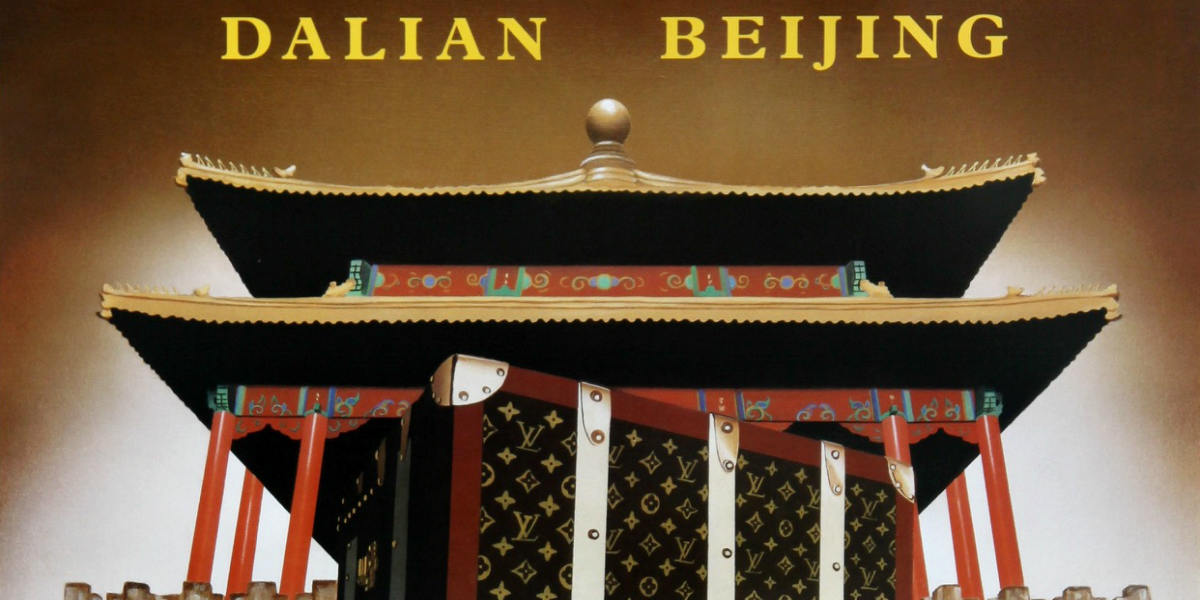
Louis Vuitton China Run 1998 large original poster by Razzia


A Talented Artist Finds his Niche

by Jacques Vaucher


In an age when most poster art is computer generated, Razzia is one of the world’s only modern day “poster artist”. During the Golden age of posters, late 1800’s and early 1900’s, before television and certainly computers, advertisers employed the best artists they could find to make interesting and unique renderings of the product they wished to sell or advertise. This was done in order to impact the market and stand out from their competitors with a strong image. In most cases the artist would produce a painting which when approved would be lithographed in a larger size with the appropriate text. Razzia still conceives his posters from an original painting, a technique not common in this day and age. Razzia lives and works outside Paris and has done numerous posters for Louis Vuitton worldwide including the Bagatelle Concours of Elegance and the America’s Cup Challenge. Producing poster images for them established Razzia as an automotive artist to much of his delight as he is an automobile and Formula 1 enthusiast who owns and has owned a few Porsches, Mini Cooper and Triumphs. Since 1985, Razzia has created close to 30 different automobile images for the Louis Vuitton sponsored rallies and Concours d’ Elegance they have organized around the world.


Other clients for which he has worked include Stetson hats, Lancia Automobiles, L’Oreal, International Prêt à Porter Feminin (France), Bloomingdale’s, Macy’s in the U.S., Harrods in the U.K., the Nice Jazz Festival, the City of Deauville, several brand name Champagnes and several restaurants in Paris and New York. Among collectors around the world are Elton John, Jackie Collins and Michael Caine. His work has been shown in every major city around the world and is highly collected.

Louis Vuitton Classic 2004 Waddesdon Manor Concours d'Elegance U.K. large poster by Razzia
Louis Vuitton Classic 2004 Waddesdon Manor Concours d'Elegance U.K. poster by Razzia


Possibly the best description of Razzia’s work, as well as his contribution to posters and the art world is this excerpt from the forward of the book: Razzia; 25 Years of Poster Art

Razzia’s Posters embody perfect communication with modern cool in an elegant, crisp style. In his somewhat surreal, stylized brevity we find a technique that is uniquely his own, although ripples of past master can be observed throughout. Cappiello, Erte and Broders are incorporated into Razzia’s works as stylistic touches without resorting to mimicry.

I see razzia’s work as divided into two groups. The first is best described as illustrative, with outstanding examples being the Café de Flore and the Bistro du Nord posters, the stetson design and his many Louis Vuitton images. All are persuasive and decorative visions.

The second group - in my opinion the most compelling - is comprised of posters that attract viewers with their graphic simplicity and unflinching clarity: images such as the Cigar advertisement, the Pasta poster (without a doubt Razzia’s signature piece), Prêt à Porter, the Deauville swimmer, the Bugatti Atlantic and the Lancia (which I fondly remember also having been hand-painted on the side of a ten-story building off the Périphérique road that encircles Paris). I believe that it is in these bold, concise, focused images that we see the strength and graphic through-line of Razzia’s promotional narrative.

Razzia's Famous "Pasta" Poster, available in the collection at arteauto.com


But make no mistake about it: Razzia is the last of a dying breed. Quite possibly, he represents a glorious Art Deco conclusion to the contemporary possibilities of the poster. To look at his work is to be mesmerized by his graphic inventiveness and yet one cant quite ignore the fact that in his creations we see the work of the last artist who, at present, can legitimately be called a posterist.
Sadly, the poster as a viable marketing tool has been in a steady decline. From magazine and television ads to the advent of internet advertising, it’s not hard to see the writing on the wall. Today’s global firms hire the finest artists and craftsmen to make 30-second commercials; they don’t commission posters to be dispersed with their anachronistic distribution system. And on the odd occasion a poster is actually commissioned by advertisers, instead of hiring a top graphic artist to do the job: they hire a fine-art painter in an effort to produce “arty” promotions. Look no further than the yearly French Open (Roland Garros) posters to understand their irrelevance. But compare these designs with Razzia’s poster for that event in 1984 and you’ll quickly comprehend the opportunities squandered by not utilizing a posterist to create - well, posters.

It’s ironic, however, that the popularity of vintage poster art - the true “people’s art” - is reaching an all-time zenith at the exact same time that new poster production appears to be heading the way of the dinosaur. But it’s important to note that rare and vintage posters have achieved this recognition as collectables and decorative items that have nothing to do with the function for which they were originally conceived: widely-disseminated advertising, absolutely necessary for the promotion of products or events.

With that in mind, this book serves not only as a testimonial to Razzia’s graphic flair, but also to his tenacity and ability to straddle the precarious line between the artistic and the commercial. Not only did he carve out a posterist’s career by getting important commissions from top companies, he also managed to retain the publishing rights to his designs, reprinting them and marketing them in galleries throughout the world. This is proof of Razzia’s savvy comprehension of the contemporary marketplace, both in terms of a realistic business acumen as well as his adherence to a personal vision.

I’ve known Razzia for many years. In 1992, I chose him, from a field of renowned worldwide posterists, to create the inaugural poster for my auction enterprise - Poster Auctions International. I also commissioned him to design the poster for my daughter’s wedding. Obviously I was very happy with the results of the artistic endeavors that he undertook on my behalf and I’m pleased that he decided to include them both in this book.

Whatever the future holds in store for the poster medium, one ting is perfectly clear: Razzia’s most striking contribution to graphic art is a personal clarity of vision, a playful freshness that hold the eye of the viewer as if it’s the first time that they’ve come across a design - even if that’s far from the truth. And that, without question, is a contribution well worth celebrating.

Jack Rennert
Director
The International Poster Center
New York City
2007

Louis Vuitton Vintage Equator Run 1993 Large event poster by Razzia
Louis Vuitton Vintage Equator Run 1993 event poster by Razzia


Razzia with an example of his work.
We are proud to have been working with Razzia for the last 20 years. You can see most of his images on our website at www.arteauto.com. In 2007, with the help of Mickey Ross, Razzia produced a beautiful book; “25 years of Poster art” about his work. It shows his complete production of paintings and posters he has created.

Razzia has found his niche by creating compositions which blend perfectly with vintage advertising posters.

At l'art et l'automobile, we have always held artists and their work in the highest regard, so much so that we call many of these luminaries friends. Razzia (left) is one of those, and to celebrate a partnership that has lasted for more than 25 years, we have gathered a good selection of our best work by Razzia and are ready to present them to you.

Enjoy looking through the collection and tell us which ones you would like to own. Please Tour the gallery at arteauto.com, and perhaps add a piece to your collection.

All our best from the staff at l’art et l’automobile,

Jacques Vaucher

For more great automotive artwork and memorabilia, don't forget to browse the many other categories on our WEBSITE. Remember we also have many more items in our gallery, do not hesitate to contact us if you are looking for something in particular.

And as always, be sure to Like and Share on Facebook, Follow us on Twitter, or share a photo on Instagram.

Thursday, July 19, 2018

The 7 most memorable German Grand Prix moments

Check out the seven most eye-catching and hair-raising moments that have happened at the German Grand Prix      (and one we at l'art et l'automobile feel they missed)

By James W Roberts edited by James Karthauser

The German Grand Prix has been held 75 times and has been part of the FIA Formula One World Championship since 1951, so it is safe to say that in that time a few pretty memorable events have occurred there.  Since the Second World War the race has been hosted by three venues:  Hockenheimring, the Nürburgring Nordschleife, and at a shorter version of the Nürburgring and there have been plenty of unforgettable moments.  Here are seven momentous German Grand Prix moments.

Max Verstappen’s dad turns up the heat

Hockenheim, 31st July 1994

Jos Verstappen's miraculous escape at Hockenheim
The 1994 F1 season saw the return of in-race refuelling and a few drivers and team bosses worried about the dangers of fuel spraying over red-hot F1 cars, but for the first eight races of the championship it was a case of so far so good.
…but then came the German Grand Prix.

On lap 47, Jos Verstappen stopped in the pits for fuel and tyres. As the refuelling mechanic inserted the fuel hose a clear liquid was seen spraying all over the car. An eerie calm followed before a huge explosion engulfed Verstappen’s Benetton B194 and his mechanics.  The cause? Benetton had fiddled with the refuelling components in an attempt to ensure a quicker stop.  Naughty.  The result? Thankfully, the ensuing fireball was quickly extinguished, Verstappen and a mechanic escaped with minor burns and Gerhard Berger went on to win a crazy race that was dogged by political squabbling and a first corner smash that eliminated ten cars on the spot.

First pole and first win for Webber

Nürburgring, 12th July 2009

Maiden win at Nurburgring 2009

By the time of the 2009 German Grand Prix Mark Webber was in his third season with Red Bull Racing and despite clocking up four podium finishes, his first Grand Prix victory eluded him.
That was until F1 returned to the reconfigured Nürburgring, under the banner of the German Grand Prix, for the first time since 1985.  Webber confirmed the promise he had been showing since coming into F1 back in 2002 and nailed pole position, the first of his career, ahead of the Brawn-Mercedes machines of Rubens Barrichello and Jenson Button.  In the race Webber led home a memorable Red Bull Racing one-two in front of Sebastian Vettel, sealing a hugely popular victory and becoming the first Australian to win a Grand Prix since Alan Jones triumphed in the 1981 Caesars Palace Grand Prix.

Piquet’s punch up

Hockenheim, 8th August 1982

Nelson Piquet
Nelson Piquet

Perhaps one of F1’s most bizarre (and comical) moments happened during the 1982 German Grand Prix at Hockenheim.  Reigning World Champion Nelson Piquet was easily leading the race in his BMW-powered Brabham and on lap 18 and approaching the newly installed Ostkurve chicane he caught the lapped car of backmarker Eliseo Salazar.
And the rest is history…

Piquet contro Salazar al GP Germania 1982


"Quite what Salazar thought he was doing…and I have to say that is an absolute disgrace," James Hunt, BBC commentator.  As Piquet went to pass Salazar the Columbian driver inexplicably hit Piquet’s Brabham from behind and sent both cars spinning out of the race.  The furious Piquet leaped from his car, confronted the hapless Salazar and shoved, punched and kicked him in an act of aggression rarely seen (in front of the cameras at least) in the civilised world of F1.


After the dust had settled the Brabham mechanics discovered that Piquet’s engine wouldn’t have lasted the race distance anyway.

Patrick Tambay’s emotional win

Hockenheim, 8th August 1982

Patrick Tambay
Patrick Tambay


The 1982 season was so full of drama and tragedy not even movie director Ron Howard could’ve come up with a crazier plot.  By the time of the German Grand Prix, F1 had witnessed a driver’s strike, the death of popular Ferrari driver Gilles Villeneuve, and in practice for the race at Hockenheim Ferrari suffered another catastrophic blow.  Didier Pironi, the man expected to win the driver’s title had a monumental airborne accident in practice, smashing his legs and ending his career.

Didier Pironi Crash 1982

On race day it was left to Villeneuve’s replacement Patrick Tambay to climb into the sole Ferrari, tackle the high-speed straights of Hockenheim and bring the number 27 car home to score a memorable and emotional win for the prancing horse.

Jackie Stewart’s finest hour

Nürburgring, 4th August 1968

Jackie Stewart in the rain at the Nürburgring

Back in the 1960s the original 13-odd mile long Nürburgring Nordschlife was a daunting prospect for any driver.

"The track is narrow, the undulations so pronounced, the bends so numerous, that you can hardly remember where you are on the circuit even on a clear day, but in fog and ceaseless spray you just have no idea at all," .Jackie Stewart.  Jackie Stewart called it ‘the green hell’ and his drive on that August afternoon at the German Grand Prix in appalling conditions has gone down as legend.

"When I left home to race at the German Grand Prix, I always used to pause at the end of my driveway and take a long look back at my house. I was never sure I would come home again."

 Epic Grand Prix Instagram


In heavy rain and fog, the Scottish driver, racing with a broken wrist, sailed his Matra-Ford in zero visibility through the spray to win the race a massive four minutes ahead of Graham Hill.  The skill and bravery Stewart displayed in a race he himself thought should have been cancelled remains one of the finest displays by any F1 driver ever.

Niki Lauda’s miraculous escape

Nürburgring, 1st August 1976

Niki Lauda at the 1976 German GP

The 1976 F1 season had it all. The British upstart James Hunt against the cool and calculated Austrian world champion Niki Lauda. McLaren Vs Ferrari.  And at the German Grand Prix that year, the notorious Nürburgring would be the scene for one of the most dramatic events in F1 history.
Reigning champion Lauda crashed at speed on lap two and as his Ferrari slewed to a halt burst into flames and was hit by two other cars. Grainy footage dramatically shows the Austrian trapped in his burning car as drivers Guy Edwards, Arturo Merzario, Brett Lunger and Harald Ertl heroically struggle to free him.

 Where is Palmer Instagram


Lauda suffered serious burns and almost fatal smoke inhalation. He was given the last rites by a priest, but in a super human feat of recovery was back at the wheel of his car two races later.

"I am bandaged, blind and dumb. A man appears: I understand it’s the priest. He speaks Latin, it sounds like a judgement, the last rites. It makes me so cross – I want to shout: HEY STOP, THIS IS THE WORST F***-UP YOU MAKE IN YOUR LIFE. I AM NOT GOING TO DIE."

Lauda bravely retired his car from the 1976 finale

When all was said and done, Lauda only lost the 1976 driver’s title by one point to Hunt and went on to regain his F1 crown in 1977.  F1 never returned to the original Nürburgring Nordschleife.

Schumacher’s first German Grand Prix win

Hockenheim, 30th July 1995

Michael Schumacher on the podium in 1995

The 1995 F1 season was the first where German fans could see a reigning world champion on home soil.  By the time of the 1995 German Grand Prix at Hockenheim, Michael Schumacher fever was everywhere, and as the championship battle heated up with British rival Damon Hill, the partisan crowd were desperate to see their new hero win.  On a hot summer day the capacity crowd basked in sun and scadenfreude as they witnessed Hill’s Williams spin off into the barriers leaving Schumacher and Benetton to make history.  The fact this happened right in front of the densely packed stadium section only added to the fan’s delight and Schumacher cruised to his first German Grand Prix victory and place one hand on the 1995 title.

Die Regenmeister - King of the Rain

Nurburgring, 23 July 1939

Rudolf Caracciola
Rudolf Caracciola

The German Grand Prix at Nurburgring would be one of the last races of the 1939 season, due to the outbreak of World War II in September, but as that event took place months before, contention was still as hot as ever.  

Rudolf Caracciola, the famous German Champion, took it upon himself to tally another win for Mercedes and for Germany.  In a pouring Deluge, Caracciola pushed his Mercedes Benz W154 from the third position to the winners circle, dealing with the weather and engine hardships.  Though he was suspicious that the Daimler-Benz Racing Team favored his Teammate Hermann Lang, he pulled out the victory and went on to become the German Road Racing Champion, proving once again his title of 'King of the Rain.'


This week marks the 77th running of the German Grand Prix. This biennial event has hosted Grand Prix and Formula 1 races since 1926 and is recently returning to the Formula 1 schedule as the Premier German Racing Event. 


 GP of Germany - Hockenheim 1983 poster by Carlo Demand 1939 German GP at the Nurburgring print by Carlo Demand, autographedGP of Germany Hockenheim 1994 official event poster
  Many prints, posters, brochures and memorabilia detailing the German Grand Prix over the years available at arteauto.com

We here at l'art et l'automobile are definitely not going to miss this illustrious event, and we very much hope that you will be joining us as well. To that end, we have gathered a collection of Artifacts and Memorabilia from this momentous race and are providing it to you, our followers. Follow this link to our Newsfeed, where you will find a sampling of the collection as well as a link to find all the German GP artwork and Automobilia we have to offer. Please feel free to tour the gallery here, and perhaps you will find something to add to your collection.

And as always, Like and Share us on Facebook, Follow us on Twitter, Share a Picture with us on Instagram and catch up on the rest of the blog below.

James Karthauser
Development and Social Media
l'art et l'automobile

Thursday, June 21, 2018

Porsche Museum builds a second “No. 1” 356 prototype

Replica is more accurate than the existing No. 1


Daniel Stroll of Hemmings Daily


Photos courtesy Porsche.
In its first decade, 356-001, the first vehicle to carry the Porsche name, suffered a number of ignominies. The letters in that nameplate got rearranged, an Opel full of nuns rear-ended it, and two of its seven private owners allowed it to lapse into neglect. Porsche itself, which has owned the car for the last 60 years, hasn’t done much better, restoring it but leaving intact many of the modifications those seven owners made. Using modern technology, however, the Porsche Museum has created a far more authentic replica as part of the marque’s 70th anniversary celebrations.

As it was conceived, the 356-001 wasn’t supposed to be badged a Porsche. Instead, as Karl Ludvigsen noted in “Porsche: Origin of the Species,” the Porsche family and senior staff wanted to renew the company’s design-consultancy relationship with Volkswagen and give the 200 or so workers on the company’s payroll in Gmünd, Austria, something substantial to do.

Inspiration came from a variety of sources, though chiefly from the design work Porsche was doing at the time for Cisitalia. “At the time that company was building a small sports car with a Fiat engine,” Ludvigsen quoted Ferry Porsche. “I said to myself: Why shouldn’t we be able to do the same thing with VW parts?” War-surplus Kubelwagens were common in that part of Austria, so Porsche had plenty of raw materials to work with.

The tubular space frame chassis that Erwin Komenda drew up in the summer of 1947 used Volkswagen suspension front and rear, though it placed the engine ahead of the rear axle to conform to Ferry Porsche’s wish that the car’s design emulate the pre-war Auto Union Grand Prix cars. To accommodate the mid-engine design, Komenda simply rotated the Volkswagen suspension 180 degrees with the transaxle. As Ludvigsen pointed out, that was less than ideal.


The leading-arm design of the rear-suspension geometry meant that when the rear wheels bounced up, or when the car rolled in a turn, the wheels toed outward instead of inward. In theory this reduced their cornering power and tended to increase oversteer. As well, torque reaction from rear-brake application tended to lift the rear of the car.

For an engine, the Porsche team simply repurposed a Volkswagen flat-four with a handful of modifications to bump output from 25 to 35 horsepower. Despite the increased performance, the Porsche team relied on cable-operated brakes.

Porsche 356-001 shortly after completion.

Komenda finalized the body design in the early months of 1948 and by April Porsche craftsman Friedrich Weber began construction of the aluminum body, ultimately finished in yellow. While Ferry Porsche once stated that construction of the body took two months, Ludvigsen wrote that Weber finished the body in a little more than three weeks, plenty enough time for the Porsche team to road-test serial number 356-001 prior to its July 4 debut at the Swiss Grand Prix in Bern and its July 11 demonstration laps at Innsbruck’s Rund um den Hofgarten road race.

By this time, Porsche had already turned its sights toward producing the 356 itself, albeit in a rear-engine configuration dubbed the 356/2. With their sights set on production, the Porsches decided to sell 356-001 in September 1948 to Josh Heintz of the Reisbach garage in Zürich. Heintz in turn sold it to Peter Kaiser, who rearranged the Porsche lettering on the car’s nose to read Pesco, a name he found snappier than Porsche.

Porsche 356-001 while in Hermann Schulthess’s ownership.


Kaiser had the brakes converted to hydraulic and drove it regularly until he sold it in 1951 to Zürich-based importer AMAG, which in turn sold 356-001 to Rosemarie Muff who, according to Ludvigsen, drove the car into the ground. Its next owner, Hermann Schulthess, rebuilt the car and replaced the Porsche lettering, but ended up sandwiched between the aforementioned Opel full of nuns and another car in a crash on the Gotthard pass. AMAG repaired the damage and in the process reshaped both front and rear ends and converted the single-piece rear-hinged engine and rear trunk cover to two pieces: one for the engine bay, one for the rear trunk.

Schulthess also had Porsche itself install a 1500S engine and larger hydraulic brakes before entering 356-001 into its first and only competition event, the Mitholz-Kandersteg hillclimb, in 1953. A baker by the name of Igoris swapped a 1300 coupe for 356-001 but, as Ludvigsen wrote, suffered from buyer’s remorse and simply garaged the car. Auto mechanic Franz Blaser bought it from Igoris and overhauled the car once again before exchanging it for a brand-new Speedster when Porsche finally decided to track down its very first car in 1958.

Around 1975 Porsche then restored the prototype one more time, though not to its original configuration: The 1500S engine remains part of the car, as do the hydraulic brakes, two-piece decklid, reshaped front and rear sheetmetal, and the bucket seats it picked up at some point.

356 No.1 Replica being assembled.


To celebrate the car’s 70th anniversary, the Porsche Museum decided – rather than subject 356-001 to another restoration – to re-create 356-001 a it appeared in 1948. To do so, the museum had 356-001 3D scanned and compared those scans with original photographs and with digitizations of Komenda’s original drawings.

Museum staff then edited the 3D scan to the prototype’s original shape and used that data to carve a life-size model of the prototype from rigid foam. That foam then served as a buck of sorts for modern-day craftsmen to build from scratch a new chassis and aluminum body before finishing the car with exact replicas of the trim, upholstery, gauges, and other fittings that adorned the original prototype.

For the most part, that is. Museum officials decided not to install a drivetrain in the replica. Instead, they had a basic tube axle fitted to allow the replica to roll around. According to a spokesperson for the museum, the decision to build it sans drivetrain was to avoid labeling it with terms such as “replica” or “recreation” and to avoid confusion with the original; instead, the museum considers it a “showcar.”
The Porsche Museum has scheduled an extensive tour for both the prototype and the replica, starting with a June 8 ceremony in Stuttgart-Zuffenhausen and continuing to Johannesburg, Goodwood, Guangzhou, and Vancouver. The prototype itself will also make an appearance at this year’s Rennsport Reunion in September at Laguna Seca.

We here at l'art et l'automobile are diehard Porsche fanatics, and we love finding and sharing tidbits of Porsche's legacy, like this replica, with our followers.  As a matter of fact, we are currently in the midst of a big Promotion of Porsche Memorabilia on our Website as we speak.  Not long ago, our blog detailed the history and creation of some Victory Posters commissioned by the Porsche Factory, and we've just released Chapter 2 of that collection that we acquired.  You can visit the Gallery here, and possibly add one of these pieces to your collection.  But hurry they're going fast, and We Only Have One of Each.  

And as always, Like and Share us on Facebook, Follow us on Twitter, Share a Picture with us on Instagram and catch up on the rest of the blog below.


James Karthauser
Development and Social Media
l'art et l'automobile

Thursday, May 10, 2018

Auto Poster Designs of the Century


How Auto Posters have influenced Graphic Design in the early 20th century


The process of Lithography - poster printing - though invented in 1798, only began to emerge as meaningful method of advertising and artistic expression around the moment to perfectly coincide with the introduction of the automobile. In a way, Cars and Posters are inherently linked. most of us will remember as children having a poster of our dream car hung on our walls, and even to this day flipping through a magazine to stumble across a beautiful pull-out poster of a shiny new supercar will fill us with delight.


Monaco poster by Alain Lévesque

In this article, we will embark on a voyage, through history and the imaginations of famous artists and advertisers, to explore the history of automobile posters and how they were influenced by the artistic stylings of their era. On this journey we will see the influence of Art, Expression, Culture and Counter Culture and how they altered the artistic world in which these beautiful pieces were created.

Early Lithographs were drab, uncolorful affairs, usually engraved into wood or metal, that were far too difficult to mass produce. This all changed around 1880 with Jules Cheret’s ”3 stone lithographic process," which allowed artists to achieve every color in the rainbow with as little as three stones - usually red, yellow and blue - printed in careful registration. Cheret's process nevertheless still demanded superb artistry and remarkable craftsmanship. The result was worthwhile - a remarkable intensity of color and texture, with sublime transparencies and nuances impossible in other media (even to this day). The ability to combine word and image in such an attractive and economical format finally allowed the lithographic poster to usher in the modern age of advertising.


Automobiles & Cycles Rochet original poster by Philippe Chapellier circa 1900

Just a few years later, the first masterpieces of Art Nouveau poster design were created. This flowering, ornate style became the major international decorative art movement up until World War I. A perfect example of the Art Nouveau movement is this original work, created by Philippe Chapellier for the French Marque Rochet, that manufactured bicycles, motorcycles and automobiles in the early part of this century. Notice how the supple curves of the woman’s form and the road behind her contrast with the rigid layers of the pillar and the surrounding border, all classic hallmarks of the Art Nouveau movement. 


Type 35 Bugatti poster by Roger Soubie, autographed

By 1910, Art Nouveau was already out of style. It was replaced as the dominant European architectural and decorative style by Art Deco. After World War I, Art Nouveau's organic inspiration became irrelevant in an increasingly industrial society; the modern art movements Cubism, Futurism, Expressionism, and Dadaism became chief influences. By the mid-Twenties, these often disparate modernist approaches would coalesce into a major new international decorative movement called Art Deco. In this machine age style, power and speed became the primary themes. Shapes were simplified and streamlined, and curved typefaces were replaced by sleek, angular ones that would reflect the jazz age.


MCF (Motor Club de France) original poster by Geo Ham

Above we see two examples of Automobile Racing posters, done in the Art Deco style. The first is an advertising poster by Roger Soubie commissioned by Bugatti for their Type 35 Racing Car and the second was done for the Motor Club de France by the famous automobilia artist Geo Ham. They both have all the hallmarks of an Art Deco Masterpiece, the bold imagery, attention grabbing styling and colors, and a distinctive simplicity that communicates directly with the audience. We see the cars racing toward us, hurtling from the picture and we know; this car is fast and we must have one.


Save Rubber original World War II propaganda poster by W. Richards 

The poster again played a large communication role in World War II, but this time it shared the spotlight with other media, particularly radio and print. By this time, most posters were printed using the mass production technique of photo offset, which resulted in the familiar dot pattern seen in newspapers and magazines. Above is the Famous ‘Save Rubber’ Poster by W. Richards which was a classic display of 1940’s contemporary art, as well as an effective motivator of National Pride and Sacrifice during that time of struggle.  


7th Grand Prix of Rouen original poster 1959
Packard original dealer showroom poster, 1956

Despite the looming tensions of the Cold War, the end of World War II ushered in a baby boom and a new consumer society with the arrival of television, jet travel and global brands fueling the way. Advertising methods shifted to adapt to the times. A veritable "poster boom" occurred in the early 1950s, driving forward two distinct styles, one consumer and one corporate. The first, which we have labeled the '50s Style, was brightly colored and whimsical, as demonstrated by the G.P. of Rouen Poster above, while the second, called the International Typographic Style, was more rational and orderly, which companies like Packard chose to use to advertise their selection of conservative cars.


Monterey Grand Prix 1964 original poster by Earl Newman

The orderliness of the Fifties would yield to a more chaotic and revolutionary tenor by the mid-Sixties. A new illustration style, one which borrowed freely from Surrealism, Pop Art and Expressionism, was more relaxed and intuitive and the first wave of a Post-Modernist sensibility. A perfect example was Earl Newman’s mesmerizingly surreal event poster for 1964’s Monterey Grand Prix. With it’s vividly dark and forbidding colors and it’s nebulous depictions of racers and track hurtling toward you, this piece perfectly captures the excitement and danger of auto racing in the style of the era.  


Monte Carlo original tourism poster by Steve Carpenter

The excesses of the drug culture and political alienation led to a brief but spectacular Psychedelic Poster craze, which recalled the floral excesses of Art Nouveau, the pulsating afterimages of Pop-Art, and the bizarre juxtapositions of Surrealism. These influences and attributes can be seen vividly in this Monte Carlo original tourism poster created by Steve Carpenter. Scenes of the exotic thrills and locales of Monte Carlo are seen tumbling from the mind of a young and beautiful woman and cascading down her hair as she observes the city’s famous Grand Prix, all captured in the surreal and mind-bending style of the sixties.  


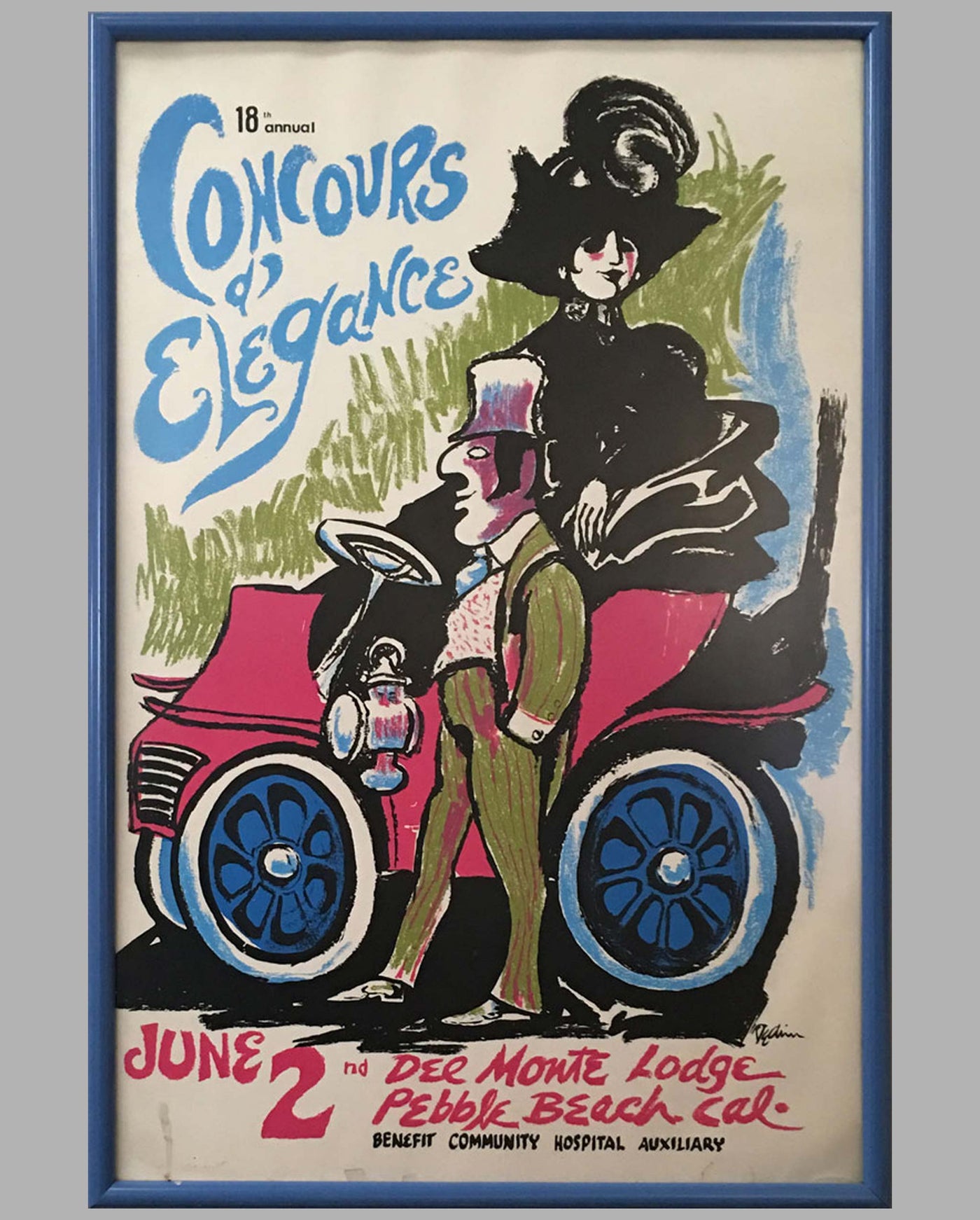
1968 18th Annual Concours d'Elegance Pebble Beach poster by Dedini

Posters like these were placed in windows or pasted on walls to draw people’s attention to the products of auto manufacturer’s, upcoming or famous races or to celebrate important car shows or auto clubs. Before the advent of the television, these pieces of collectable art were one of the only visual mediums that could attract the attention of customers and race fans and deliver them to the Companies and Venues that survived on their patronage. We have seen how the art of the period has effected the advertisements and commemorations that have been put down to poster paper and how those works of automobilia have effected the art world in turn. Now its your turn to collect a piece of history. All the pieces displayed above and many others are available in our gallery, which can be toured here and here. Feel free to peruse it at your leisure and possibly add a piece of art and automobile history to your collection.

Jacques Vaucher
Owner and Curator
l'art et l'automobile

Make sure to Like and Follow on Facebook, Tweet us @arteauto on Twitter, Share a Photo with us on Instagram and don't miss the rest of our Blog below.  

Thursday, March 29, 2018

70 years of sports cars at Porsche

PORSCHE COMPANY - PORSCHE NEWSROOM


01/25/2018

Fast. Puristic. Emotive. For the past 70 years, the Porsche brand has been synonymous with sports car construction at the very highest level. The company begins its anniversary year with a New Year Reception.

The Type 356 (on the left) turned Ferry Porsche’s dream of a sports car into a reality
The first vehicle to bear the Porsche name was registered on June 8, 1948: It was the 356 “No.1” Roadster. This is the day on which the Porsche brand was born. The Type 356 turned Ferry Porsche’s dream of a sports car into a reality. “His vision at that time embodied all of the values that still define the brand to this day”, said Oliver Blume, Chairman of the Executive Board of Porsche AG, at the New Year Reception at the Porsche Museum. Representatives from the state of Baden-Württemberg as well as from the city of Stuttgart and the worlds of politics, economics and society, joined Porsche to celebrate the beginning of its anniversary year with the slogan “70 years of the Porsche sports car”.

“Tradition is a commitment. Without our tradition and without our core values, we would not be where we are today”, explained Blume. “We plan to uphold the standard of technical excellence set by Ferry Porsche well into the future. Intelligent dynamic mobility has a great future ahead of it. And we have the solid technological expertise, creative employees and unique team spirit to be involved. We have what it takes to ensure that the Porsche brand continues to fascinate – even in another 70 years.”

The Mission E (on the right) is already coming up to the starting line


The history of the Porsche brand begins in 1948. Yet the foundation of the sports car manufacturer is built upon the life’s work of Professor Ferdinand Porsche – work which his son Ferry then continued. Ferdinand Porsche had already designed pioneering innovations for the automotive industry as early as the start of the last century. In 1900, he built an electric car with a wheel hub drive known as the Lohner-Porsche, a vehicle on which he would then base the world’s first all-wheel-drive passenger car. In the same year, he created a template for hybrid vehicles with the development of a mixed petrol-electric powertrain. In 1931, Ferdinand Porsche founded his own engineering office. The “Berlin-Rome Car” showcased in 1939 was the beginning of his idea for a sports car bearing the Porsche name, although this dream was only realized by his son Ferry in 1948 with the Type 356.

The successor model to the 356, the Porsche 911 designed by Ferry Porsche’s son Ferdinand Alexander, finally gave the company its breakthrough as one of the leading manufacturers of sports cars in the world, both from a technical and a design perspective. The Porsche 911, presented to the global public for the first time in 1963, has now been built over a million times. “Although the 911 has been consistently developed in the intervening decades and enhanced many times over with new, innovative technologies, no other vehicle has managed to retain its original essence in the same way as the 911”, says Blume. “All Porsche models to be developed now and in the future are based on this sports car. As the centrepiece of the brand, the 911 has become the sports car of dreams, winning the collective heart of enthusiasts all over the world.”

Porsche celebrates the jubilee all over the world


The future of Porsche sports cars is already coming up to the starting line in the form of the Mission E, the first purely electrically driven technology champion from Zuffenhausen. This concept vehicle combines the distinctive emotional design of a Porsche, exceptional driving performance and forward-thinking everyday functionality. The four-door model with four individual seats delivers a system performance of over 440 kW (600 hp) and a range of more than 500 km, acceleration from 0 to 100 km/h in less than 3.5 seconds and a charging time of around 15 minutes for 80 per cent of the electrical energy required. Porsche has invested around one billion euro in this futuristic project, creating more than 1,200 additional jobs just at the headquarters in Stuttgart-Zuffenhausen, where the Mission E will be built. “Porsche will always be Porsche – the leading brand for exclusive, sporty mobility”, reinforces Blume.

Porsche is celebrating this year’s anniversary with numerous activities around the world. On February 3 “The Porsche Effect” opened at the Petersen Automotive Museum in Los Angeles. In Germany, the first “70 years of the Porsche sports car” exhibition will open from March 20–31, at “DRIVE, the Volkswagen Group Forum” in Berlin. The Porsche Museum will also be holding its own anniversary celebrations with a comprehensive special exhibition opening on June 9. On the same day, Porsche will be inviting sports car fans to its “Sports Car Together Day” at all of its sites around the world.

For the weekend of June 16–17, the sports car manufacturer will host employees, residents of the Zuffenhausen district and prospective customers to a public celebration in and around the Porsche Museum in Stuttgart. The “Festival of Speed” held from July 12–15, at the Goodwood race track in the UK will also celebrate the anniversary, as will the “Rennsport Reunion” in California from September 27–30. The celebrations will conclude with the “Sound Night” event to be held for the first time in the Porsche Arena in Stuttgart on October 13. Further information is available at https://www.porsche.com/museum/en/.


We here at l’art et l’automobile are virtual connoisseurs of Porsche artwork and automobilia, having collected and curated hundreds if not thousands of items and artifacts celebrating the Porsche name and legacy over the years.  We even have two very fine examples of Ferry and company’s work in the Gallery and we love them.  In fact, we have just managed to obtain a large and highly valuable collection of original Porche Factory Posters that we are making available to you. Come read about them here, and of course we encourage you to tour the gallery.

Bravo Porsche, here's to the next 70 years!

Jacques Vaucher
Owner and Curator
l'art et l'automobile


Tuesday, March 10, 2015

Why Collect Vintage Car Posters & Prints?

What makes vintage car prints, paintings and other car artwork extraordinary?

Any collector of these has his or her own reasons why he or she instigated their collection, and there are as many explanations for collecting as there are topics illustrated. There are, nevertheless, some overall characteristics of vintage car prints and artwork which make them particularly wonderful for collecting.

Sunday, August 11, 2013

Why Collect Vintage Car Posters & Prints?

Niki Lauda What makes vintage car prints, paintings and other car artwork extraordinary? Any collector of these has his or her own reasons why he or she instigated their collection, and there are as many explanations for collecting as there are topics illustrated. There are, nevertheless, some overall characteristics of vintage car prints and artwork which make them particularly wonderful for collecting. First of all, vintage car prints cover a vast variety of themes, from make of the car to designer of the print, such as Louis Vuitton Classic’s by Razzia and Alain Levesque Paintings’, posters and prints. These prints come in a vast selection of artistic styles, sizes, and cost. There is, then, a type of vintage print that should charm and be available for almost anyone. Louis Vuitton Classic’s Prints by Razzia can be found at l’art et l’automobile and on EBay, and Alain Levesque Paintings’, posters and prints can be found at l’art et l’automobile for sale. However, the most distinctive characteristic of Vintage car prints is their character and content. Vintage car prints provide us with an unswerving link back in time. As most historical car prints depict subjects concurrent with their publication, they depict these topics not as contemporary historians portray them, but from the vantage point of modern onlookers. A glorifying image of the first Model T, a magnificent example of a Rolls Royce, a roaring depicted Ford Lotus, all express the attitudes and understanding of the printmakers and buyers of their day, giving us a privileged look at the automobile world through the eyes of the past. While providing modern viewers with a window to the past, antique car prints were also an integral part of their own time. Car Prints, with their numerous copies, usually had considerably more influence in their day than did concurrent drawings and paintings, all of which are exclusive pictures. Only a restricted number of spectators could see a particular painting or drawing, whereas most historical car prints were distributed broadly to the general public. Indeed, broad distribution was often the intent of these prints. Like books, they would have had noteworthy influence on their time. Some examples of this influence are clear –advertising a new car model or opening a new dealership, but all historical car prints were significant in the overall social, political, and intellectual fabric of their time.

Thursday, July 18, 2013

Where to find Vintage Car Posters and Banners


Collecting vintage automobile memorabilia, like car posters and banners are sometimes hard to find and confusing as to what is valuable and what is just plain junk.  Serious collectors concentrate in a particular genre of exclusive objects that they have come to appreciate and are well-informed about. There is such a wide variety of Vintage Automotive Memorabilia obtainable, that it is impossible to talk about all the collectible options. However, some vintage automotive memorabilia items shine above the rest as sought-after possessions and are more than worthy of spending time to learn about.
Vintage car posters are rare sought after collectables that are possibly very valuable. Automobile manufactures send auto dealerships banners and posters promoting new cars and sales events.  Even though the same car posters are sent to a lot of different dealerships, most car posters and banners are discarded after the automobile promotion event is over, leaving very few available today.
Procuring the precise car poster or automobile banner to complete a collection is tricky, but possible, if you know where to look. Collectors must consider a several different locations in able to find concealed gems of vintage car publication memorabilia. Most of the fun of Collecting is locating the missing publications in the collection and should seriously ponder the following recommendations when searching for collector car posters, banners, books and manuals.
Garage sales are an excellent place to search for hidden jewels, what one person considers trash is another man’s treasure. Usually the person selling items at an estate sale will not have an emotional attachment to an item like the original owner and will price items lower, giving the collector a better deal. Locating vintage car publications at estate sales and garage sales is usually as easy as just as easy as being present and looking.
Collectors searching for vintage car posters, banners, manuals and books will typically discover a large variety of these types of publications at swap meets. Vintage automotive fanatics frequently gather at swap meets to exchange automotive related materials. Generally, automotive swap meets are similar to flea markets where sellers set up display areas to allure buyers looking for exclusive or hard to find items, like collectible pieces of car memorabilia. While Car swap meets are automotive-specific, flea markets are not and you may have to search a little harder, however, you can generally still find a lot of unique car posters, books and publications there and you should not discount flea markets as a decent source for finding vintage car publications
Locating car collector posters, banners, books and manuals online is as easy as point and click. One of the best places to hunt for collectible automotive publications is eBay, another is l’art et l’automobile. With hundreds collectible pieces of automotive publications, l’art et l’automobile is a safe and secure site from which to make an online purchase. l’art et l’automobile has been decorating the automobile enthusiast's business, home, garage and museum since 1975 and collectibles are regularly added to the web-store on a weekly basis.
Collecting car memorabilia is a pleasurable hobby that thousands of individuals participate in. Vintage car posters, books and manuals are unique collectibles that are attractive to classic car buffs and automotive enthusiasts. Knowing just where to look to find vintage car posters, banners, books and manuals can help collectors improve their explorations. Online buyers and collectors can find a great selection of collector car posters, banners, books and manuals on eBay and l’art et l’automobile by following the links above. The only difficulty buyers will have in purchasing collector car posters, banners, books and manuals it deciding what will best improve their existing collections!