Showing posts with label Vintage Cars. Show all posts

Thursday, December 20, 2018

How Fast is the Fastest?

History: December 18, 1898: First Land Speed Record Ever, In an Electric Car!


By MAJOR DAN edited by James Karthauser


The first vehicle to ever turn a wheel in France was powered by electricity and
the mind of engineer Charles Jeantaud. Photo Courtesey of The Right Reasons


A Brief History


On December 18, 1898, French race car driver Gaston de Chassaloup-Laubat set the first recognized World Record for Land Speed at an unimpressive 63.13 kilometers per hour (39.25 mph). (Note: For Land Speed Record we are referring to human steered vehicles powered by a motor of some type, and not considering bicycles or horseback riding.)


Digging Deeper


Gaston was driving a Jeantaud electric car for his record run, and at that time when automobiles were in their infancy it was not yet clear which means of propulsion would become preeminent, whether gasoline, electric, steam or diesel powered motors.

Over the next couple years Gaston and his arch rival Camille Janatzy would trade the record status back and forth in an ever increasing raising of the bar. When Janatzy set a new record in 1899 as the first man to drive a car over 100 kph (62 mph) the record stood for a whopping 3 years (105 kph/65 mph). Also in 1899, “Mile a Minute” Murphy rode a human powered bicycle over a 1 mile course in 57 seconds, over 60mph! (The current bicycle speed record is 167 mph.)

The record setting Jeantaud electric car was a chain drive primitive affair that produced only 36 horsepower. Steering was done with a vertical stick that was attached to history‘s first known steering wheel, when other cars were steered with a tiller. The car was rebuilt and won back the land speed record 2 more times, for a distinguished career of having set the Land Speed Record 3 times in all. In fact, the first 5 times the record was set it would be in electric cars, before steam powered cars eclipsed the electrics and finally gasoline powered cars became king of the hill.

The record attempt would first come to the United States in 1904 when Henry Ford drove one of his early creations to the record setting performance, this time on frozen Lake St. Clair near Detroit. By 1927, almost every Land Speed World Record set was accomplished in the United States, though not always by Americans. The current record is held by the Thrust SSC, a jet powered car, at a supersonic 763 mph, set in 1997. (Note: The Ford 999 was powered by an 18.9 liter/ 1150 cubic inch 4 cylinder engine!)


Designer Stefan Marjoram took on the ambitious project of creating a massive poster commemorating
and comparing history's official land-speed record holders. Photo Courtesy of Autoblog.com

What is the fastest you have ever driven a car? The fastest you have ever been in a car driven by someone else? Feel free to share your high speed stories.

We here at l'art et l'automobile have an extraordinary appreciation and yearning for acceleration and velocity.  A need for speed, if you will.  We also appreciate the historical achievements of the daredevils who risk it all on an ever expanding quest for maximum velocity, and of the artists who capture these men and moments rendered in paint or sculpture.  You can find a myriad of Artwork, Sculpture, Collectibles and Memorabilia depicting the pursuit of Acceleration in our Gallery, here at arteauto.com.  Perhaps there you can find something that will satisfy your Need for Speed.  

Cheers, 

Jacques Vaucher

Remember we have a wide variety of items in our gallery, so do not hesitate to contact us if you are looking for something in particular.

And as always, be sure to Like and Share on Facebook, Follow us on Twitter, share a photo on Instagram and read our Blogs.

Thursday, December 6, 2018

Speed Lines by Porsche Panorama

The Final Targa print by Nicholas Watts, Autographed by Gijs Van Lennep

Delivering a fleeting moment in time at a very particular place.


By Michael Jordan, with addition from Jacques Vaucher


When you look at the work of Nicholas Watts, you once again realize that painters have a unique vision of every scene, and this gives them the ability to portray their work in a way that a photographer simply cannot.

To be sure, Watts has a deep respect for automotive machinery, and like a photographer, his realistic images give you a picture of what the cars really look like. Yet painting also gives him the opportunity to put the cars in context, capturing a moment in time that includes not only other cars but also the place where it happened. Through his paintings, Watts is able to tell the story that underlies the speed.

Carrera Panamericana 1952 print by Nicholas Watts, Autographed by Karl Kling, available at l'art et l'automobile.
Carrera Panamericana 1952 print by Nicholas Watts, Autographed by Karl Kling,
available at l'art et l'automobile.


Nicholas Watts is another British boy of the 1950s who grew up fascinated by cars. The fact that he lived practically within earshot of the Brands Hatch racing circuit inevitably drew him to motorsport. He started out as a draftsman at Vauxhall, which perhaps accounts for his ability to make the cars look right. He later went into the Royal Air Force as a specialist in navigation systems, which might have something to do with his dedication to making sure the details are correct. Working with both gouache on board and acrylic on canvas over the past 40 years, Watts has created an astonishing number of paintings and prints, and they cover an equally astonishing range of motorsport disciplines.

Raging Bulls giclee by Nicholas Watts, autographed, available at l'art et l'automobile.
Raging Bulls giclee by Nicholas Watts, autographed, available at l'art et l'automobile.


In this particular painting, we see the Martini-sponsored Porsche 911 RSR 2.8 that wild man Herbert Müller and Le Mans-winner Gijs van Lennep drove to a win at the Targa Florio in 1973, the last year that this race over the mountain roads of Sicily was included in the sports car world championship. Watts gives us a scene that juxtaposes the speed of the high-tech Porsche with the slow pace of a rustic Sicilian town. The proximity of the spectators shows us the spe- cial enthusiasm that always accompanied this event, as well as the danger that nally ended it.

Le Mans 1954 print by Nicholas Watts, autographed by 5 drivers, available at l'art et l'automobile.

The work of Nicholas Watts is available from many sources, a measure of both its enduring popularity and its relative affordability. We recommend l’art et l’automobile (arteauto.com), Jacques Vaucher’s legendary outlet for automotive art and collectibles. Vaucher has been in the eld since 1975, and he virtually invented the business in the U.S. Most important, Vaucher has a personal relationship with the artists he represents, and his ongoing blog is an entertaining window on the personalities in the eld.

Grand Prix of Japan 1976 acrylic painting by Nicholas Watts, available at l'art et l'automobile.


Richard Baron, Panorama’s creative director, notes, “Like Walter Gotschke and Michael Turner, Nicholas Watts is at the center of the great tradition of automotive art. His realistic style and unique perspectives have made things possible for younger automotive artists— photographers as well as painters.”

Many thanks to Porsche Panorama for Highlighting Nicholas Watts and his talent, as well as the mention of us and our website.

At l’art et l’automobile we have a deep appreciation for the artistry of vintage automobiles, but particularly for the artwork that celebrates them. Nicholas Watts is at the forefront of this sense of dedication to capturing the automotive world through the lens of paint and canvas. To celebrate this fact, we have collected all our pieces by this wonderful artist and present them to you. Find out more about this collection here or enjoy looking through the gallery at arteauto.com, and perhaps add a piece to your collection.

Jacques Vaucher

For more great automotive memorabilia, don't forget to browse the many other categories on our Website. Remember we also have many more items in our gallery, do not hesitate to contact us if you are looking for something in particular.

And as always, be sure to Like and Share on Facebook, Follow us on Twitter, share a photo on Instagram and read our Blogs.

Thursday, November 29, 2018

Ford's Assembly Line Turns 105: How It Really Put the World on Wheels


It was this innovation—not the Model T itself—that cemented the automobile's future.


Originally Published April 2013 by Tony Swan, edited by James Karthauser
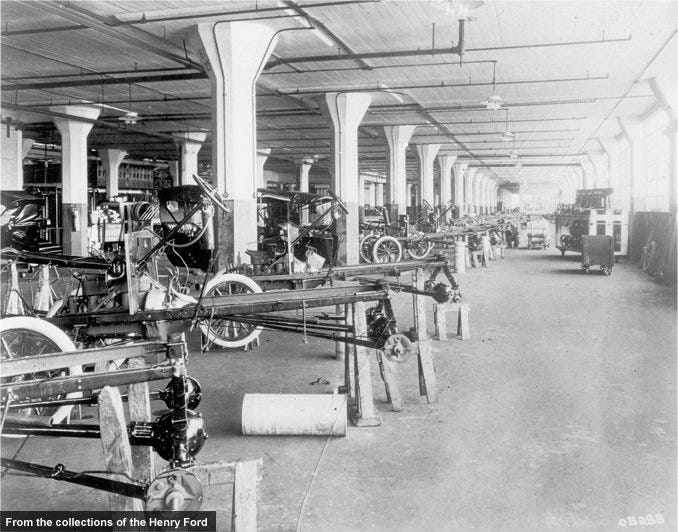


Before the advent of the moving assembly line, Ford and other automakers used variations of the station-build approach. Rather than the car coming to individual workers, a team of workers came to the car. Ford produced Model Ts in this manner for three years at its new Highland Park plant before adopting the assembly line.
Before the advent of the moving assembly line, Ford and other automakers used variations of the
station-build approach. Rather than the car coming to individual workers, a team of workers came
to the car. Ford produced Model Ts in this manner for three years at its new Highland Park plant
before adopting the assembly line.  Photo courtesy of Aaron Kiley


When modern drivers think about the Ford Model T—if they think about it at all—they perhaps dimly perceive it as the car that changed the world. That is correct, of course, as far as it goes. But this month, the Ford Motor Company is quietly commemorating a T-related centennial that was the true source of that seismic shift in mobility: the automotive assembly line. The Model T just happened to be the product it was used to build.

Indeed, the innovations could very well have been made by some other company and involved some other car. But in April 1913, led by production boss Charlie “Cast Iron” Sorensen, Ford began taking its first tentative steps toward a moving line that used conveyor belts to stream components past workers who performed one or two tasks each. This pioneering manufacturing process made automobiles affordable to just about anyone and became the template for the entire industry.

Prior to 1913, Ford and virtually every other automaker assembled whole cars at a station with a team of workers working together to complete a single example, usually from start to finish. Like other companies, Ford had made numerous refinements to the process, achieving impressive production totals at the Piquette Avenue plant where the Model T was born in October 1908.

When deciding to implement the assembly line, neither Sorensen nor Henry Ford nor anyone else involved had the benefit of time-motion studies. They simply reasoned that moving the component at a fixed rate past each station would reduce the number of workers required to build the cars, reduce the time required for assembly, increase volume, and allow the company to control the pace.

The guinea pig was the T’s magneto, a component that supplied ignition energy to the engine before generators became common. A complex and innovative component that was one of the early Model T’s technological advantages, Ford’s magneto was integrated with the engine’s flywheel and involved many pieces. Under the old system, each magneto was assembled by one worker. On average, that worker could assemble 35 of them in a nine-hour shift, or roughly one every 15 minutes.

After some tinkering with the line rate and other factors, Sorensen and his cohorts achieved results that were probably startling even to them. Starting with 29 workers performing 29 different tasks, the experiment reduced assembly time by about seven minutes per unit. And with more refinements, Sorensen was able to reduce the magneto-line workforce to 14 and cut assembly time to five minutes.
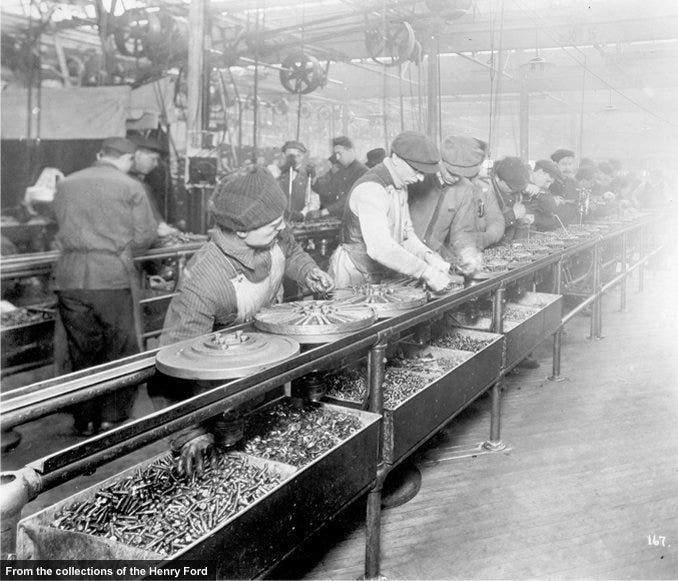
Ford’s transition to moving assembly lines began in April 1913 with the integrated (and complex) flywheel/magneto. With each worker assigned to complete a few specific tasks rather than build the entire unit, Ford reduced magneto assembly time from about 15 minutes to 5, and the required workforce decreased from 29 to 14.
Ford’s transition to moving assembly lines began in April 1913 with the integrated (and complex)
flywheel/magneto. With each worker assigned to complete a few specific tasks rather than build
the entire unit, Ford reduced magneto assembly time from about 15 minutes to 5, and the required
workforce decreased from 29 to 14.  Photo courtesy of Aaron Kiley

FULL SPEED AHEAD


It didn’t take long for Sorensen to apply the moving-line principle to all aspects of Model T production. Engine assembly time was cut from almost 10 hours to less than four. The team tackled chassis assembly in August and quickly cut completion time from 12 hours to six. It was down to slightly less than three hours by October, then to 2.3 in December.

By October, Ford’s vast plant in Highland Park, Michigan, was a maze of conveyors, powered drive belts, overhead traveling cranes, and hundreds of machine tools. Moving assembly went into full swing. And the efficiencies established on a small scale with the magneto line translated directly to total production, which exploded.

Four years prior, while construction crews were at work on the gigantic Highland Park facility, the Piquette work teams assembled 10,660 Model Ts, keeping Ford atop the manufacturing standings ahead of Buick. In Highland Park’s immense spaces, production for 1910 rose to 19,050, despite various hiccups associated with settling into the new facility. By 1912, output was up to 68,773.

But those numbers were dwarfed by the results of the moving assembly line. The process netted 170,211 examples in 1913, 202,667 in 1914, well over half a million in 1916, and 735,020 in 1917. All U.S. industrial output was down in 1918, a casualty of the final year of World War I, as well as the economic downturn that followed in its wake. But the market rebounded in 1920, and Model T production topped one million cars for the first time, at 1,301,067. Output peaked at 2,011,125 in 1923, followed by almost two million units in 1924 and ’25 before demand finally began to tail off.

Verging on obsolescence and dowdy compared with many competitors, the T finally went out of production on May 26, 1927. Although final tallies vary, the generally accepted total stands at just over 15 million built.
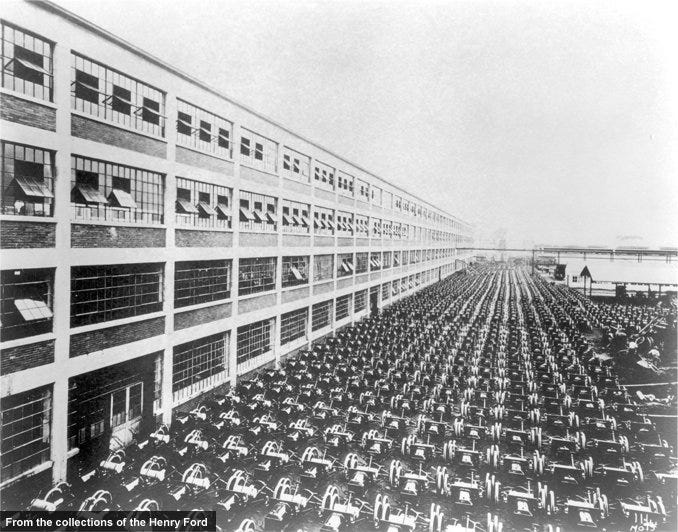
Even as Ford’s moving assembly line was still in its infancy, Model T production was ramping up exponentially. This August 1913 photo shows 1000 completed chassis at the Highland Park plant—one day’s production. By 1916, the plant was cranking out 2000 per day. And in 1926, the factory hit an all-time high with 9000 in one day.
Even as Ford’s moving assembly line was still in its infancy, Model T production was ramping
up exponentially. This August 1913 photo shows 1000 completed chassis at the Highland Park
plant—one day’s production. By 1916, the plant was cranking out 2000 per day. And in 1926, the
factory hit an all-time high with 9000 in one day. Photo courtesy of Aaron Kiley

THE PAYOFF


Henry Ford’s much publicized Model T mission was to “build a car for the great multitude,” and the key to the quest was economies of scale, making the car affordable to as many potential customers as possible.

When the car made its debut, it was innovative, simple, rugged, and easily repaired by owners with even modest mechanical skills. But it wasn’t exactly cheap: $825 for a basic Runabout, the least expensive model, and $850 for the five-passenger Touring version. The pricing didn’t include extras such as a top or side curtains and actually increased to $900 and $950 for 1910.

But as production numbers soared, the prices went down. Ford charged $600 in 1913 for a Touring T, $440 in 1915, and $360 in 1917. Pricing bottomed out at $290 for a 1925 Touring model (the Runabout cost $30 less) and ramped up slightly in the last year and a half of the Model T’s long life.

The assembly innovations at Highland Park did not go unnoticed. The multiple buildings of Ford’s big facility regularly welcomed visitors, and it wasn’t long before competitors began adopting the techniques developed there. So by the end of the Model T’s 19-year run, it was fair to say that Ford really had put the world on wheels.
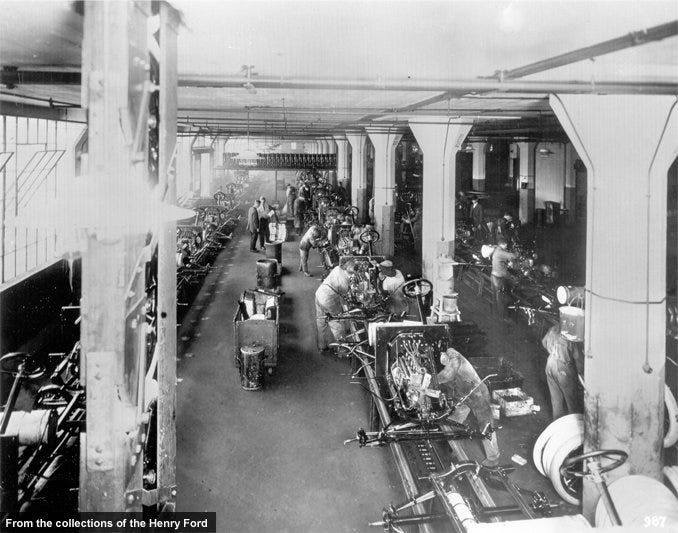

Chassis construction was the final step in Ford’s transition from static to moving assembly. This 1914 photo shows in-progress chassis on the line. The moving lines cut the Model T's final assembly time in half, from 12 hours to six. Continual adjustments and refinements kept reducing final assembly time until nearly four more hours were saved.
Chassis construction was the final step in Ford’s transition from static to moving assembly. This 1914
photo shows in-progress chassis on the line. The moving lines cut the Model T's final assembly time
in half, from 12 hours to six. Continual adjustments and refinements kept reducing final assembly time
until nearly four more hours were saved. Photo courtesy of Aaron Kiley


THE $5 DAY AND SOCIAL CHANGE


One of the more noteworthy chapters in the moving-assembly story was Ford’s announcement on January 5, 1914, that the company was increasing its wage rate to $5 per eight-hour workday—more than double the existing rate for the then-standard nine-hour day.

Ford was already racking up huge profits, and the new policy could be interpreted as altruistic, although other automakers received the news with clenched jaws. There was open speculation that Henry was only aiming to ensure that his workers could afford to buy the products they were assembling.

But Ford’s motives were far more pragmatic. Assembly-line work—performing the same tasks every day for long hours at a stretch—was mind-numbingly dull, and the company found itself beset with unacceptable turnover in its labor pool. In 1913, for example, Ford was forced to hire more than 52,000 workers to sustain a workforce of about 14,000.

There were strings attached to that $5 bill. The basic wage was $2.34. To qualify for the additional $2.66, a worker had to meet company standards for clean living, including sobriety, no gambling, thrift, and a happy home environment. Ford actually formed a sociological department whose staff members visited homes to assess workers’ worthiness for the full five bucks.

That policy would provoke torch-bearing mobs and militant picket lines today, but it was acceptable in 1914 and produced dramatic reductions in absenteeism and turnover. Moreover, the $5 day attracted job seekers from all over the country, particularly the South, permanently changing the demographics of Detroit.

Other changes were even more profound. The availability of an affordable, durable automobile put the dream of unlimited personal mobility within reach of a broad swath of society, setting the stage for the rise of the suburbs and the establishment of a national highway network. Automobiles were no longer a novelty when the Model T made its first appearance, but they were far from universal. By the time the last T left the line, the automobile was fully integrated into everyday life, and the world would never be the same.
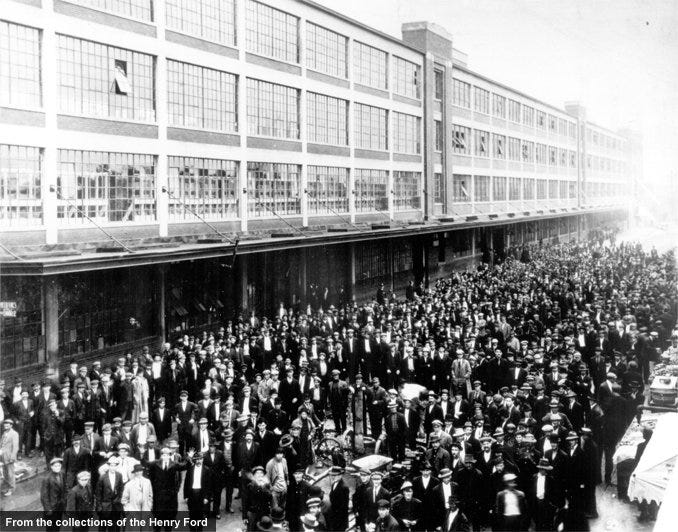
The tedium of moving-assembly-line work proved to be more than many employees could tolerate. Massive turnover prompted Ford to announce the celebrated $5 workday in January 1914. The $5 day, roughly double existing wages, attracted workers from all over the country. Here, an estimated 10,000 applicants brave early January weather in hopes of employment.
The tedium of moving-assembly-line work proved to be more than many employees could
tolerate. Massive turnover prompted Ford to announce the celebrated $5 workday in January
1914. The $5 day, roughly double existing wages, attracted workers from all over the country.
Here, an estimated 10,000 applicants brave early January weather in hopes of employment.
Photo courtesy of Aaron Kiley


Model T Myths


The Model T moving assembly was Henry Ford’s idea. Not really. As production honcho Charlie Sorensen observed in his memoirs, “Henry Ford is generally regarded as the father of mass production. He was not. He was the sponsor of it. Mr. Ford had nothing to do with originating, planning, and carrying out the assembly line. He encouraged the work. His vision to try unorthodox methods was an example to us.”

All Model Ts were black. Not true. The “any color you want, as long as it’s black” ethic began in 1913. Folklore says the black color was a Japanese lacquer chosen for its fast-drying properties. Also not true. The black paint was cheaper and more durable. Ford restored colors to the Model T palette in 1926.

The Model T was all-new. Not quite. It was innovative and included the extensive use of vanadium steel, which was stronger and lighter than ordinary steel; an integrated flywheel/magneto; and a monoblock four-cylinder engine with a removable cylinder head. It was also lightweight, at about 1200 pounds. But for all that, it was an evolution of the highly successful Model N (1906–08).

1913 – Ford Highland Park Plant- First Moving Assembly Line, Photo courtesy of Western Slope Auto.com
1913 – Ford Highland Park Plant- First Moving Assembly Line,
Photo courtesy of Western Slope Auto.com


The Model T never changed. Wrong. Ford made a number of mechanical and cosmetic running changes to the T over the years, including the introduction of safety glass in 1926, an industry first. But the Model T failed to change in key ways. It retained its two-speed planetary transmission long after competitors were offering three-speed gearboxes with shift levers, the cooling system was via thermosyphon (meaning no water pump), and electric starting wasn’t even an option until 1919.

The Model T was hard to drive. Quite the opposite. Compared with other cars of the day, it was easy once a driver acquired minimal skill in advancing or retarding the spark. The hard part was cranking the T’s engine to life. It was prone to backfires, accounting for a good many fractured limbs over the years. For more, check out our feature "How to Drive a Model T."

We here at l'art et l'automobile have a passion for how the legendary automobiles of the past were envisioned, designed and built, just as intense as our passion for how they are celebrated and rendered into art and memorabilia.  We would like to honor Ford's monumental achievement, bring the automobile to the mainstream consumer through the use of the assembly line, by sharing a little history on the subject, that will hopefully enlighten you just a little bit more on the amazing history of our shared love; the automobile.  

Cheers and Happy Holidays, 

Jacques Vaucher

Remember, this week we are hosting our Special 12 days of Christmas Online Auction, which opens for bidding December 1st at 12pm (noon) and Closes at noon on December 13th.  This Auction contains many exciting, recently acquired pieces of Artwork, Memorabilia and Collectibles that would be perfect for filling your stockings or going under your tree this Holiday Season.  Viewing has already begun at arteautoauction.com, so you definitely don't be a Grinch or you might get scrooged out of these amazing items.  


Also, for great automotive artwork and memorabilia, don't forget to browse the many categories on our WEBSITE. Remember we also have many more items in our gallery, do not hesitate to contact us if you are looking for something in particular. Also be sure to check out our Newsfeed, which has details on our collection of Ford Artwork, and Memorabilia.

And as always, be sure to Like and Share on Facebook, Follow us on Twitter, or share a photo on Instagram.  

Thursday, August 2, 2018

Monterey Car Week Unrestrained

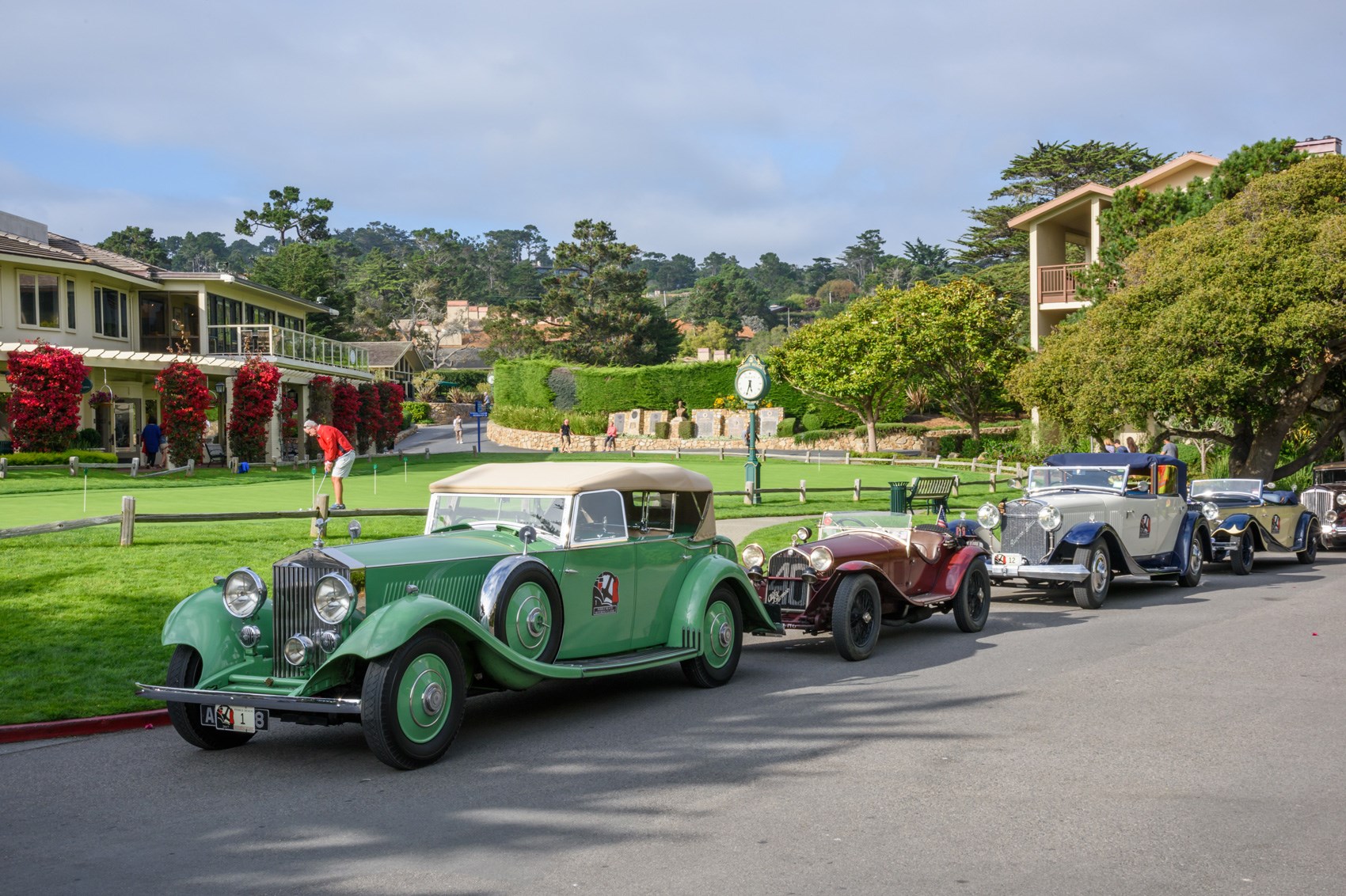
The Motoring Classic convoying down a California Highway on its way to the 68th annual Pebble Beach Concours d'Elegance

How to do it all and do it large, for under $5,000 a day

by Carl Bomstead edited by James Kathauser


 Having attended Pebble for the past 25 years or so, I’ve watched costs continue to escalate and have always dreaded the arrival of the credit-card bill that documented what a great time my wife and I had. But not this time. For the purposes of this exercise, the only caveat is try to keep it under $5,000 a day.

Now, of course, this doesn’t include any car purchases — just everything else.

Arriving in style


The Motoring Classic arrives at the 68th Annual Pebble Beach Concours d'Elegance Courtesy of AutoNXT
The Motoring Classic arrives at the 68th Annual Pebble Beach Concours d'Elegance
Courtesy of AutoNXT


My first call is to Tour Master extraordinaire AlMcEwan, who is the majordomo for the famed Pebble Beach Motoring Classic. The tour is a nine-day, 1,500 mile extravaganza that leaves from Seattle, continues through the Oregon Cascades and then down the California coast, crossing the San Francisco Bay Bridge and arriving at the Pebble Beach Lodge on Wednesday afternoon. About 30 cars attend, and the requirement is that the cars have appeared on the lawn at Pebble Beach or are eligible to do so. The tour cost is $12,000 for a couple but is all-inclusive, including premium lodging, food and libations.

Fortunately, Al has an opening, and we quickly take care of the nancial arrangements.

Rolling tab: $12,000, and that’s before arriving in Monterey.


Where to sleep


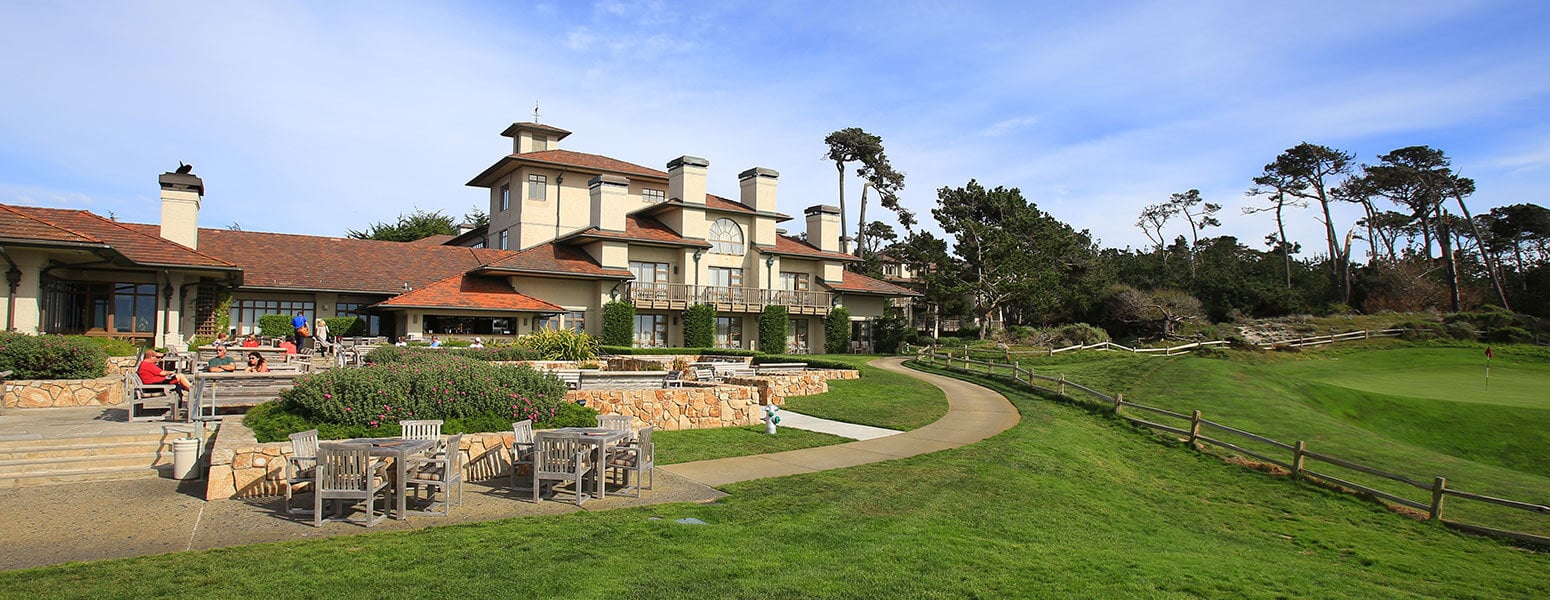
The newly renovated Pebble Beach Lodge borders the 18th hole and provides great accommodation for Concours Visitors Courtesy of Pebble Beach Resorts
The newly renovated Pebble Beach Lodge borders the 18th hole and provides great accommodation
for Concours Visitors.  Courtesy of Pebble Beach Resorts


Accommodations are always an issue during the week. I have my normal overpriced franchise motel reserved, but I’ve always wanted to stay at The Lodge. Checking with the powers that be at the concours of office tells me that there has been a cancellation at Casa Palmero, the boutique 24-room facility that resembles a Mediterranean villa. It is part of The Lodge and is renowned for its personal service, but it comes with a price. The Estate Studio that is available is $1,150 a night plus the taxes, gratuities and other fees. For Wednesday through Sunday, that’s around $6,200.

Rolling tab: $18,200.


Red cars and carpets


A Day at the Pebble Beach Concours d'Elegance Car Show Courtesy of Dwell
A Day at the Pebble Beach Concours d'Elegance Car Show
Courtesy of Dwell


I won’t have much time to relax, as my wife and I will be picked up at 5 p.m. on Wednesday for the McCall’s Motorworks Revival at the Monterey Jet Center. We have purchased Red Carpet tickets for $575 each and look forward to enjoying the “see and be seen” lifestyle event that features current super and vintage cars and aircraft, along with food and beverages from the local upscale providers.

McCall’s Motorworks Revival at the Monterey Jet Center
Thursday we will be participating in the Tour d’Elegance, so I will have my car ready to go at the Polo Field in time for scrutineering and renewing friendships. The majority of the entrants in the concours now participate in the Tour, which travels through 17-Mile Drive, often continues out to Laureles Grade and then down Highway One to scenic Bixby Bridge. It returns to Carmel, where the cars are parked along Ocean Avenue for all to enjoy. The cars always draw a crowd in Carmel, and this year will not be an exception.

We will get back to “Casa P” in time to unwind a bit before I gather my group of 10 or so friends and head out the Carmel Valley Road to the Baja Cantina and Hot Chili Nights — a gathering of 100 or more collector cars. The Baja Cantina is known for its Mexican food, but I’m also attracted to the automotive memorabilia that owner Pat Phinney has displayed throughout the restaurant. Dinner for the party? $600.

Rolling tab: $19,950.


Exclusive fun


The McCall’s Motorworks Revival at the Monterey Jet Center is an exclusive event hosted during the Festivities Courtesy of Autoweek
The McCall’s Motorworks Revival at the Monterey Jet Center is an exclusive event hosted
 during the Festivities.  Courtesy of Autoweek

Friday, my wife and I will be off to The Quail, A Motorsports Gathering, as we have found a pair of tickets on eBay for $1,500, which is an absolute bargain, as they are listed on StubHub starting at $1,950.

The Quail is a day of exciting motorcars, excellent food pavilions and refreshments from a variety of premium suppliers. It is also a lifestyle event, as you can find displays for anything from exotic cars to multimillion-dollar yachts and most anything in between.

We will need some time to unwind when we return to “Casa P,” then we will join friends and walk down to the Lodge for dinner at the Stillwater Bar and Grill, which overlooks the famed 18th fairway and Stillwater Cove. A smaller, more intimate evening. $500.

But it will be an early evening, as Saturday will find us in our transportation to Concorso Italiano at the Black Horse Golf Course. Concorso Italiano was first presented in 1985 and features all that is Italian. There will be close to 1,000 cars that are Italian in origin presented in a number of classes. Keith Martin is again scheduled to have microphone in hand as master of ceremonies as he interviews owners and presents the awards. Two CI Club tickets: $495 each.

The evening will find us at the Gala Dinner for Pebble Beach entrants, judges and sponsors. We are included as part of the Motoring Classic. The fare is always exceptional and the drink is all top-shelf. The band plays on, but we will duck into the Gooding auction taking place next door. Bidder credentials there are $200, in addition to the $300 we spent at RM Sotheby’s, $150 at Bonhams, $100 at Mecum, $200 at Russo and Steele, and $150 at Worldwide Auctioneers — gotta be ready in case a special car pops up that we need to own.

Rolling tab: $24,140


Concours Sunday


Lining up for the Prestigious Concours d'Elegance at Pebble Beach Courtesy of CAR Magazine
Lining up for the Prestigious Concours d'Elegance at Pebble Beach
Courtesy of CAR Magazine
Sunday morning will arrive early, as we will be at Dawn Patrol. There, the cars are greeted by Pebble Beach Concours Chairperson Sandra Button as they enter the field. It is also the best time for photos before it becomes too crowded. We have managed to acquire a pair of tickets for the Chairman’s Hospitality at the Lodge for $2,750 apiece, which provides VIP access credentials and access to the Stillwater Bar and Grill for viewing of the award ceremony. Food and beverages will, of course, be provided.

Grand Finale: Pebble Beach Concours d’Elegance
Following the Best of Show presentation, we will take the short walk to the Beach Club for the after-party, which is part of the Motoring Classic package. It is primarily for entrants and judges, as the winners will be congratulated and the others thanked for their participation. It will have been a long day, so it will hopefully be an early evening.

When we return to Casa Palmero, there will most likely be a celebration under way in the hosted bar, so plans for an early evening will probably go out the window.


Grand total: $29,540.


Cost per day: $5,908.


Of course, this all illustrates that you can’t see or do everything regardless of your budget — and speaking of budgets, I blew my $5,000-per-day plan, too. But what’s Monterey if not a time to splurge on the experience?

With this, I have an exciting Monterey Car Week planned. But my ever-skeptical wife asks if I’m sure the magazine is going to cover this expensive trip. Could my fantasy trip be just that — a fantasy?


Jacques in the Gallery of L'art et l'automobile
Monterey Week is coming quickly, August 17th to the 27th. The motoring world will be converging on the Peninsula at Pebble Beach. The 10 day long event will be packed with racetrack celebrities, Concours d’Elegance and automobile week, numerous manufacturers’ meetings, car club reunions, forums, vintage car auctions and so much more. But Carl forgot to go to the Race Track at Laguna Secca, where they hold great Vintage Car Races, namely the Rolex Monterey Motorsports Reunion held throughout Autoweek. Great fun but exhausting.

L’art et l’automobile’s very own Jacques Vaucher will as usual be exhibiting some of our latest vintage Automobile Memorabilia at the Spanish Bay Inn from Thursday the 23rd through Saturday the 25th. Make sure to please come by, have a chat with Jacques and Karen and peruse the collection in person.

In addition, Jacques has been invited to participate in the Pebble Beach Classic Car Forum on Friday afternoon at 3:30 pm, also at the Spanish Bay Inn. He will be collaborating in a talk on “collecting everything but cars” as part of the panel, for a discussion on all memorabilia surrounding car collecting.

Come Visit, and we hope to see you there.

Jacques Vaucher

For more great automotive memorabilia, don't forget to browse the many other categories on our WEBSITE. Remember we also have many more items in our gallery, do not hesitate to contact us if you are looking for something in particular.

And as always, be sure to Like and Share on Facebook, Follow us on Twitter, share a photo on Instagram and read our Blogs.